































Complete Measurement Conversion Worksheet | Grade 4 Math

Paste this activity's link or code into your existing LMS (Google Classroom, Canvas, Teams, Schoology, Moodle, etc.).
Students can open and work on the activity right away, with no student login required.
You'll still be able to track student progress and results from your teacher account.
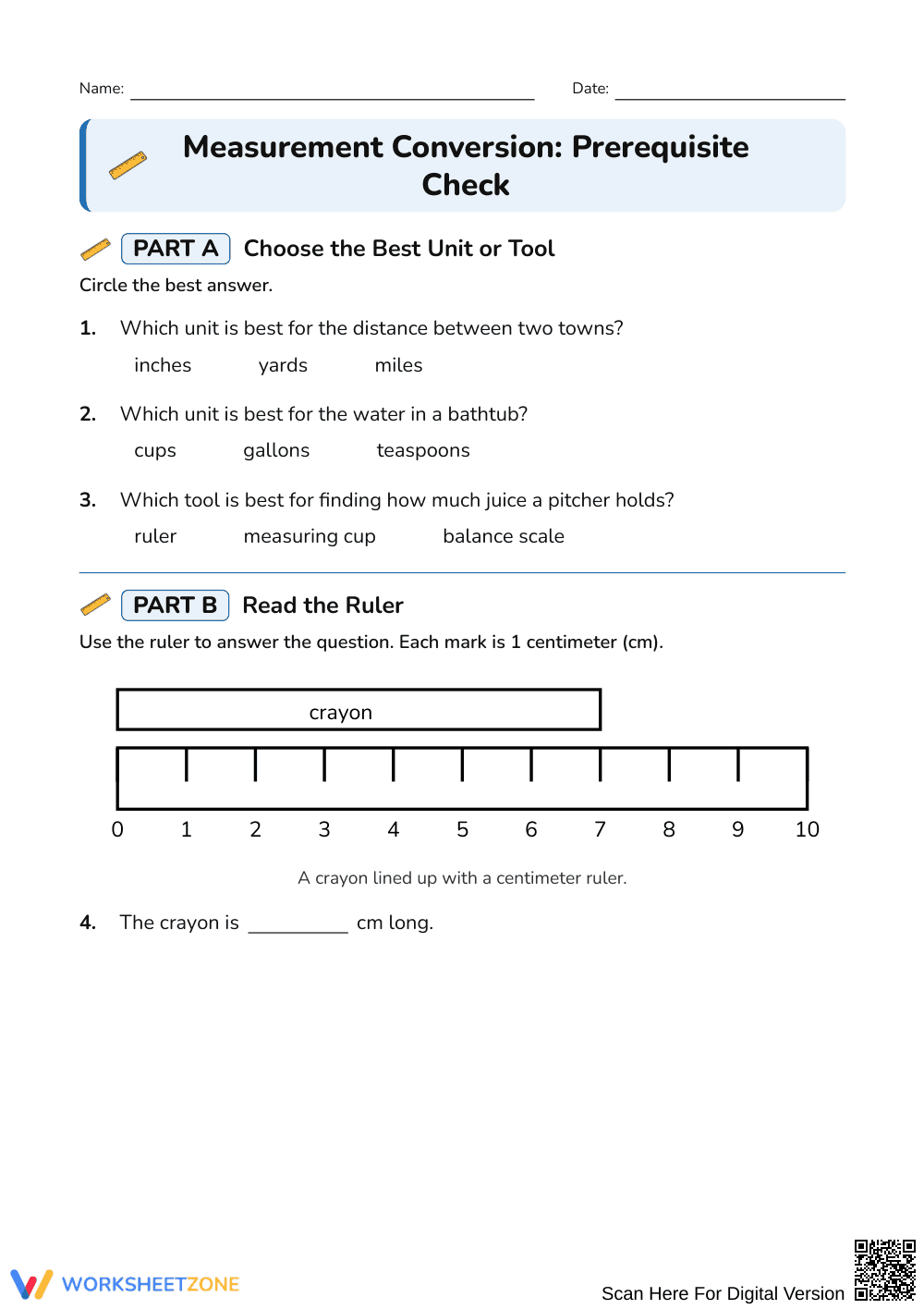
This Grade 4 math worksheet prepares fourth-grade learners for measurement conversions by diagnosing and reinforcing prerequisite skills across customary and metric systems. Students evaluate real-world units, read linear rulers, apply benchmark equivalents, utilize double number lines, and justify reasoning across 17 structured tasks designed to secure solid conceptual footing.
At a Glance
- Grade: 4 · Subject: Math
- Standard:
4.MD.A.1— Express larger measurement units in terms of equivalent smaller units across customary and metric systems- Skill Focus: Measurement Conversion prerequisite review
- Format: 3 student pages · 17 practice problems · Full answer key included · Printable PDF
- Best For: Prerequisite diagnostic check, intervention, and unit readiness
- Time: 25–35 minutes total completion time
What's Inside
This 3-page printable resource features 17 problems organized into six sections to assess unit readiness. Tasks include multiple-choice unit selection, centimeter ruler reading, a measurement conversion chart, a double number line model, basic multiplication and division computation, and written reasoning prompts. A full 3-page answer key provides complete solutions.
Skill Progression
- Guided practice (Parts A–B, 4 tasks): Students select appropriate measurement units and tools, then read length on a centimeter ruler.
- Supported practice (Parts C–D, 8 tasks): Learners complete conversion charts and interpret proportional double number lines comparing feet and inches.
- Independent practice (Parts E–F, 5 tasks): Students calculate conversion facts, estimate heights, and write conceptual explanations of relative unit sizes.
This structure follows the gradual-release model, moving from scaffolded identification to independent mathematical reasoning.
Standards Alignment
This worksheet aligns directly to 4.MD.A.1: Know relative sizes of measurement units within one system of units, and record measurement equivalents in tables. It also supports 3.MD.A.2 regarding standard units of liquid volume and mass. Both standard codes can be copied directly into lesson plans, IEP goals, or district curriculum mapping tools.
How to Use It
Administer this worksheet before instruction as a diagnostic readiness check, or during small-group review to target gaps. As students work, check whether they recognize that smaller units require larger numbers to express the same measurement. Plan for 25 to 35 minutes.
Who It's For
This worksheet is ideal for fourth-grade students beginning measurement conversion, as well as students needing targeted tier-2 intervention. Pair this practice with classroom measuring tapes or balance scales for concrete reinforcement.
Mastering fourth-grade unit conversions under standard 4.MD.A.1 requires learners to understand relative unit sizes and express larger measurements in terms of equivalent smaller units. According to Fisher & Frey (2014), structured prerequisite checks and explicit gradual-release frameworks are vital for helping students transition from conceptual understanding to procedural fluency in mathematical measurement. When elementary learners practice with multi-modal representations, such as dual-scale number lines, reference conversion tables, and real-world estimation tasks, they establish strong mental benchmarks that prevent common misconceptions regarding inverse proportionality. Diagnostic prerequisite materials ensure classroom educators can swiftly pinpoint foundational gaps in basic multiplication facts or linear ruler reading before introducing complex multi-step conversions. By blending scaffolded visual models with verbal justification prompts, this comprehensive review equips students with the durable mathematical reasoning needed for advanced problem-solving success across both metric and customary systems.


