




























Views
Downloads



Complete Mass Records Worksheet | Grade 7 Science

Paste this activity's link or code into your existing LMS (Google Classroom, Canvas, Teams, Schoology, Moodle, etc.).
Students can open and work on the activity right away, with no student login required.
You'll still be able to track student progress and results from your teacher account.
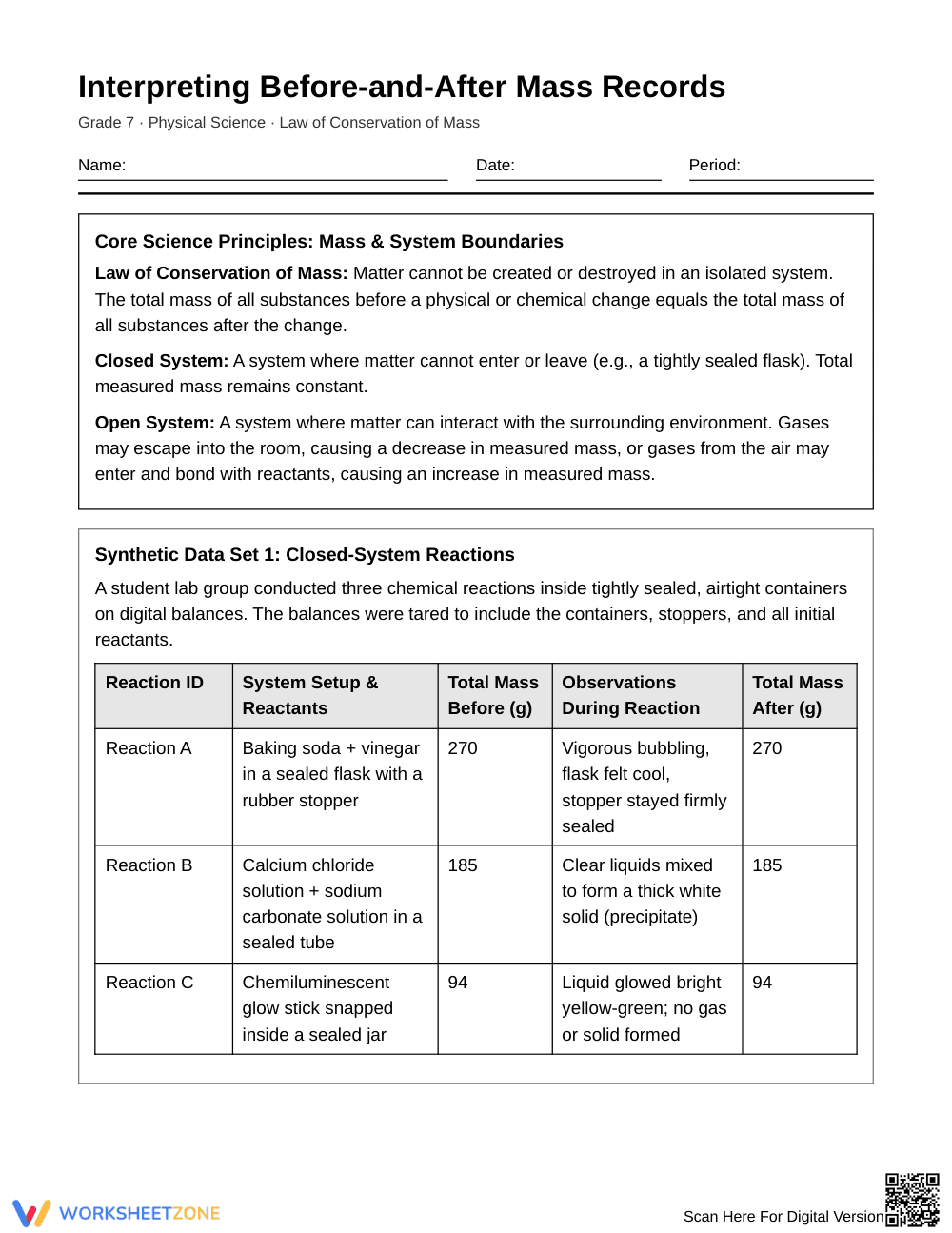
This physical science worksheet equips Grade 7 students to interpret before-and-after mass records across physical and chemical reactions. Learners analyze synthetic laboratory data sets, differentiate open and closed system boundaries, and confirm that matter is conserved despite visible state changes or gas production across ten focused, standards-based analytical tasks.
At a Glance
- Grade: 7 · Subject: Middle School Physical Science
- Standard: Analyze and interpret recorded mass data before and after changes to model mass conservation
- Skill Focus: Interpreting Before-and-After Mass Records
- Format: 5 total pages · 10 multi-step problems · Complete answer key included · PDF
- Best For: Post-lab analysis and conservation of mass mastery
- Time: 40–50 minutes
What's Inside
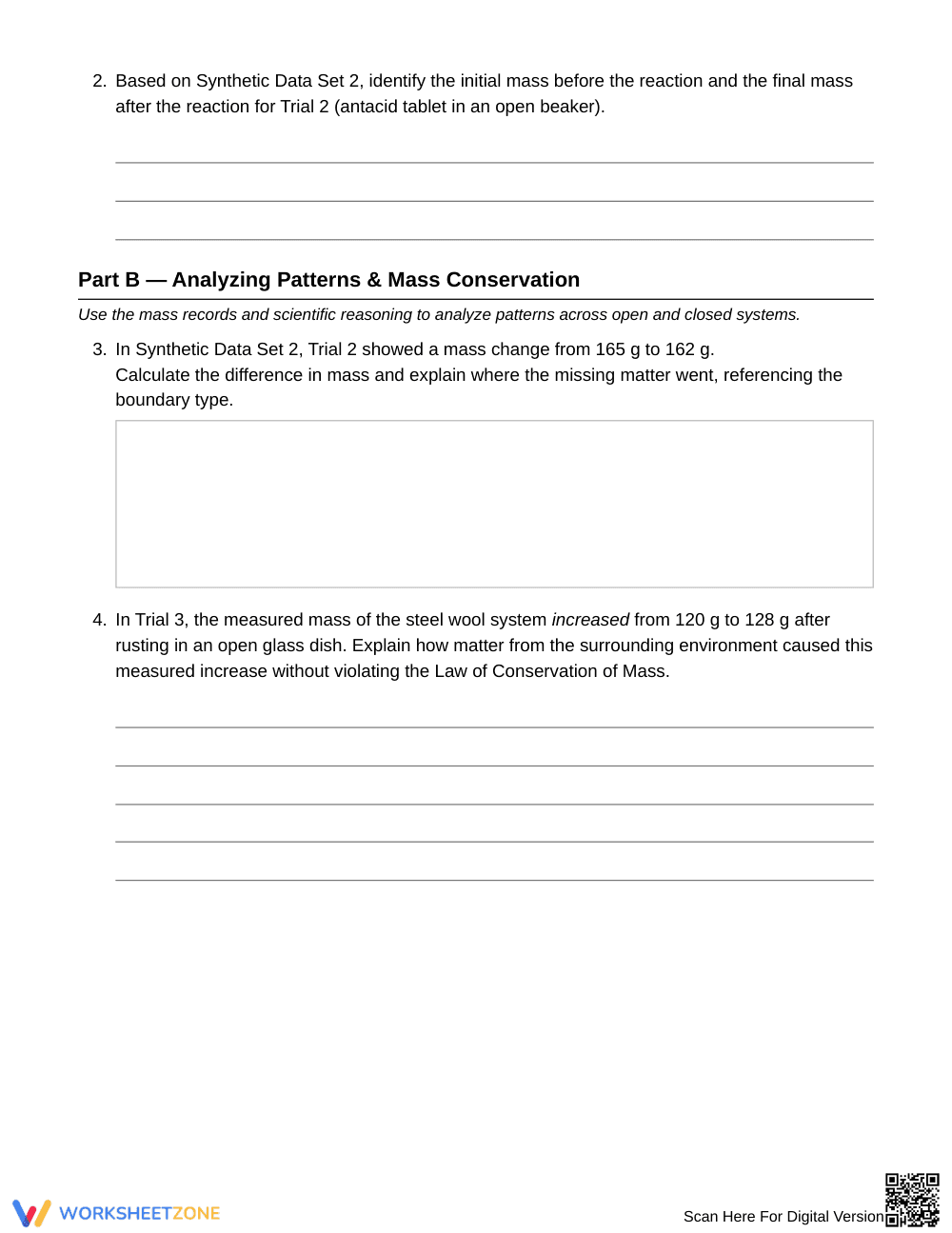
This 5-page resource features two synthetic data tables, a core principles reference box defining open and closed systems, and 10 targeted analytical problems across three parts. Students read values directly from reaction data, calculate mass differences, account for escaping gases, and evaluate boundary limitations. A 2-page answer key provides complete calculations and model written responses.
Skill Progression
- Guided practice (Problems 1–2): Direct data identification where students extract baseline and final mass values from structured tables.
- Supported practice (Problems 3–8): Intermediate analysis prompts requiring students to calculate mass changes, account for gas release in open beakers, and verify conservation during precipitation.
- Independent practice (Problems 9–10): Critical evaluation tasks diagnosing experimental limitations like loose stoppers and redefining system boundaries.
This progression mirrors the gradual-release framework, advancing students from basic reading to independent scientific analysis.
Standards Alignment
This worksheet aligns with physical science standards requiring students to analyze data to prove that total mass is conserved during physical and chemical changes. A supporting standard involves evaluating experimental designs and identifying boundary limitations. Both standard codes can be copied directly into lesson plans, IEP goals, or district curriculum mapping tools.
How to Use It
Use this worksheet after direct instruction on conservation of mass as guided group practice or an independent lab follow-up. For formative assessment, monitor Part B to check if students recognize that escaping gas causes measured decreases in open systems. Expected completion time is 40 to 50 minutes.
Who It's For
This resource supports Grade 7 science classes exploring chemical changes. The reference box scaffolds foundational vocabulary for struggling learners, while the boundary-redefining items challenge advanced students. Pair this worksheet with a hands-on baking soda lab demonstration to connect real-world phenomena to written data analysis.
Designed for middle school physical science standards focused on the Law of Conservation of Mass, this five-page instructional resource cultivates student proficiency in interpreting before-and-after mass records across physical and chemical transformations. Through ten structured analytical tasks, students examine synthetic laboratory data sets, calculate quantitative mass discrepancies, and evaluate boundary differences between open and closed systems. Grounded in the gradual-release framework documented by Fisher & Frey (2014), the progression transitions students from direct value identification to sophisticated evaluation of experimental limitations, such as gas loss through improper seals. By requiring learners to explain measured mass changes in rusting steel wool and effervescent reactions without violating foundational conservation principles, the worksheet bridges theoretical definitions with empirical evidence. Complete with a two-page answer key, this resource provides an effective, classroom-verified tool for developing scientific reasoning, data analysis fluency, and conceptual mastery.


