

































Complete Mass Conservation Worksheet | Grade 7 Science

Paste this activity's link or code into your existing LMS (Google Classroom, Canvas, Teams, Schoology, Moodle, etc.).
Students can open and work on the activity right away, with no student login required.
You'll still be able to track student progress and results from your teacher account.
This 4-page mass conservation worksheet provides Grade 7 physical science students with structured practice analyzing mass in open and closed systems. Students evaluate chemical reactions, phase changes, and experimental data across 12 targeted problems to prove matter is conserved.
At a Glance
- Grade: 7 · Subject: Science
- Standard: Physical Science — Model and explain how matter is conserved across chemical and physical reactions
- Skill Focus: Introductory Mass-Conservation Check
- Format: 4 pages · 12 problems · Answer key included · PDF
- Best For: Independent practice after direct instruction
- Time: 30–45 minutes
What's Inside
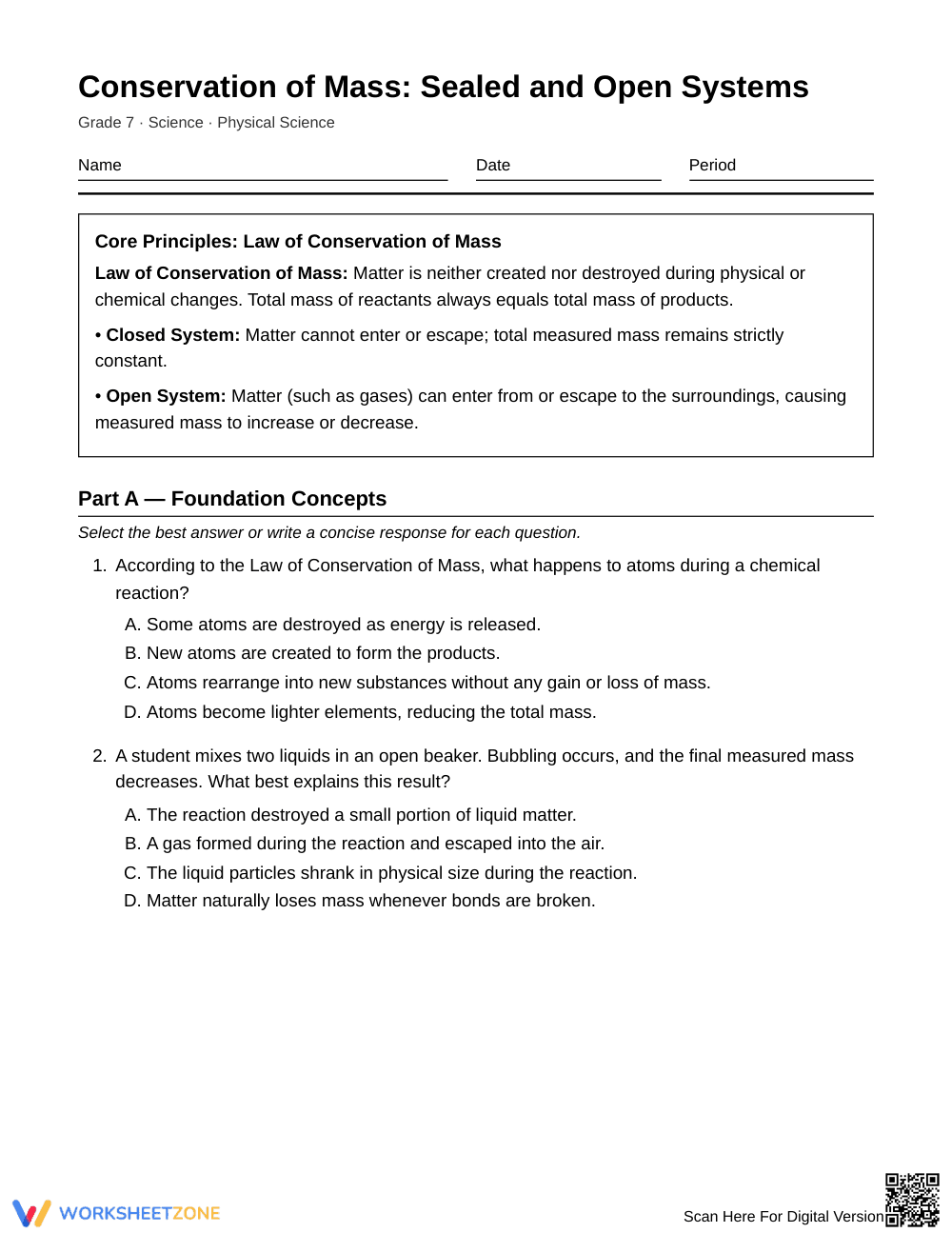
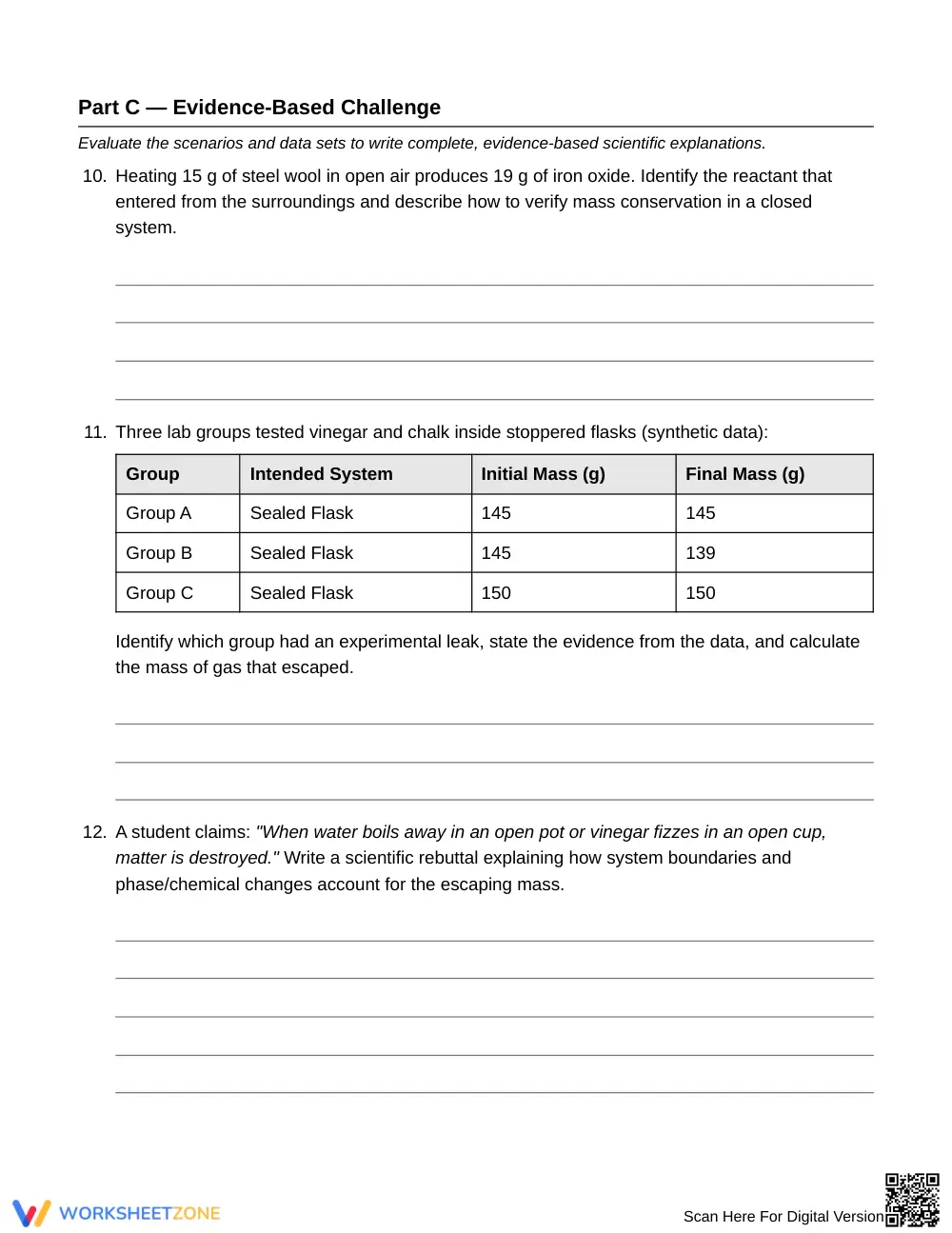
This resource opens with a core principles reference box defining open and closed systems, followed by 12 scaffolded problems across three sections. Students interpret laboratory data tables, calculate missing product masses, track escaping gases, and write evidence-based scientific explanations. A 2-page answer key provides complete calculations and model responses.
Skill Progression
- Guided Practice (Part A): Three foundation questions review atomic rearrangement and system boundaries through multiple-choice prompts and conceptual explanations.
- Supported Practice (Part B): Six multi-step calculation and data interpretation problems guide students through balancing reaction masses in open and closed setups.
- Independent Practice (Part C): Three challenge prompts require students to identify experimental leaks, analyze discrepancies, and construct formal scientific rebuttals.
This sequence follows the gradual-release model (I Do, We Do, You Do) to build mastery from conceptual understanding to rigorous quantitative analysis.
Standards Alignment
This resource aligns with middle school physical science standards requiring students to analyze data and demonstrate that total mass is conserved during changes in matter. Standard descriptions can be copied directly into lesson plans, IEP goals, or curriculum mapping documents.
How to Use It
Use this worksheet after direct instruction on the Law of Conservation of Mass or as paired collaborative practice. During Part B, check whether students subtract initial from final mass to account for escaping gas rather than assuming mass disappeared. Expected completion time is 30 to 45 minutes.
Who It's For
Designed for Grade 7 physical science classes, this worksheet features built-in reference definitions for struggling learners and rigorous rebuttal writing in Part C for advanced students. Pair it with a baking soda and vinegar balance demonstration for an effective hands-on lesson.
Physical science education research highlights the necessity of structured scaffolded problem sets when teaching abstract principles like the Law of Conservation of Mass. According to Fisher & Frey (2014), gradual release of responsibility—moving from foundational concept recognition to autonomous evidence-based evaluation—significantly improves middle school student retention and scientific reasoning accuracy. This Grade 7 science worksheet directly implements that instructional framework through 12 carefully sequenced tasks spanning closed system calculations and open system gas-loss analyses. In addition, embedding realistic laboratory data tables bridges theoretical chemical concepts with authentic empirical inquiry. By moving learners progressively from basic atom rearrangement checks to complex multi-group lab scenario troubleshooting, the resource ensures students do not misinterpret escaping gas as matter destruction. Educators can deploy this 4-page printable resource as an aligned formative assessment or targeted skill-building exercise to solidify core physical science competencies across diverse classroom learning environments.


