


























Views
Downloads


Complete Logarithm Errors Worksheet | Grade 11 Algebra II
Paste this activity's link or code into your existing LMS (Google Classroom, Canvas, Teams, Schoology, Moodle, etc.).
Students can open and work on the activity right away, with no student login required.
You'll still be able to track student progress and results from your teacher account.
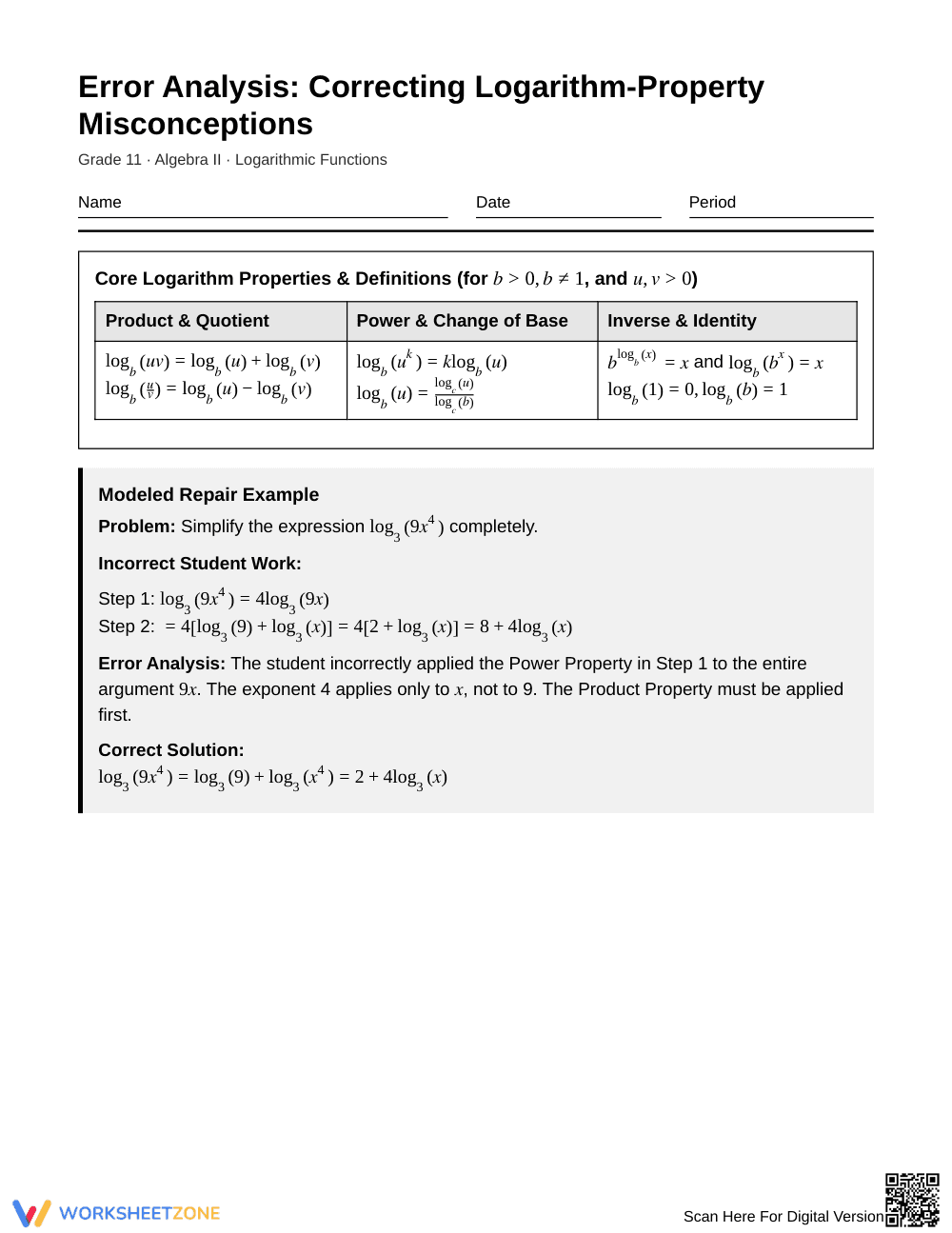
This Grade 11 Algebra II worksheet helps students eliminate common algebraic errors by identifying, analyzing, and correcting logarithm-property misconceptions. Through structured error analysis, learners examine flawed student calculations, diagnose misapplied product, quotient, and power rules, and produce verified, accurate solutions to solidify conceptual understanding.
At a Glance
- Grade: 11 · Subject: Algebra II
- Standard:
HSF-BF.B.5— Understand the inverse relationship between exponents and logarithms to solve logarithmic and exponential equations- Skill Focus: Correcting Logarithm-Property Misuse and Algebraic Misconceptions
- Format: 6 pages · 10 problems · 3-page answer key included · PDF
- Best For: Mid-unit remediation and collaborative error analysis
- Time: 40–50 minutes
What's Inside
This 6-page instructional resource contains 10 focused error-analysis tasks split into two five-problem sections. It features a properties reference box, a fully annotated modeled repair example, dedicated explanation lines for diagnosing misconceptions, and blank solution fields. A detailed 3-page answer key provides step-by-step mathematical corrections and explicit explanations of student errors.
Skill Progression
- Guided practice: Students study the modeled repair and reference table before analyzing 2 single-step expansion and quotient errors with scaffolded property reminders.
- Supported practice: Across 4 multi-step tasks, learners diagnose compound errors involving the power property, change of base formula, and linear log equations.
- Independent practice: Students solve 4 complex logarithmic equations independently, identifying factoring errors and rejecting extraneous solutions.
This sequence follows the gradual release of responsibility model, guiding students toward autonomous algebraic verification.
Standards Alignment
This worksheet aligns directly to HSF-BF.B.5: Understand the inverse relationship between exponents and logarithms to solve problems. It also supports standard HSA-REI.A.2 by requiring domain verification to eliminate extraneous roots when solving logarithmic equations. Both standard codes can be copied directly into lesson plans, IEP goals, or district curriculum mapping tools.
How to Use It
Use this resource as a mid-unit formative check following direct instruction, or as targeted review before an exam. For collaborative practice, have pairs discuss and justify error locations before writing repairs. Formatively monitor whether students verify argument domains in Part B, where extraneous roots frequently go unnoticed. Completion typically takes 40 to 50 minutes.
Who It's For
This packet suits Grade 11 Algebra II and Pre-Calculus students struggling with algebraic abstraction or misapplying distributive rules to logarithmic terms. It provides targeted scaffolding for intervention groups while challenging advanced learners. Pair this worksheet with a logarithm identities anchor chart or guided notes on exponential-logarithmic conversions.
Mastering logarithmic relationships under standard HSF-BF.B.5 requires high school students to discern valid algebraic transformations from superficial symbol manipulation. Groundbreaking research by Fisher & Frey (2014) emphasizes that deliberate error analysis fosters significantly deeper metacognitive awareness and conceptual consolidation than repetitive mechanical computation alone. By critically evaluating flawed student work to correct logarithm-property misuse, eleventh-grade Algebra II students confront and dismantle pervasive misconceptions, such as improperly distributing logarithmic operators across sums or confusing exponent rules with logarithmic identities. This targeted instructional intervention compels secondary learners to articulate precise mathematical justifications in writing, reconcile inverse function properties, and verify domain restrictions to reject extraneous solutions. Consequently, structured error detection shifts adolescent learners from rote procedural execution to authentic mathematical argumentation, ensuring durable retention of logarithmic principles across advanced secondary coursework and college-preparatory mathematics pathways.


