





























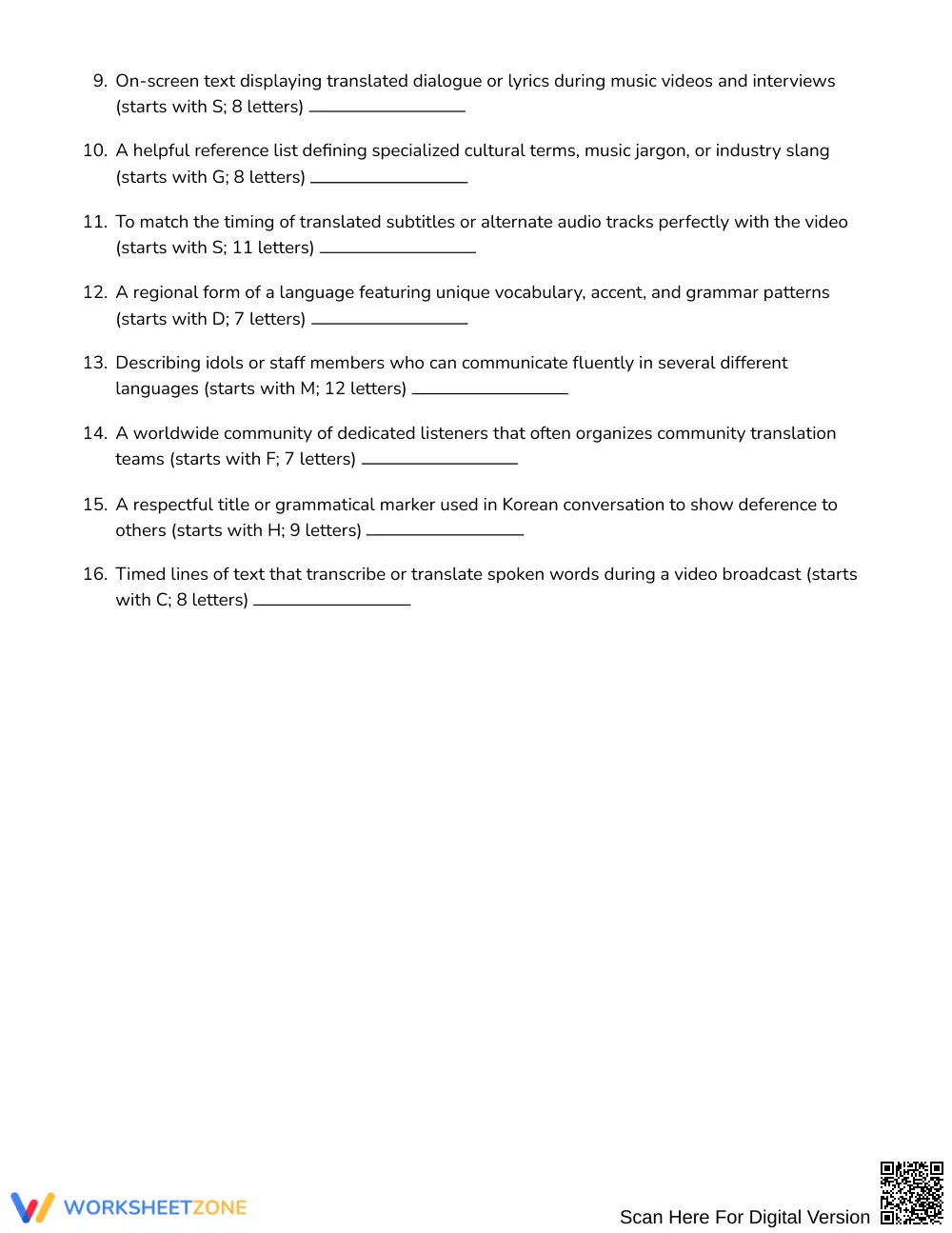


Complete K-Pop Translation Word Search | Grades 6–7 ELA

Paste this activity's link or code into your existing LMS (Google Classroom, Canvas, Teams, Schoology, Moodle, etc.).
Students can open and work on the activity right away, with no student login required.
You'll still be able to track student progress and results from your teacher account.
This K-pop translation and international communication word search builds contextual vocabulary mastery for middle school readers. Students decode definitions related to global media, subtitle localization, and cross-cultural broadcasting to identify target terms before locating them within the grid. It offers rigorous, clue-driven language practice centered on high-interest international pop culture topics.
At a Glance
- Grade: Grades 6–7 · Subject: English Language Arts (ELA)
- Standard: Not standards-assessed — vocabulary enrichment
- Skill Focus: Translation and international communication
- Format: 3 pages · 16 words · Answer key included · PDF
- Best For: Vocabulary enrichment and early finishers
- Time: 25–35 minutes
What's Inside
This 3-page printable activity delivers a clue-based vocabulary puzzle containing 16 words to find. Rather than relying on a simple word list, students must read content-rich definitions to determine each target term before tracking it down. The resource includes the puzzle grid, clue sheets, and a comprehensive 4-page answer key showing exact letter paths for fast verification.
Puzzle Mechanics
Students work through an 18 x 18 grid engineered to build persistence and orthographic pattern recognition:
- Search Grid: Words hide across an 18 x 18 letter matrix, requiring methodical scanning across rows and columns.
- Word Placement: Terms run in all 8 possible directions: north, northeast, east, southeast, south, southwest, west, and northwest.
- No-Bank Clue Challenge: With no word bank provided, students must use the 16 contextual clues to recall or deduce terms such as romanization, localization, and honorific.
Standards Alignment
This resource serves as targeted vocabulary enrichment and is not aligned to a specific state or national content standard. It reinforces domain-specific terminology, morphological recognition, and cross-cultural media literacy across middle school English Language Arts classrooms.
How to Use It
Deploy this activity during an informational text unit on global media or as an independent task during literacy stations. Prior to independent work, model how to use syntactic cues in the clue definitions to determine the target vocabulary word before scanning the grid. During seatwork, circulate to observe whether learners correctly identify root words and affixes when searching backward or diagonally. Expect typical completion times between 25 and 35 minutes.
Who It's For
Designed specifically for Grades 6–7 English Language Arts learners, this puzzle challenges students to apply critical thinking to global communication concepts. For learners needing additional support, allow peer collaboration to solve clues before searching. Pair this activity with an informational reading passage on international media localization or subtitling technology.
Vocabulary enrichment activities that integrate contextual clues with orthographic search tasks reinforce word consciousness and deepen semantic memory. According to research from Fisher & Frey (2014), intentional vocabulary instruction that requires students to retrieve definitions and manipulate technical terms in novel contexts strengthens reading comprehension and domain-specific communication skills. This Grades 6–7 word search challenges learners to deduce 16 precise translation terms across an 18 x 18 grid without a supportive word bank, turning passive puzzle-solving into an active retrieval exercise. By engaging middle school readers through contemporary international media topics, the resource builds linguistic confidence and cross-cultural literacy in practical classroom settings.


