


























Views
Downloads



Complete Inequality Graphs Worksheet | Grade 7 Math
Paste this activity's link or code into your existing LMS (Google Classroom, Canvas, Teams, Schoology, Moodle, etc.).
Students can open and work on the activity right away, with no student login required.
You'll still be able to track student progress and results from your teacher account.
This Grade 7 math worksheet helps students connect algebraic inequalities with their number-line representations. Through 12 structured tasks, middle school learners practice graphing boundary values, interpreting open and closed circles, applying sign-reversal rules for negative coefficients, and resolving common graphical reasoning misconceptions.
At a Glance
- Grade: 7 · Subject: Math
- Standard:
7.EE.B.4— Solve word problems leading to inequalities and graph the resulting solution set- Skill Focus: Connect Algebraic and Number-Line Solutions
- Format: 5 pages · 12 problems · Full answer key included · Printable PDF
- Best For: Guided classroom practice and formative assessment checks
- Time: 35–45 minutes
What's Inside
This 5-page printable resource includes a Core Concepts reference box detailing boundary rules and sign reversals, 12 multi-step student problems, and a 3-page answer key with complete algebraic solutions and number-line graphs.
Skill Progression
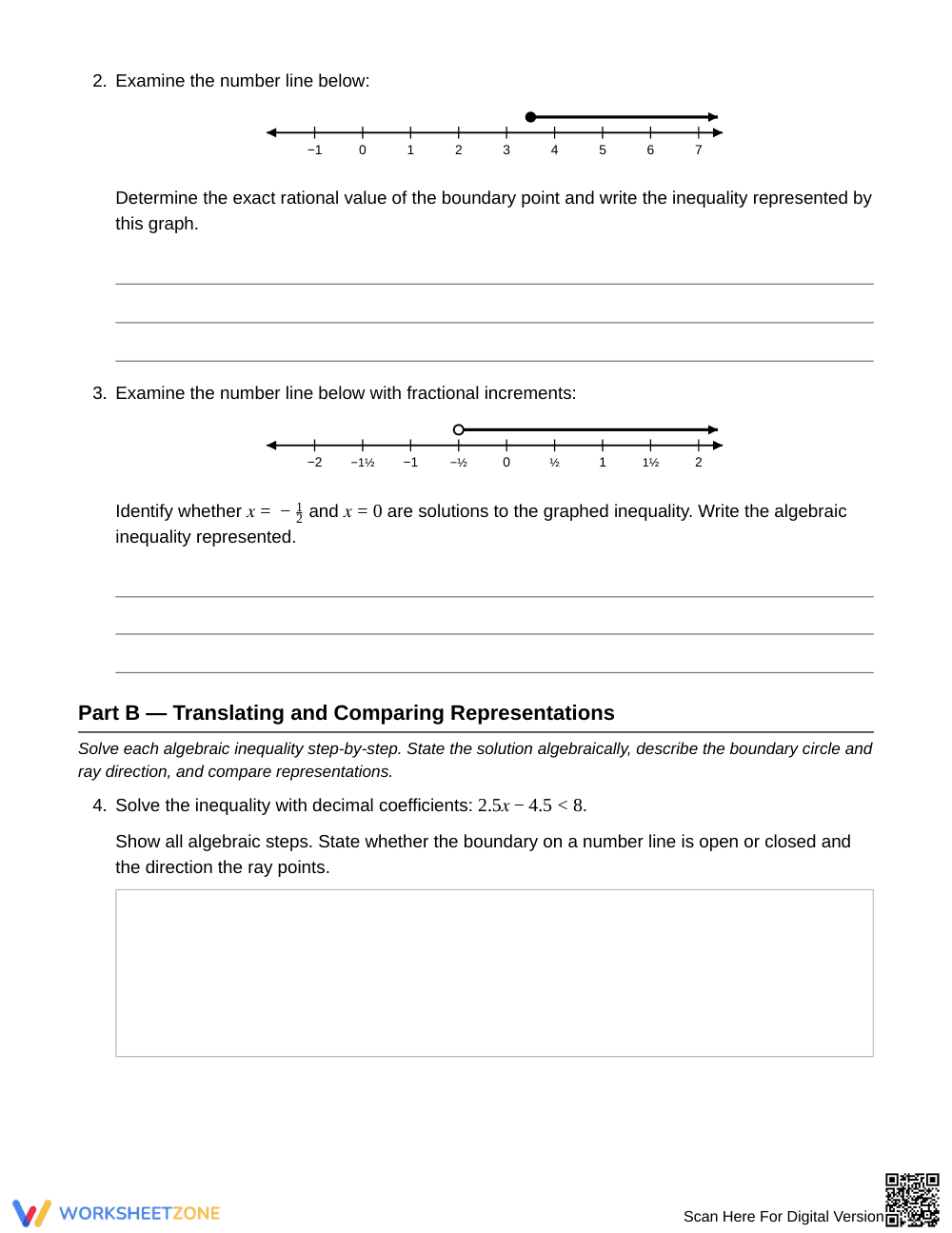
- Guided Practice (Part A, Tasks 1–3): Students read number lines to identify boundary points, circle types, and corresponding algebraic expressions.
- Supported Practice (Part B, Tasks 4–9): Students solve inequalities with rational coefficients, model real-world scenarios, and compare how opposite signs affect ray directions.
- Independent Practice (Part C, Tasks 10–12): Students analyze student errors, critique elevator safety constraints, and evaluate graph-equation equivalence.
This gradual-release structure guides learners from visual identification to independent algebraic and graphical mastery.
Standards Alignment
This worksheet aligns to standard 7.EE.B.4: "Use variables to represent quantities in a real-world or mathematical problem, and construct simple equations and inequalities to solve problems." It specifically reinforces 7.EE.B.4.b by requiring learners to graph and interpret solution sets in context. Both standard codes can be copied directly into lesson plans, IEP goals, or district curriculum mapping tools.
How to Use It
Use this resource after introducing two-step inequalities to link algebraic operations with graph rays. For small-group intervention, have students highlight negative coefficients before dividing. During independent practice, use Part C as a formative check on sign-reversal reasoning. Expected completion time is 35 to 45 minutes.
Who It's For
This worksheet serves Grade 7 math classes, accelerated Grade 6 students, and Grade 8 intervention groups. Built-in reference boxes support English learners, while Part C offers enrichment for advanced learners. Pair this resource with a two-step inequality anchor chart or visual sorting activity.
According to research from Fisher & Frey (2014) on the gradual release of responsibility framework, structured cognitive modeling paired with visual scaffolding substantially deepens student retention of abstract algebraic concepts. Aligning to standard 7.EE.B.4, this worksheet grounds students in connecting algebraic and number-line solutions through purposeful progression. By transitioning from visual graph interpretation to multi-step inequality computation with positive and negative rational coefficients, students build robust conceptual schema. The inclusion of non-routine error analysis and contextual constraint modeling directly targets documented middle school misconceptions surrounding inequality reversal rules and inclusive boundary conditions. As demonstrated in contemporary empirical studies on mathematics pedagogy, providing rigorous dual-representation practice alongside immediate corrective feedback accelerates procedural fluency and equips Grade 7 learners with the foundational reasoning required for linear inequality systems in high school algebra coursework.


