






























Complete Habitat Restoration Worksheet | Grade 12 Science
Paste this activity's link or code into your existing LMS (Google Classroom, Canvas, Teams, Schoology, Moodle, etc.).
Students can open and work on the activity right away, with no student login required.
You'll still be able to track student progress and results from your teacher account.
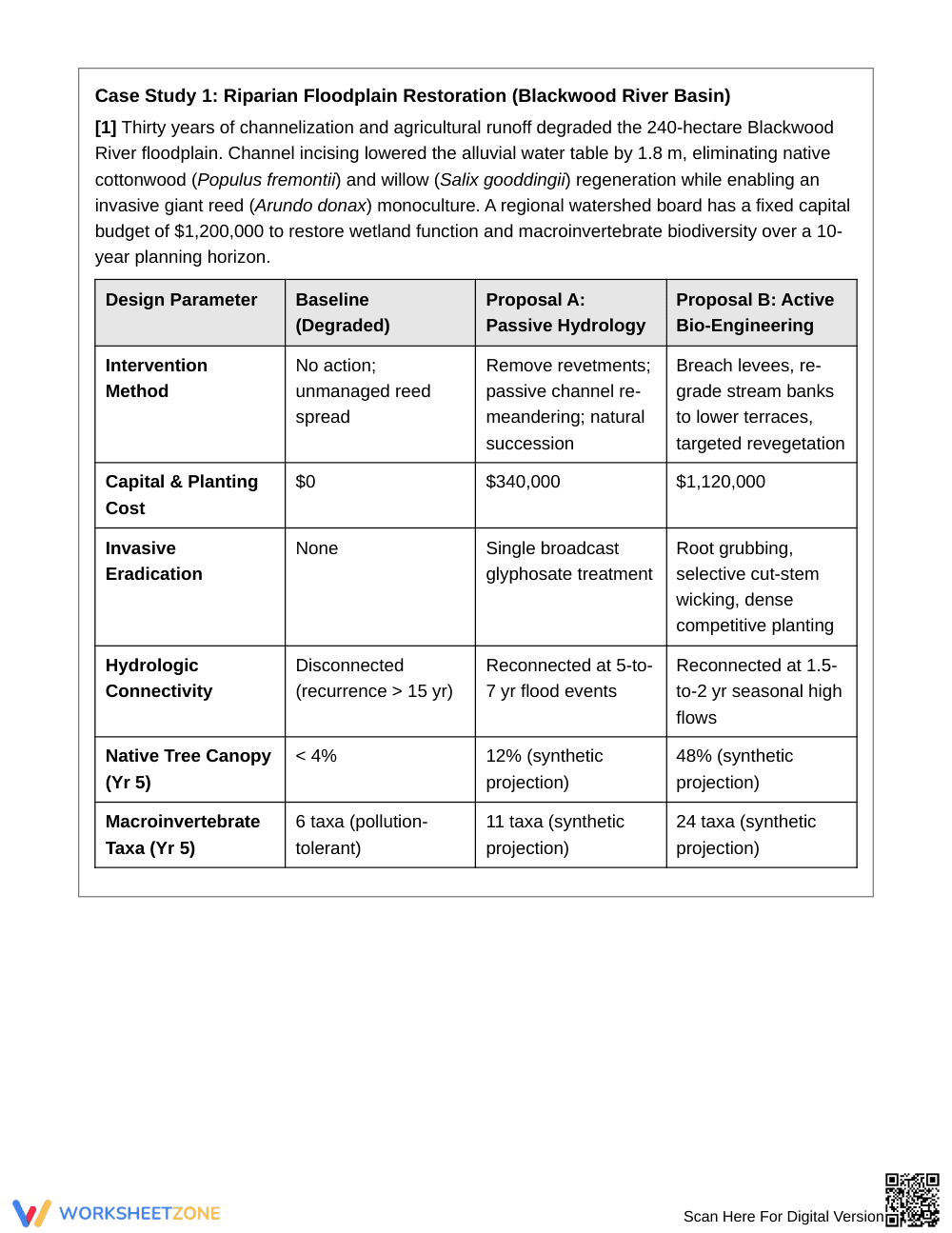
This comprehensive environmental science worksheet trains high school students to analyze ecological data, weigh abiotic and economic constraints, and evaluate competing habitat-restoration proposals. Students investigate real-world riparian floodplain degradation and post-wildfire oak savanna recovery scenarios to make evidence-based conservation management decisions.
At a Glance
- Grade: 12 · Subject: Environmental Science
- Standard: Evaluate ecological design solutions for biodiversity and ecosystem resilience
- Skill Focus: Evaluating Habitat-Restoration Proposals
- Format: 6 pages · 10 problems · Answer key included · PDF
- Best For: Advanced Environmental Science Units
- Time: 45–60 minutes
What's Inside
The 6-page activity features two in-depth ecological case studies accompanied by multi-variable data tables. Students examine hydrological modifications, invasive species dynamics (such as Arundo donax and cheatgrass), and soil infiltration metrics across 10 multi-part analytical questions. A complete 3-page answer key provides full model responses, quantitative calculations, and ecological rationale.
Skill Progression
- Guided practice (Part A — 2 tasks): Students identify physical, abiotic, and budgetary boundary conditions from structured narrative briefs with explicit restoration framework definitions.
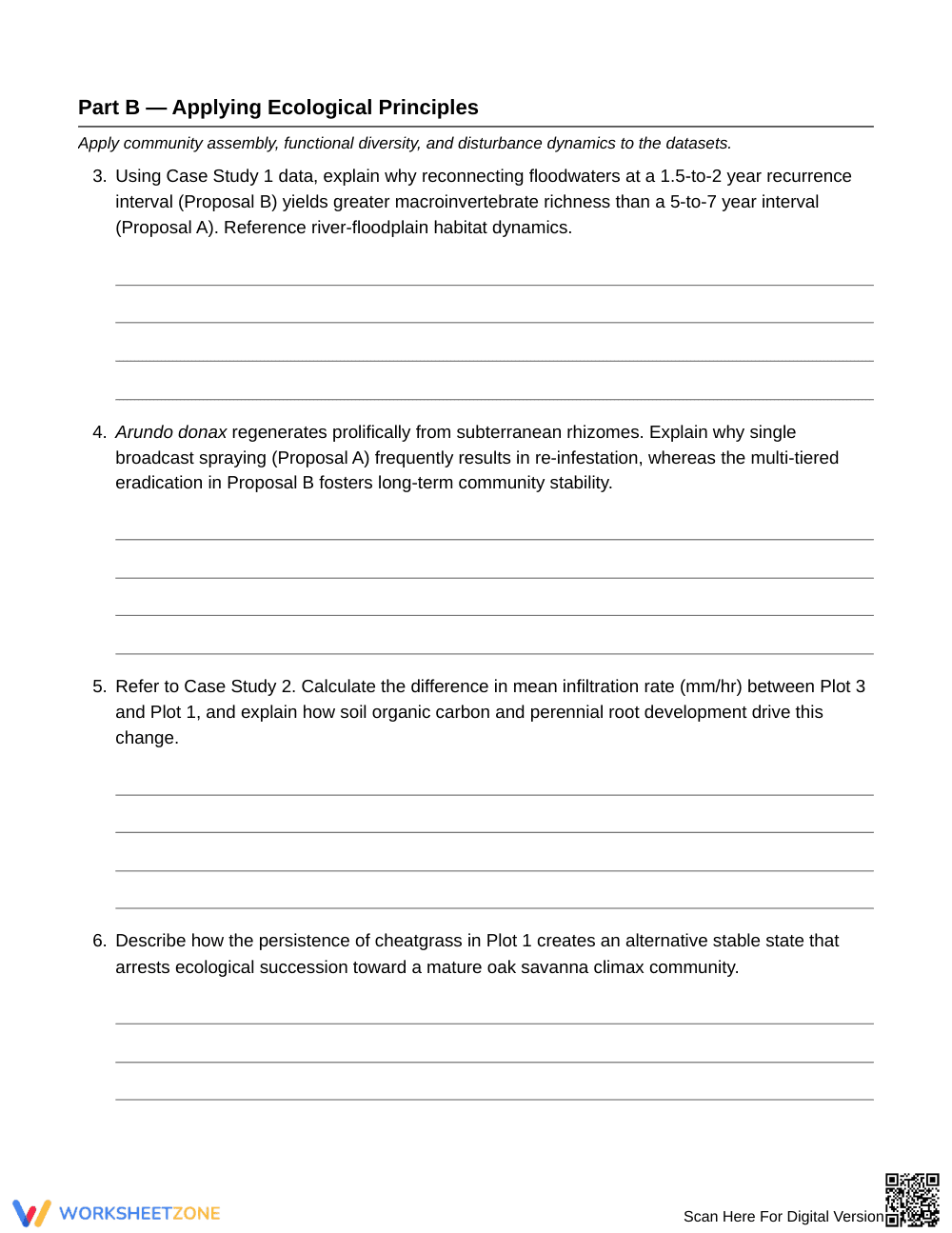
- Supported practice (Part B — 6 tasks): Students analyze quantitative field datasets, calculate changes in infiltration rates, and explain mechanisms involving functional redundancy, trophic interactions, and alternative stable states.
- Independent practice (Part C — 2 tasks): Students synthesize multi-year ecological, hydrological, and financial trade-offs to critically refute invalid management claims and justify long-term restoration plans.
This structured progression reflects a gradual-release model that builds analytical rigor from basic constraint identification to high-level synthesis.
Standards Alignment
This activity aligns with high school earth and environmental science core ideas on ecosystem stability, response to disturbances, and engineering design evaluation. Students evaluate competing design solutions for maintaining biodiversity and ecosystem services under realistic abiotic and financial constraints. These objectives can be copied directly into lesson plans, IEP goals, or district curriculum mapping tools.
How to Use It
Deploy this resource during the second half of a conservation biology unit after direct instruction on succession and resilience. For formative assessment, observe student reasoning in Part B to verify that learners connect soil physical properties directly to community recovery rates rather than treating metrics in isolation. Anticipated completion time is 45 to 60 minutes.
Who It's For
Designed for Grade 12 environmental science and AP Biology learners, this resource challenges students with authentic ecological trade-offs. For differentiated support, pair this document with an ecological succession anchor chart or graphic organizer illustrating trophic web functional redundancy.
Evaluating habitat-restoration proposals requires students to integrate community ecology, abiotic constraints, and cost-benefit analysis into evidence-based scientific arguments. According to research synthesized by Fisher & Frey (2014) on guided instruction and gradual-release frameworks, scaffolded exposure to complex case study data significantly deepens student capacity to evaluate scientific trade-offs and justify engineering solutions. By progressing from constraint identification to dataset calculation and critical claim evaluation, this 6-page resource equips Grade 12 learners with the analytical tools necessary to assess biodiversity resilience, functional redundancy, and long-term ecosystem stability. Educators can utilize the structured 10-task progression to gauge mastery of high-level ecological problem-solving before summative AP or district assessments, ensuring students can successfully translate theoretical conservation biology into practical environmental stewardship solutions.


