




























Complete Graphing Inequalities Worksheet | Grade 6 Math
Paste this activity's link or code into your existing LMS (Google Classroom, Canvas, Teams, Schoology, Moodle, etc.).
Students can open and work on the activity right away, with no student login required.
You'll still be able to track student progress and results from your teacher account.
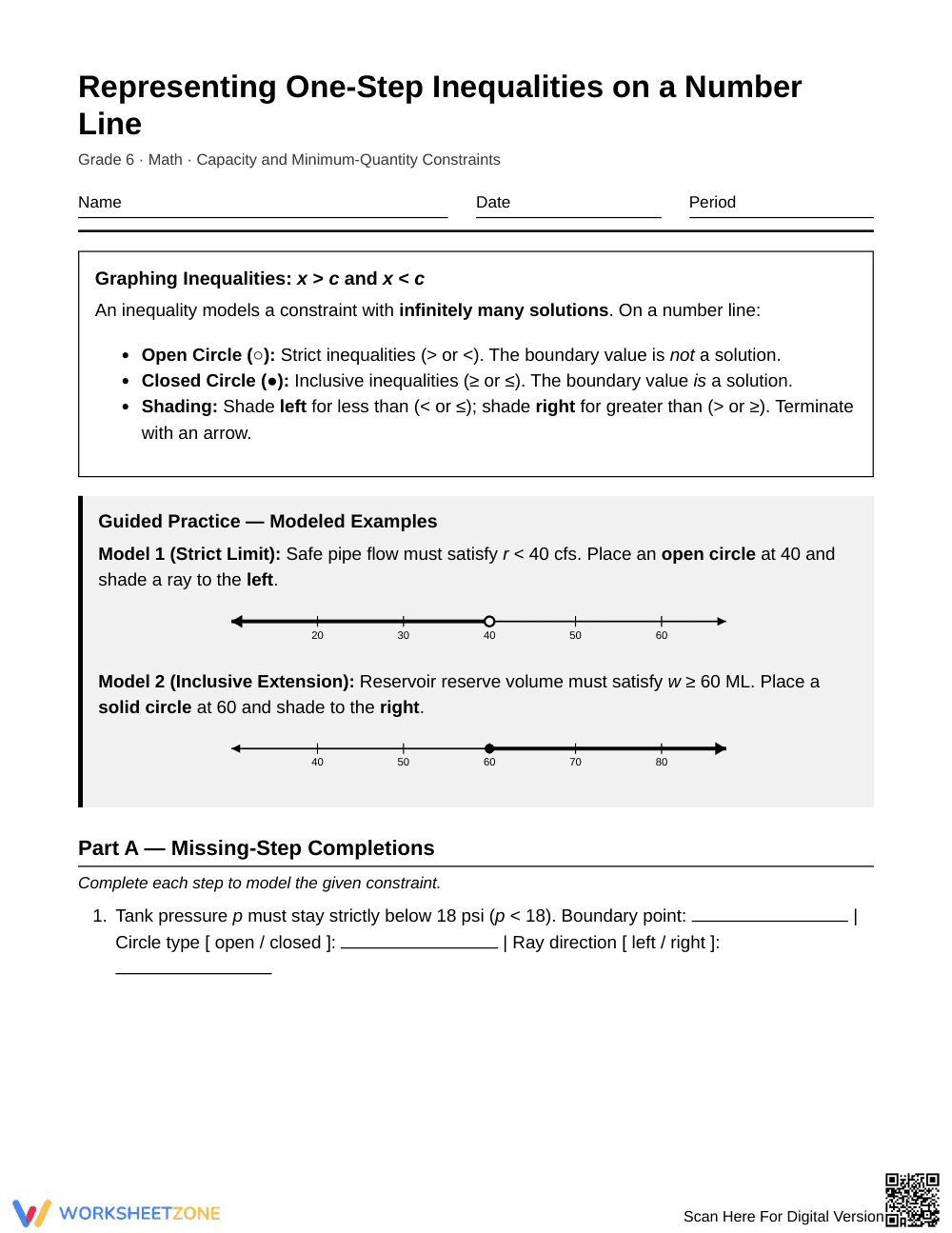
This 3-page printable math worksheet guides Grade 6 students through representing one-step inequalities on number lines using real-world constraint scenarios. Students master identifying boundary values, selecting open or closed circles, and drawing directional rays, developing a complete conceptual understanding of infinite solution sets for strict and inclusive inequalities.
At a Glance
- Grade: 6 · Subject: Math
- Standard:
6.EE.B.8— Graph solutions of mathematical and real-world inequalities on number lines- Skill Focus: Represent a Simple Inequality on a Number Line
- Format: 3 pages · 12 problems · Answer key included · PDF
- Best For: Guided practice and independent skill reinforcement
- Time: 30–45 minutes
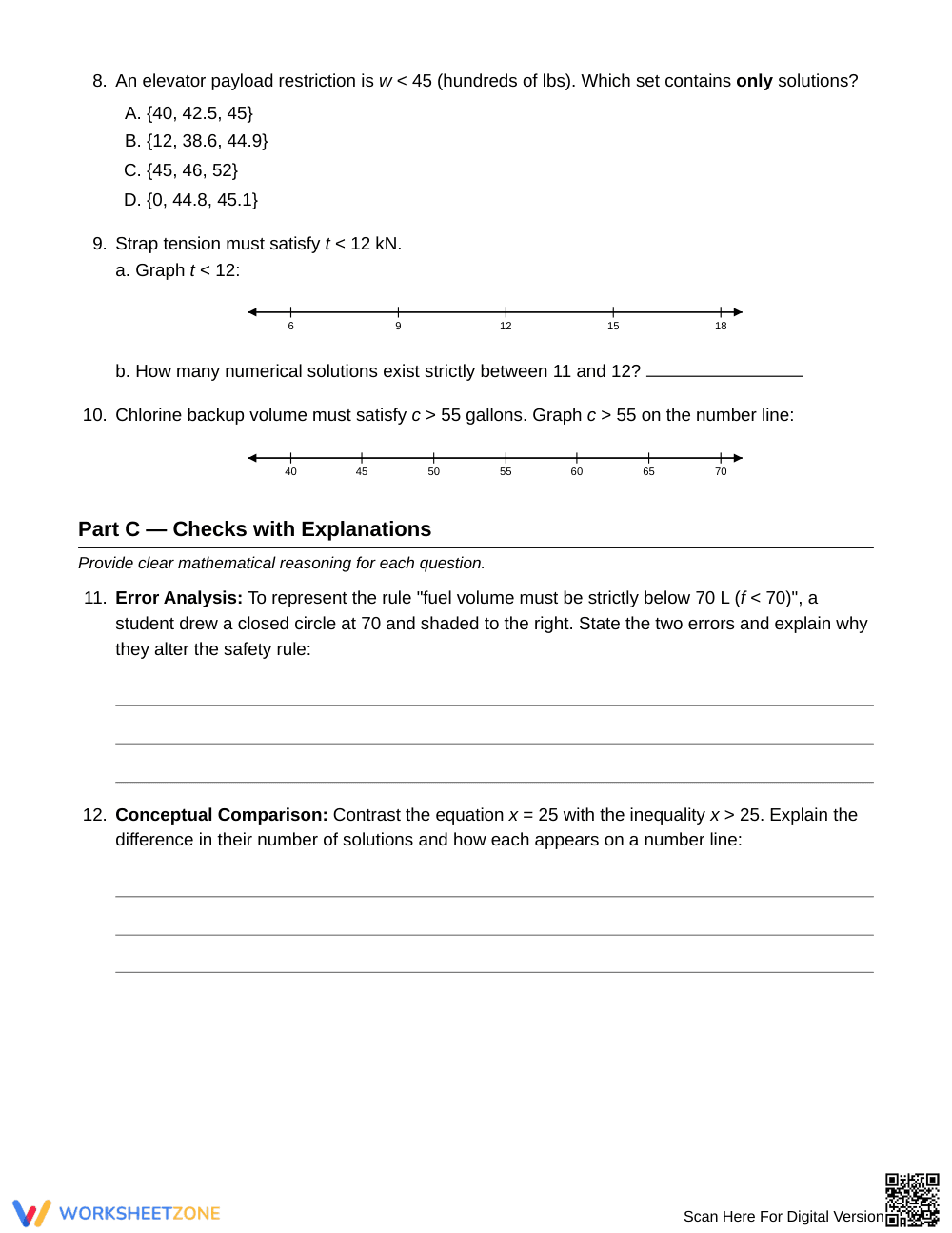
What's Inside: The resource features a concise rule summary with two visual reference models, followed by 12 structured tasks across 3 pages. Students complete guided step-by-step completions, independent ray-graphing exercises, multiple-choice solution set identification, and written error-analysis prompts. A complete 2-page answer key provides graphed number lines and detailed reasoning for efficient grading.
Skill Progression:
- Guided practice (Part A, 4 problems): Scaffolded prompts break down boundary points, circle types (open vs. closed), and ray directions before asking students to graph.
- Supported practice (Part B, 6 problems): Independent graphing tasks using capacity and payload constraints, requiring non-integer solution generation and solution set validation.
- Independent practice (Part C, 2 problems): Rigorous conceptual checks requiring written error analysis and comparative explanation between equations and inequalities.
This structured progression follows the gradual release of responsibility model to build lasting mathematical fluency.
Standards Alignment: This worksheet directly targets 6.EE.B.8: Write an inequality of the form x > c or x < c to represent a constraint or condition in a real-world or mathematical problem, and recognize that inequalities of the form x > c or x < c have infinitely many solutions; represent solutions of such inequalities on number line diagrams. Both standard codes can be copied directly into lesson plans, IEP goals, or district curriculum mapping tools.
How to Use It: Deploy this activity immediately after direct instruction on inequality symbols, or use it during small-group remediation. For formative assessment, observe whether students draw open circles for strict boundaries (such as p < 18) or mistakenly fill them in. Expected completion time is 30 to 45 minutes across individual and paired formats.
Who It's For: Designed for sixth-grade general math classrooms, intervention specialists, and resource room instructors supporting standard-level mastery. Students who struggle with continuous variables benefit from the explicit non-integer prompts. Pair this resource with a visual inequality anchor chart or hands-on clothesline number line demonstration for maximum impact.
Standard 6.EE.B.8 requires sixth-grade students to represent real-world constraint conditions using simple inequalities and plot infinite solution sets on number line diagrams. Grounded in the gradual-release framework described by Fisher & Frey (2014), this 12-task worksheet moves learners systematically from guided boundary-point identification to independent ray plotting and conceptual error analysis. Students transition from recognizing discrete values to understanding that inequalities encompass an infinite continuum of fractional and decimal solutions. By contrasting open-boundary strict limits with solid closed-boundary points across authentic engineering and capacity scenarios, the material deepens foundational algebraic reasoning. Educational research synthesized by Fisher & Frey (2014) confirms that combining modeled worked examples with structured reflective justification accelerates procedural accuracy and conceptual transfer. Consequently, this resource serves as an evidence-based tool for standards-aligned Tier 1 core instruction, targeted math intervention, and progress monitoring in middle school mathematics.


