



























Complete Graham's Law Worksheet | Grades 9-12 Science
Paste this activity's link or code into your existing LMS (Google Classroom, Canvas, Teams, Schoology, Moodle, etc.).
Students can open and work on the activity right away, with no student login required.
You'll still be able to track student progress and results from your teacher account.
This comprehensive chemistry resource develops student mastery of Graham's law through kinetic molecular theory, empirical laboratory observations, and quantitative rate calculations. High school chemistry students explore cause-and-effect relationships governing gaseous effusion and diffusion, predicting particle behavior when molar mass or thermal energy shifts while evaluating real-world experimental evidence.
At a Glance
- Grade: Grades 9–12 · Subject: Science
- Standard: Science Inquiry — Predict gas effusion rates using molecular mass and kinetic energy principles
- Skill Focus: Graham's Law, effusion rates, and kinetic molecular theory
- Format: 4 pages · 16 problems · Answer key included · PDF
- Best For: Chemistry unit practice and lab debrief
- Time: 45–60 minutes
What's Inside
Across four student-facing pages, this worksheet features 16 focused tasks organized into three distinct thematic sections. Students interpret molecular pinhole effusion diagrams, analyze experimental diffusion tube data involving ammonia and hydrochloric acid, and solve multi-step mathematical calculations using molar masses. A complete 4-page answer key provides full mathematical steps, ratio comparisons, and conceptual rationales.
Skill Progression
- Guided Practice: Part A introduces core particle principles with 6 scaffolded questions evaluating kinetic energy formulas, direct pinhole models, and initial rate predictions.
- Supported Practice: Part B challenges students with 4 empirical analysis problems based on a classic 100 cm diffusion tube experiment, comparing observed reaction distances to theoretical values.
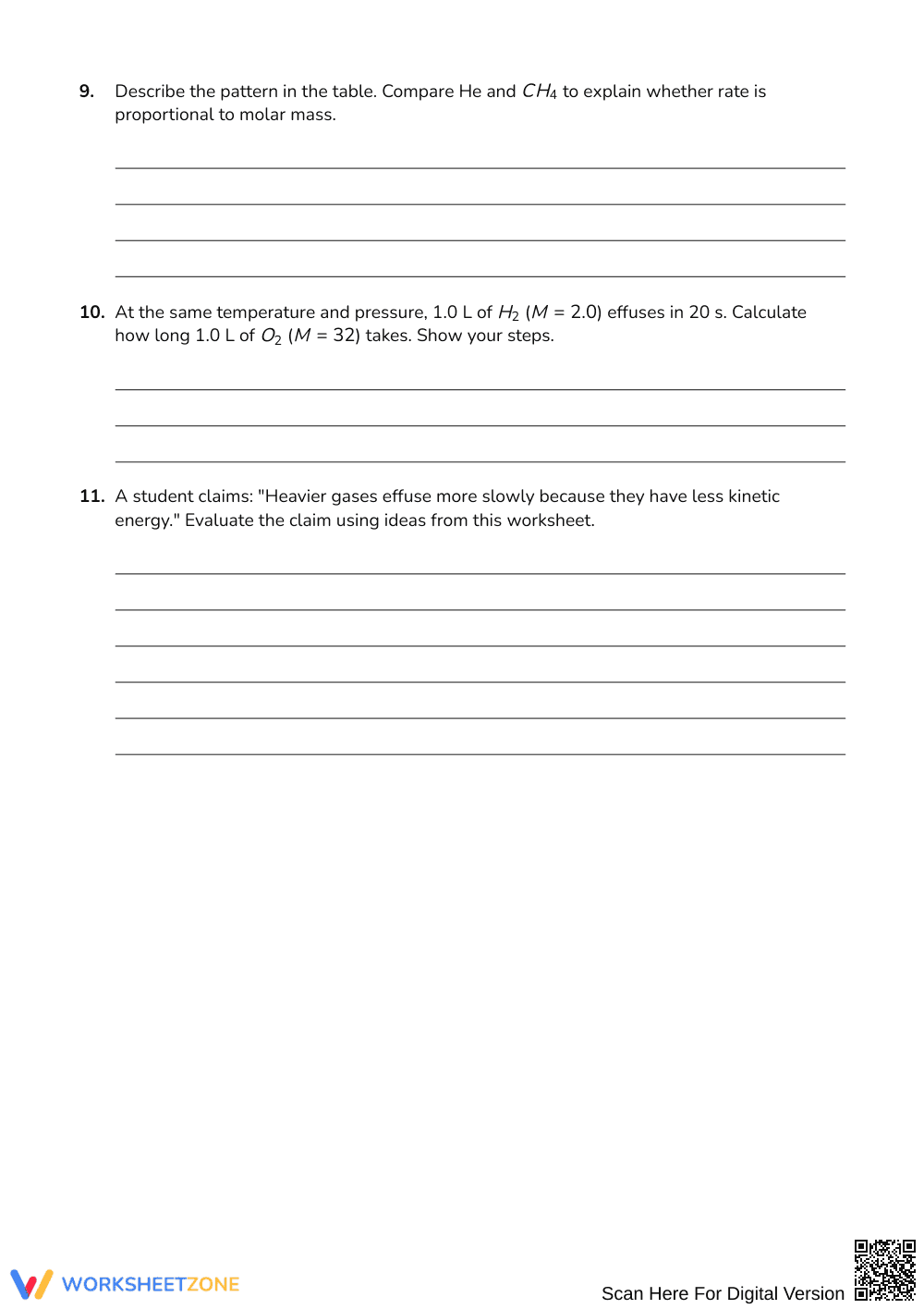
- Independent Practice: Part C presents 6 rigorous analytical tasks, requiring tabular pattern analysis, multi-step time-rate conversions, and critique of common student misconceptions.
This deliberate sequence follows a gradual-release model, transitioning learners from conceptual particle interactions to independent quantitative reasoning.
Standards Alignment
This worksheet directly addresses high school physical science performance expectations regarding the kinetic molecular theory of matter and quantitative relationships in chemical systems. Students apply mathematical representations to support claims regarding the microscopic motion of particles and predict changes in gas behavior when variables shift. Supporting standards encompass scientific argumentation and error analysis in empirical tube diffusion setups. Both standard codes can be copied directly into lesson plans, IEP goals, or district curriculum mapping tools.
How to Use It
Deploy this resource during mid-unit direct instruction as guided partner practice immediately following kinetic molecular theory lectures, or assign it after completing the ammonia-hydrochloric acid diffusion lab to solidify theoretical ratios against real data. For formative assessment, examine student responses to the misconception prompt in Part C; students frequently confuse particle speed with total kinetic energy. Expect completion in 45 to 60 minutes.
Who It's For
This activity is designed for on-level and honors high school chemistry students mastering gas laws. For students requiring support, provide formula reference cards showing inverse square-root equations. Pair this printable with a teacher demonstration of Graham's law or a molecular dynamics computer simulation.
Gaseous diffusion and effusion represent essential physical chemistry concepts linking macroscopic gas observations to microscopic particle mechanics. As demonstrated in educational research by Fisher & Frey (2014), structured scaffolded progressions from conceptual modeling to quantitative calculation significantly enhance student conceptual retention and reduce algorithmic errors. This 16-task resource targets Graham's law by grounding mathematical ratios in the foundational kinetic energy formula KE = 1/2mv². By prompting learners to calculate relative effusion rates, analyze actual 100 cm diffusion tube observations, and debunk the persistent misconception that heavier gas particles possess lower kinetic energy at thermal equilibrium, this worksheet ensures students acquire authentic scientific reasoning habits. The structured format provides rigorous formative evidence for educators tracking high school physical science mastery.


