




























Complete Graham's Law Model Worksheet | Grade 9-12 Science
Paste this activity's link or code into your existing LMS (Google Classroom, Canvas, Teams, Schoology, Moodle, etc.).
Students can open and work on the activity right away, with no student login required.
You'll still be able to track student progress and results from your teacher account.
This Grades 9–12 chemistry worksheet guides students through Graham's Law by connecting kinetic molecular theory to observable gas behavior. Across 17 scaffolded tasks in 4 pages, high school learners construct particle diagrams, critique flawed claims, analyze lab data, and solve quantitative effusion rate problems.
At a Glance
- Grade: Grades 9–12 · Subject: Science
- Standard: Construct, test, and revise particle models explaining gas behavior
- Skill Focus: Graham's Law and Kinetic Molecular Theory
- Format: 4 pages · 17 problems · Answer key included · PDF
- Best For: In-class guided practice and inquiry
- Time: 45–60 minutes
What's Inside
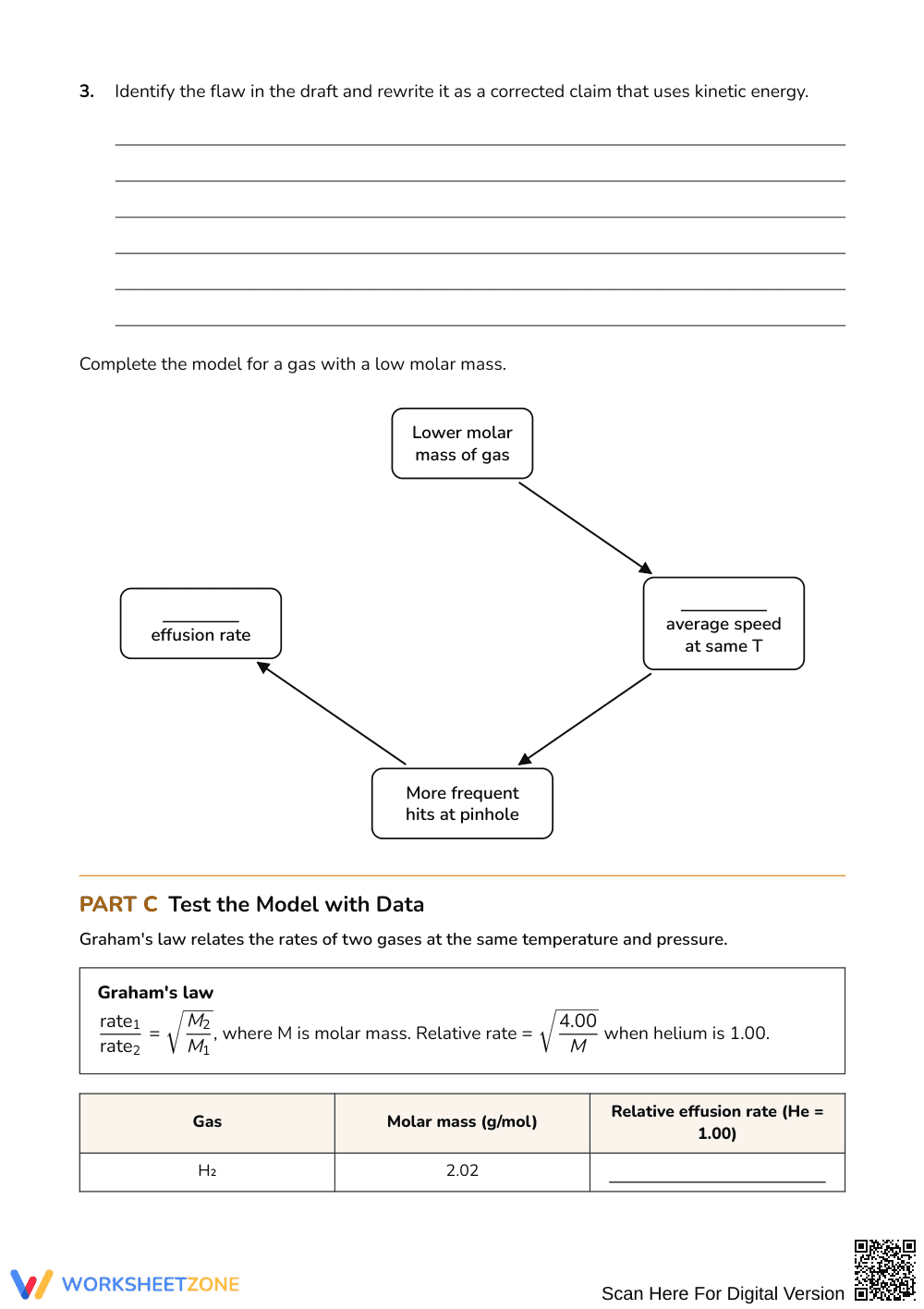
This resource includes a 4-page student worksheet and a 4-page teacher answer key with worked solutions. Students analyze pinhole effusion models, arrow-vector speeds, cause-and-effect flowcharts, and empirical data tables comparing hydrogen, helium, oxygen, and carbon dioxide rates.
Skill Progression
- Guided Practice (Part A): Students examine particle diagrams of effusion, using kinetic energy equations to connect mass, speed, and pinhole collision frequency.
- Supported Practice (Parts B & C): Learners critique a peer's flawed model, complete cause-and-effect chains, and evaluate empirical NH3 and HCl diffusion tube data.
- Independent Practice (Part D): Students calculate unknown molar masses, predict effusion times, and explain real-world phenomena.
This progression embodies gradual release, shifting from visual modeling to independent quantitative mastery.
Standards Alignment
This worksheet aligns with high school physical science standards requiring students to develop models explaining matter and energy interactions at the molecular scale. A supporting standard addresses cause-and-effect mechanisms governing rates of physical change. Both standard codes can be copied directly into lesson plans, IEP goals, or district curriculum mapping tools.
How to Use It
Use this worksheet after direct instruction on kinetic molecular theory to solidify how gas mass affects particle velocity. It also works as a structured follow-up after an ammonia-hydrochloric acid diffusion demonstration. Formatively assess whether students correctly cite particle velocity rather than collision force when explaining effusion rates. Expected completion time is 45 to 60 minutes.
Who It's For
This resource supports on-level and advanced chemistry students in Grades 9–12 exploring gas laws. Visual particle vectors and cause-and-effect organizers provide essential accessibility for multilingual learners and developing readers. It pairs naturally with an interactive gas properties simulation or an anchor chart displaying molecular velocity distributions.
Rigorous science instruction requires students to move beyond algebraic plug-and-chug routines toward mechanistic reasoning. According to Fisher & Frey (2014), scaffolding conceptual models through structured critique and gradual release ensures that secondary learners master complex relationships before tackling unguided quantitative problems. This 4-page Graham's Law worksheet embeds those findings by prompting students to construct, evaluate, and revise particle-level effusion representations before applying mathematical formulas. By analyzing how molecular mass influences particle speed, collision frequency, and effusion rates across 17 targeted tasks, high school science students reconcile mathematical ratios with physical phenomena. Empirical data analysis from classic diffusion demonstrations reinforces scientific argumentation and data synthesis. Educators receive a complete 4-page answer key that clarifies common student misconceptions regarding force versus velocity, establishing a reliable instructional bridge between abstract gas laws and observable chemical behavior.


