


























Views
Downloads



Complete Fraction Division Setup Worksheet | Grade 6 Math
Paste this activity's link or code into your existing LMS (Google Classroom, Canvas, Teams, Schoology, Moodle, etc.).
Students can open and work on the activity right away, with no student login required.
You'll still be able to track student progress and results from your teacher account.
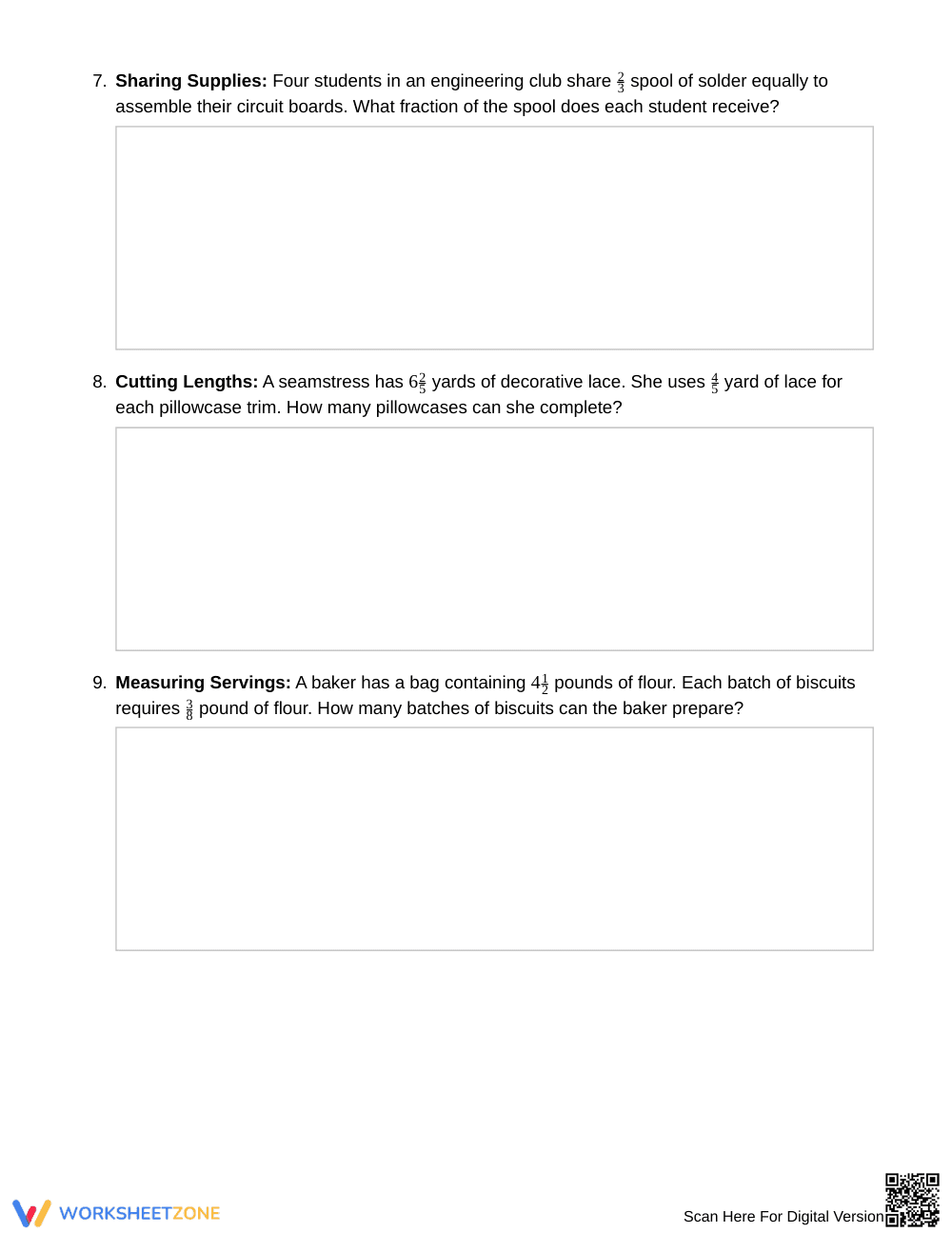
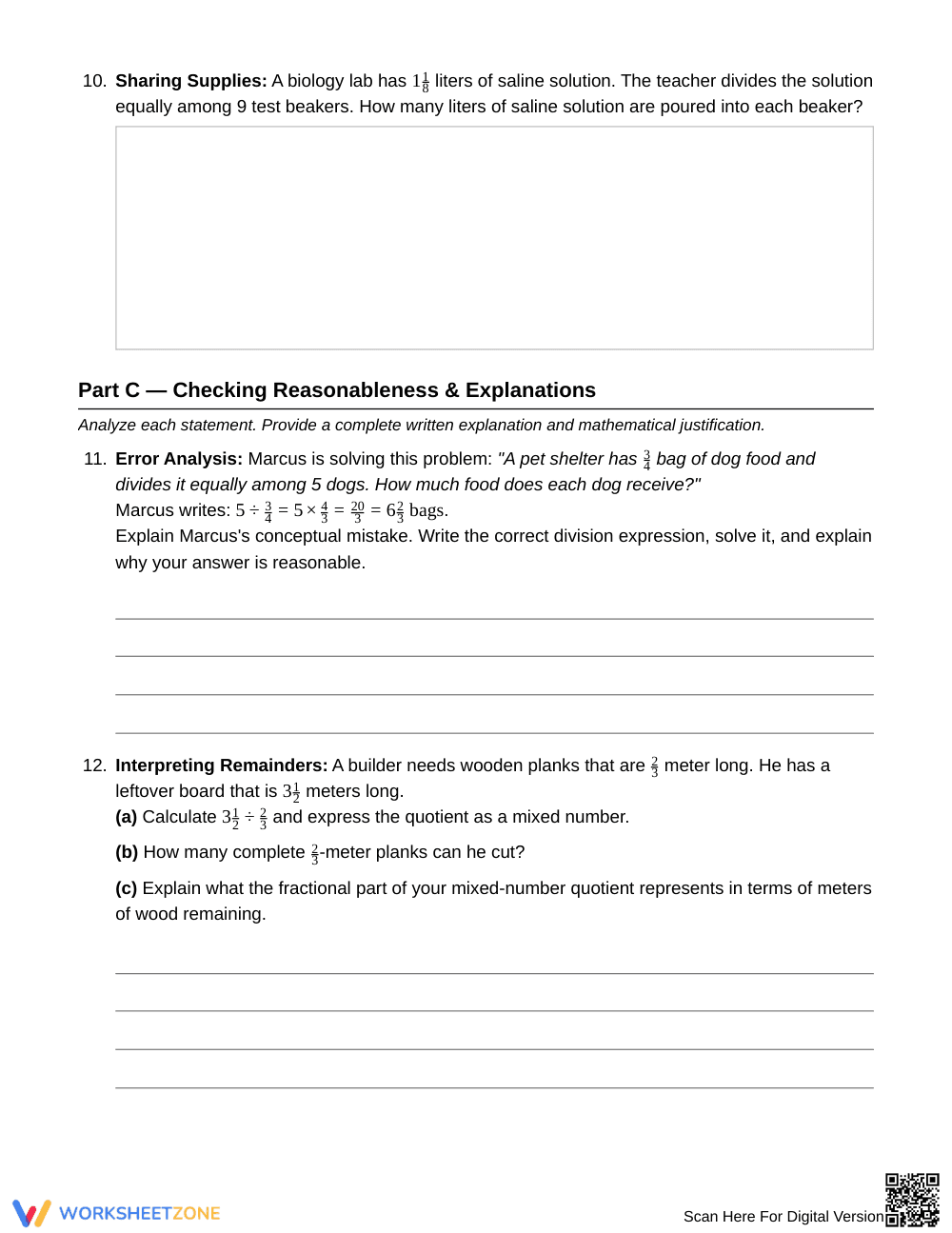
This targeted Grade 6 math worksheet strengthens students' ability to interpret real-world word problems and set up accurate fraction division equations. Students distinguish between measurement and partitive division models, apply reciprocal multiplication, and verify their reasoning using contextual problem-solving scenarios.
At a Glance
- Grade: 6 · Subject: Math
- Standard:
6.NS.A.1— Interpret and compute quotients of fractions to solve real-world word problems- Skill Focus: Translating fraction scenarios into division expressions
- Format: 5 pages · 12 problems · Answer key included · PDF
- Best For: Guided practice, intervention, or independent mastery
- Time: 40–50 minutes
What's Inside
This comprehensive 5-page printable resource includes 2 reference models, 12 rigorous student items, and a full 2-page answer key showing step-by-step calculations. The resource features clear formula definitions for measurement and partitive division, structured missing-step fill-ins, open-ended word problems, and conceptual reasoning prompts.
Skill Progression
- Guided Practice (Models 1 & 2): Fully worked reference examples demonstrating measurement division (cutting lengths) and partitive division (sharing quantities) with clear dividend and divisor labels.
- Supported Practice (Part A, Problems 1–4): Scaffolded missing-step completions where students fill in improper fractions, reciprocals, and intermediate division setups.
- Independent Practice & Reasoning (Parts B & C, Problems 5–12): Authentic word problems requiring original equation setups, unit labels, error analysis of common misconceptions, and interpretation of fractional remainders.
This structured sequence follows the gradual-release framework, moving learners from modeled instruction to autonomous contextual problem-solving.
Standards Alignment
Primary Standard: `6.NS.A.1` — Interpret and compute quotients of fractions, and solve word problems involving division of fractions by fractions, e.g., by using visual fraction models and equations to represent the problem. Both standard codes can be copied directly into lesson plans, IEP goals, or district curriculum mapping tools.
How to Use It
Deploy this worksheet during the core practice phase after introducing fraction division models, or assign Parts B and C as an independent check for understanding. As a formative assessment tip, check Part C to verify whether students can explain why dividing by a proper fraction yields a quotient larger than the dividend. The complete activity takes approximately 40 to 50 minutes.
Who It's For
This practice set serves general education sixth-grade math students, tiered math intervention groups, and resource room learners who benefit from explicit equation-setup frameworks. Pair this resource with a visual fraction bar anchor chart or hands-on fraction strip manipulatives during direct instruction.
According to research on scaffolded mathematics instruction by Fisher & Frey (2014), providing intermediate structured supports before independent problem execution significantly reduces student error rates in multi-step fraction operations. Grade 6 standard 6.NS.A.1 requires students to not only compute fraction quotients but also interpret what those values represent in real-world contexts. This worksheet directly builds that conceptual link by having students differentiate between sharing supplies equally (partitive division) and finding how many equal-sized groups can be cut from a total (measurement division). With explicit guided models, structured missing-step prompts, contextual word problems, and targeted error analysis, this resource equips middle school learners with the analytical tools needed to master complex rational number operations across varied problem structures.


