




























Views
Downloads




Complete Food Chains & Pyramids Worksheet | Grade 6 Science

Paste this activity's link or code into your existing LMS (Google Classroom, Canvas, Teams, Schoology, Moodle, etc.).
Students can open and work on the activity right away, with no student login required.
You'll still be able to track student progress and results from your teacher account.
Mastering ecological relationships requires students to track matter and energy across complex trophic systems. This four-page science worksheet provides twelve structured tasks using a meadow ecosystem profile. Students interpret food web arrows, compute kilocalorie transfer efficiency under the ten percent rule, and predict how trophic cascades alter community stability.
At a Glance
- Grade: 6 · Subject: Science
- Standard: Life Science — Trace energy flow and matter cycling through ecosystem food webs
- Skill Focus: Food Chains, Food Webs & Energy Pyramids: Interpret Feeding Connections
- Format: 4 pages · 12 problems · Answer key included · PDF
- Best For: Mid-unit practice or assessment review
- Time: 40–50 minutes
What's Inside
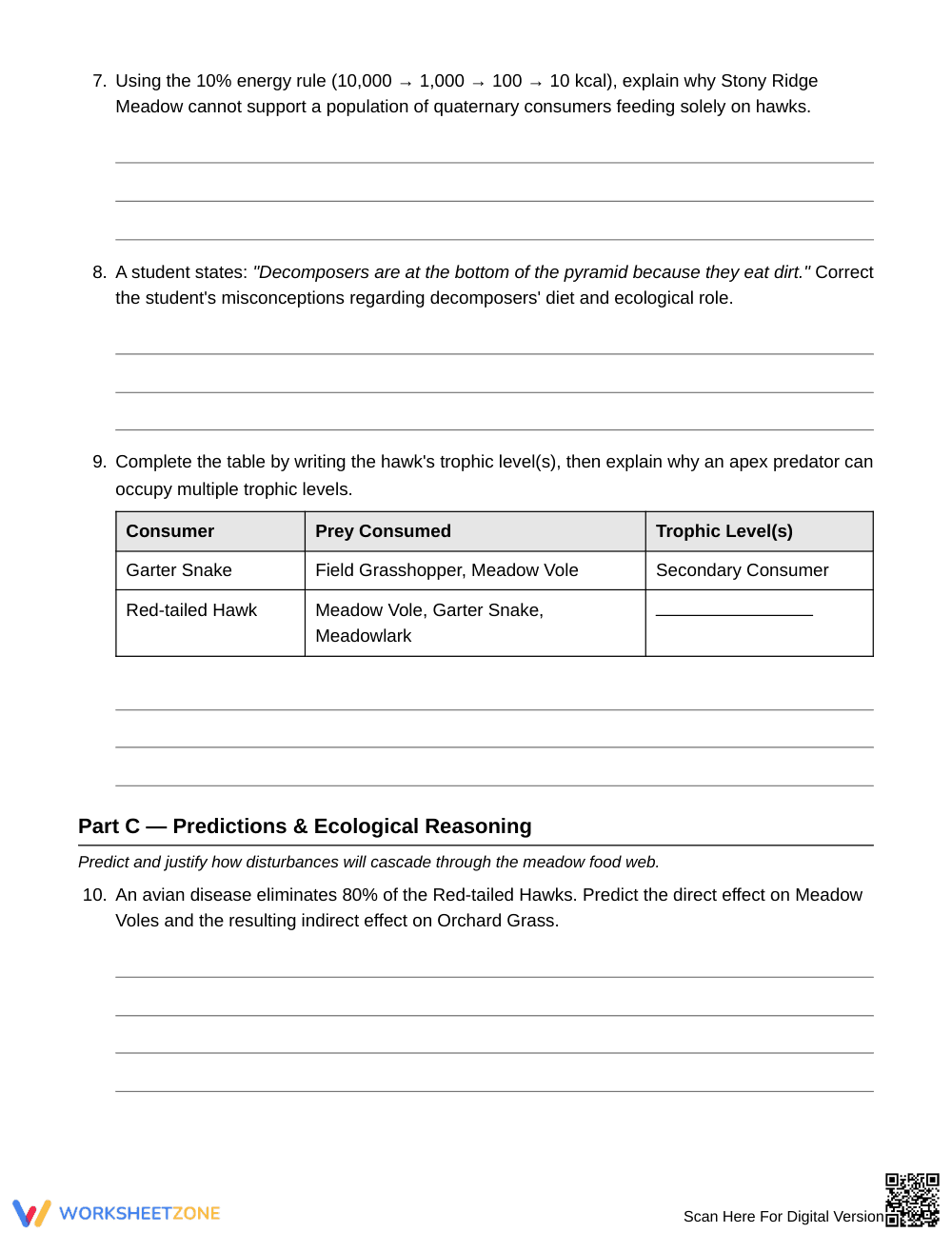
The activity opens with an ecosystem reference box detailing producers, consumers, and decomposers with annual kilocalorie metrics. Students complete multiple-choice identification items, trophic categorization prompts, percentage transfer calculations, misconception corrections, a predator analysis table, and disturbance prediction items. A comprehensive two-page answer key provides step-by-step mathematical solutions and biological explanations.
Skill Progression
- Guided Practice (Part A, 3 tasks): Students analyze arrow conventions, identify trophic roles from meadow data, and distinguish one-way energy dissipation from continuous matter cycling.
- Supported Practice (Part B, 6 tasks): Learners construct four-level chains, calculate transfer efficiency, explain metabolic heat loss, evaluate carrying capacity, and resolve decomposer misconceptions using tabular scaffolds.
- Independent Practice (Part C, 3 tasks): Students predict and justify downstream ecological impacts when predator disease, drought, and selective pesticide disruptions cascade through the food web.
This structured progression reflects the gradual release of responsibility model, guiding learners from conceptual identification toward independent systems modeling.
Standards Alignment
This resource aligns with middle school life science expectations requiring students to develop models describing the cycling of matter and flow of energy among living and nonliving parts of an ecosystem. Supporting standards address analyzing trophic interactions. This alignment can be copied directly into lesson plans, IEP goals, or district curriculum mapping tools.
How to Use It
Assign this worksheet directly after introducing trophic levels and food webs during instruction. As a formative assessment checkpoint during independent work, examine student responses to Part B's calculation task to verify whether students compute percentage loss accurately before moving to Part C's cascade prompts. The complete activity takes approximately 40 to 50 minutes.
Who It's For
This resource serves general education Grade 6 science classes, targeted remediation groups, and co-taught environments requiring clear organization. Pair this practice with an ecosystem energy flow anchor chart or an owl pellet dissection lab to solidify food web relationships.
Middle school science instruction demands that students interpret feeding connections and track energy transfer across complex ecosystems. Fisher & Frey (2014) demonstrate that structured scaffolding—transitioning purposefully from foundational role identification to quantitative energy loss calculations and open-ended disturbance predictions—significantly reinforces student acquisition of complex scientific frameworks. By working through twelve targeted tasks centered on an evidence-based meadow data set, sixth-grade learners systematically evaluate the directional flow of metabolic energy versus the closed cycling of environmental matter. Students calculate trophic efficiency rates, model apex predator multi-level feeding, and correct persistent misconceptions surrounding decomposer nutrient pathways, solidifying conceptual depth through applied problem solving. This rigorous four-page progression ensures that emerging adolescent scientists synthesize crosscutting concepts of energy and matter, preparing them to evaluate trophic cascades and ecological community stability with measurable academic precision across diverse classroom learning environments.


