


























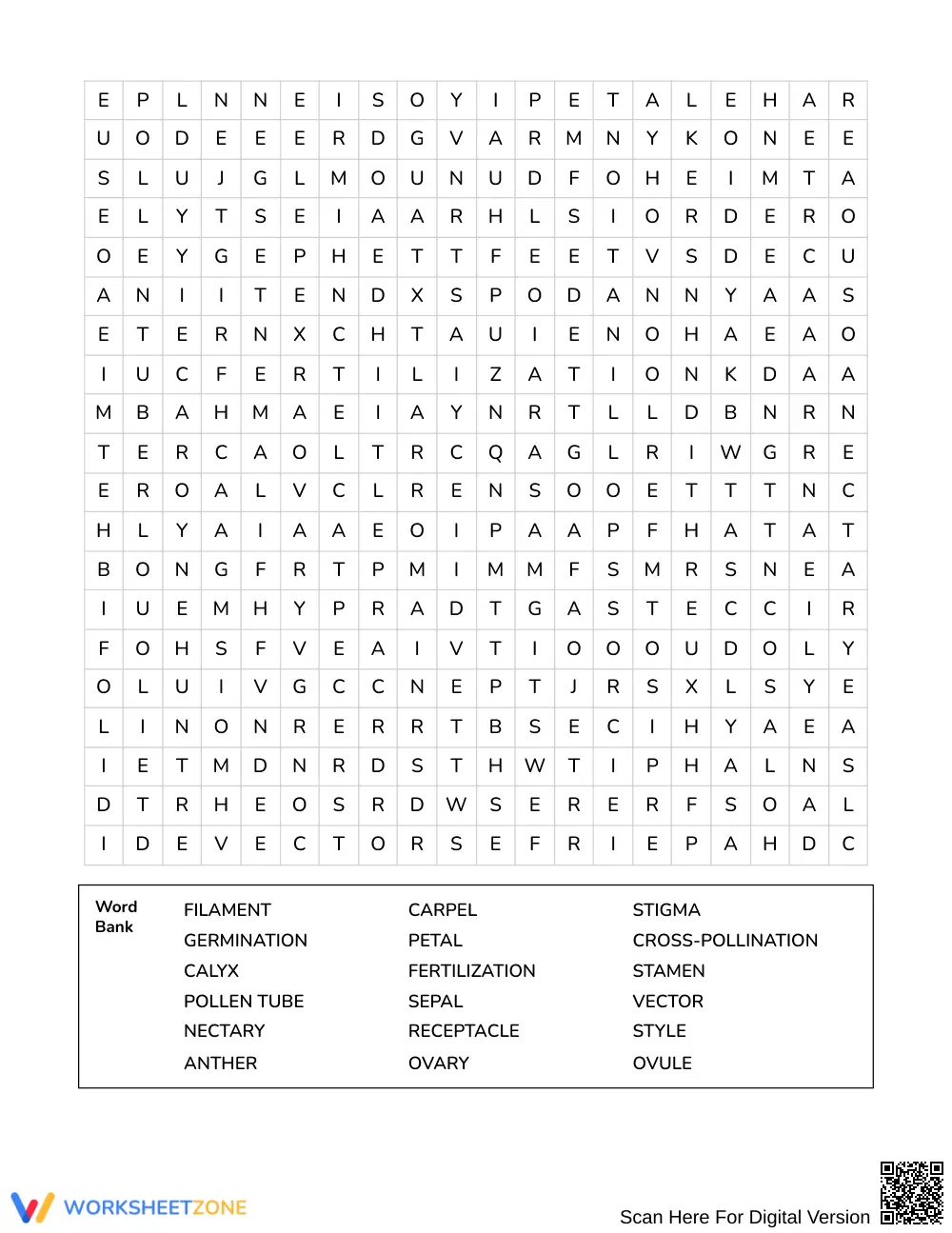

Complete Flower Anatomy Word Search | Grades 7–8 Science
Paste this activity's link or code into your existing LMS (Google Classroom, Canvas, Teams, Schoology, Moodle, etc.).
Students can open and work on the activity right away, with no student login required.
You'll still be able to track student progress and results from your teacher account.
This Grades 7–8 science word search reinforces plant biology terminology by challenging middle school students to connect botanical functions with precise anatomical structures. By defining and locating 18 core vocabulary terms, learners consolidate essential concepts surrounding floral reproduction, pollination mechanisms, and seed development before moving into broader life science assessments.
At a Glance
- Grade: Grades 7–8 · Subject: Science
- Standard: Not standards-assessed — vocabulary enrichment
- Skill Focus: Floral structures and their functions
- Format: 3 pages · 18 words · Answer key included · PDF
- Best For: Cumulative vocabulary review and early finishers
- Time: 25–35 minutes
What's Inside
This 3-page printable science resource contains a complete clue-driven vocabulary puzzle and a comprehensive answer key spread across subsequent reference pages. Rather than relying on a passive word bank, students must read 18 descriptive botanical clues to identify corresponding anatomical terms before searching for them in the letter grid.
Puzzle Mechanics & Design
The activity is built around a dense 20 × 20 letter grid designed to encourage active visual scanning and sustained focus. Hidden terms run in all 8 compass directions: North, Northeast, East, Southeast, South, Southwest, West, and Northwest, including forward, backward, and diagonal orientations. Students read challenging functional descriptions—such as identifying the female carpel, pollen tube growth, or cross-pollination vectors—deduce the correct scientific name, and circle the hidden entry within the grid.
Standards Alignment
This resource is designed specifically for vocabulary enrichment and conceptual review rather than formal standards assessment. Because it focuses on domain-specific terminology reinforcement across plant biology and reproductive anatomy units, it is not aligned to a specific state or national content standard.
How to Use It
Deploy this word search during independent seatwork following direct instruction on angiosperm life cycles, or assign it as an engaging mid-unit review station. For formative evaluation, circulate while students analyze the clues; check whether learners can identify structural terms like filament, sepal, and receptacle from the definitions alone before seeking spelling confirmation. The entire activity typically requires 25 to 35 minutes to complete.
Who It's For
This activity supports general science and introductory biology students across Grades 7–8. It offers accessible terminology reinforcement for English learners through functional definitions and provides a stimulating review task for advanced learners. Pair this puzzle with an authentic flower dissection lab or an illustrated botanical anchor chart.
Academic vocabulary acquisition in middle school life science requires structured exposure to precise terminology in diverse formats. According to Fisher & Frey (2014), intentional vocabulary review activities bridge the gap between initial concept exposure and long-term functional recall, particularly when students must actively interpret functional definitions before locating target words. This plant anatomy word search targets 18 essential botanical terms across an expansive 20 × 20 grid, prompting learners to analyze clues regarding reproductive organs, gamete conduits, and pollination vectors. By demanding active identification rather than passive copying, the resource solidifies scientific literacy and supports conceptual retention during plant structure units. The self-contained format provides clear visual practice suitable for middle school science classrooms seeking focused supplementary enrichment.


