



























Complete Fetal Pig Anatomy Worksheet | Grades 7-12 Science
Paste this activity's link or code into your existing LMS (Google Classroom, Canvas, Teams, Schoology, Moodle, etc.).
Students can open and work on the activity right away, with no student login required.
You'll still be able to track student progress and results from your teacher account.
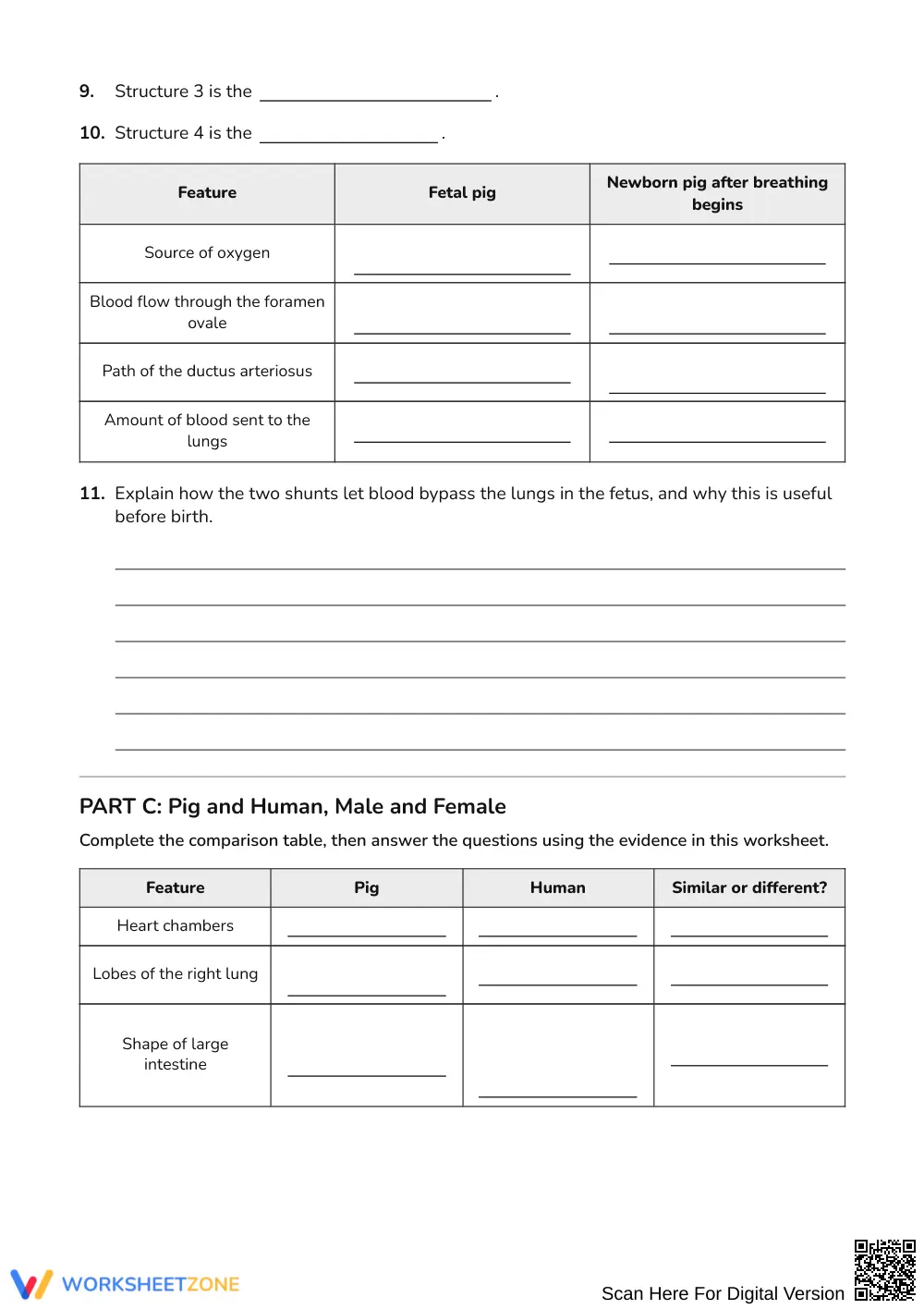
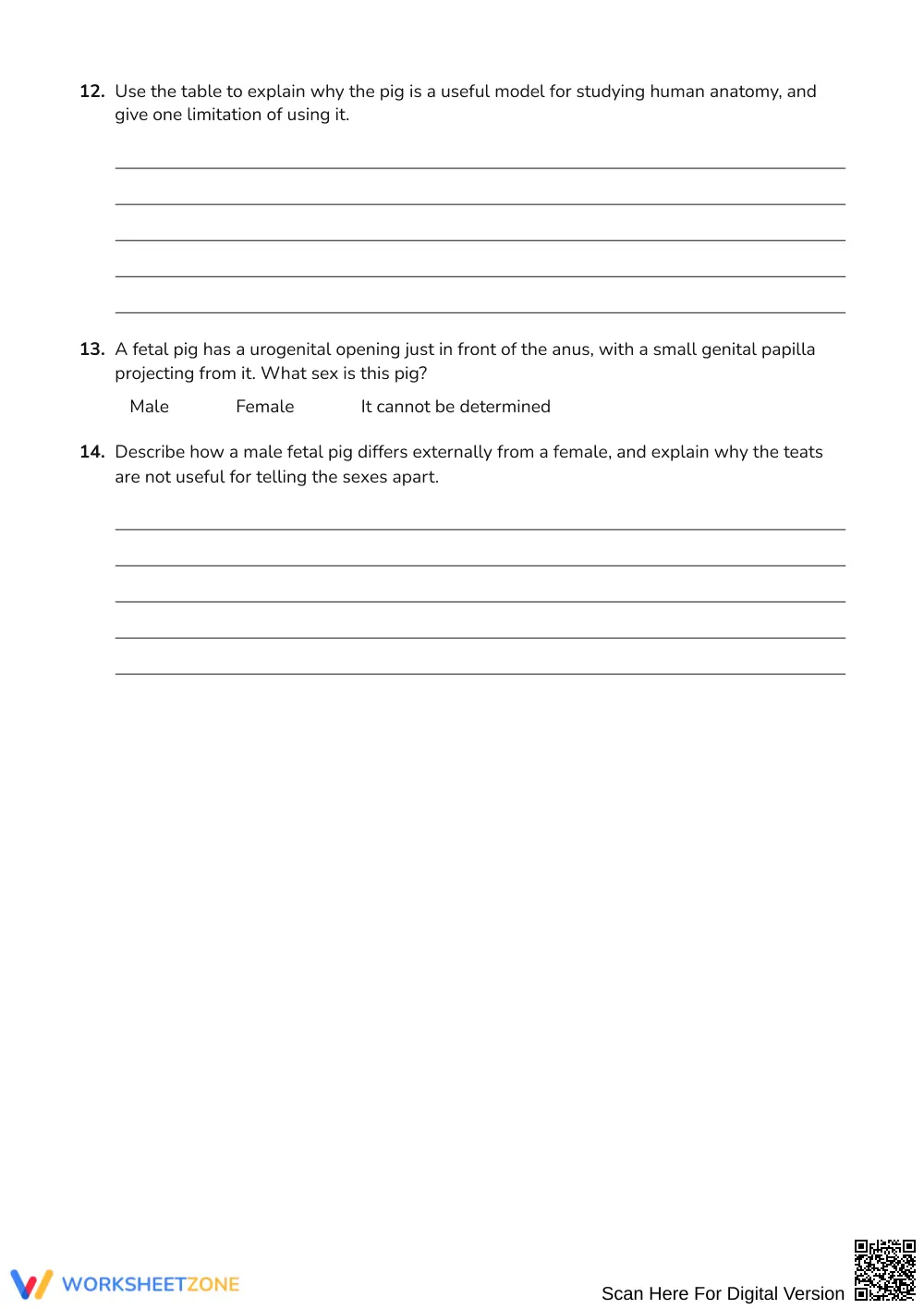
This comprehensive anatomy worksheet trains secondary biology students to analyze mammalian internal structures through comparative diagrams, anatomical identification, and functional analysis. Learners examine body cavities, track circulatory adaptations before and after birth, and evaluate anatomical homologies between fetal pigs and humans across 48 rigorous, structured questions.
At a Glance
- Grade: Grades 7–12 · Subject: Science / Biology
- Standard: Compare anatomical structures, physiological adaptations, and mammalian organ systems
- Skill Focus: Structure-function relationships and comparative anatomy
- Format: 4 pages · 48 problems · Answer key included · PDF
- Best For: Pre-lab preparation, lab review, or biology reinforcement
- Time: 45–60 minutes
What's Inside
This 4-page print-and-go resource includes detailed anatomical diagrams, targeted word banks, paired comparison charts, and analytical short-response questions. Students label visceral organs, contrast the thoracic and abdominal cavities, trace cardiovascular shunts like the ductus arteriosus and foramen ovale, and evaluate structural differences between porcine and human organs alongside a complete 4-page answer key.
Skill Progression
- Guided Practice: Tasks 1–15 guide students through anatomical identification of major visceral organs using labeled diagram cues, word banks, and cavity comparison matrices.
- Supported Practice: Tasks 16–32 require students to trace cardiovascular pathways, explain embryonic circulatory shunts, and compare prenatal versus postnatal blood flow.
- Independent Practice: Tasks 33–48 challenge learners to evaluate human-pig anatomical homologies, assess organ variations, and deduce specimen sex using external urogenital markers.
This sequence mirrors the gradual-release model, shifting students smoothly from scaffolded anatomical identification to independent physiological critique.
Standards Alignment
This resource aligns with secondary life science standards emphasizing structure-function relationships, hierarchical organization of multicellular organisms, and comparative physiological adaptations across developmental stages. Standard descriptions can be copied directly into lesson plans, IEP goals, or district curriculum mapping tools.
How to Use It
Assign this worksheet directly after direct instruction on mammalian body systems or as a mandatory pre-lab module before conducting a fetal pig dissection. During student independent work, circulate to observe whether students distinguish between pulmonary circulation pathways and fetal placental exchange. Expect completion to take between 45 and 60 minutes.
Who It's For
Designed for middle and high school life science, biology, and introductory anatomy classes. Teachers can support developing readers by pairing the worksheet with physical three-dimensional torso models or reference charts, while advanced biology students can complete the synthesis prompts as an independent dissection synthesis activity.
According to Fisher & Frey (2014), structured comparative analysis solidifies conceptual retention when secondary students contrast related physiological processes rather than memorizing isolated anatomical labels. This 4-page science resource grounds high school and middle school learners in purposeful biological comparison by systematically evaluating the thoracic cavity alongside the abdominal cavity and tracing fetal circulatory shunts against adult cardiovascular flow. By engaging with 48 distinct analytical prompts, students examine how organ placement, tissue boundaries, and systemic circulation cooperate to sustain homeostasis. The guided progression moves learners from diagram-based identification into sophisticated, evidence-based evaluations of mammalian organ homology and external sex differentiation. This deliberate pedagogical design delivers verifiable mastery of comparative anatomy, equipping students with the exact analytical framework necessary for successful laboratory dissections and rigorous life science examinations.


