


































Complete Feasible Region Worksheet | Grade 9 Algebra I

Paste this activity's link or code into your existing LMS (Google Classroom, Canvas, Teams, Schoology, Moodle, etc.).
Students can open and work on the activity right away, with no student login required.
You'll still be able to track student progress and results from your teacher account.
This Algebra I worksheet equips ninth-grade students to model realistic constraints by writing linear inequalities and testing coordinate feasibility. Learners define variables, formulate systems representing budget limits and hourly caps, and evaluate whether specified combinations satisfy all conditions, bridging abstract inequalities with real-world decision-making.
At a Glance
- Grade: 9 · Subject: Algebra I
- Standard:
HSA-CED.A.3— Represent constraints with equations or inequalities and interpret solutions as viable options- Skill Focus: Model a Budget-and-Time Feasible Region
- Format: 6 pages · 10 problems · Answer key included · PDF
- Best For: Linear inequality systems practice
- Time: 45–55 minutes
What's Inside
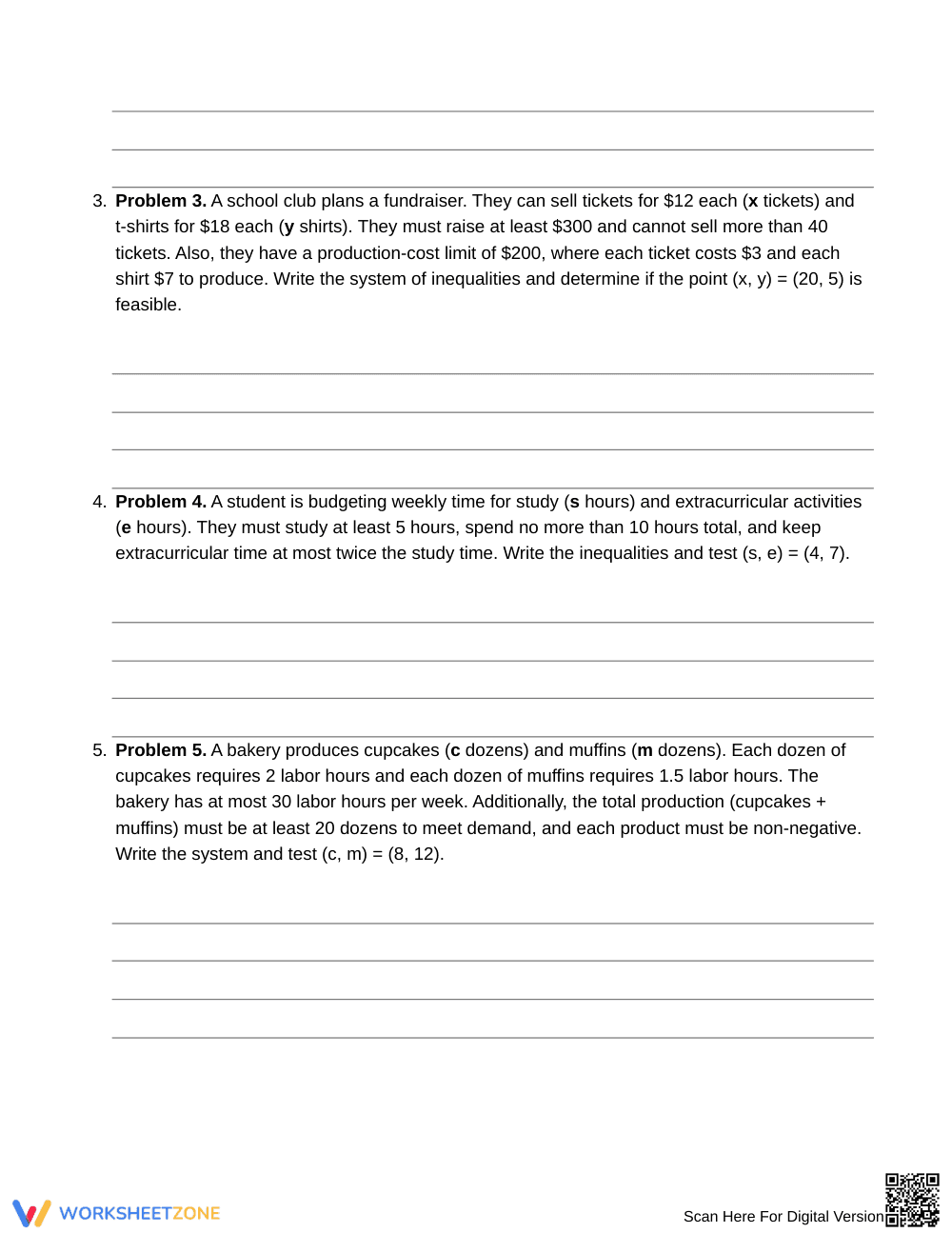
The 6-page document provides a structured 10-problem assignment and a comprehensive 4-page answer key. Students analyze real-world scenarios spanning personal budgets, work shifts, agriculture, and business operations. A worked introductory example establishes the protocol for defining variables, writing non-negativity boundaries, constructing inequality systems, and testing ordered pairs for feasibility.
Skill Progression
- Guided practice (Problems 1–2): Students define basic variables and write budget or hourly constraints alongside explicit non-negativity limits with minimal complexity.
- Supported practice (Problems 3–6): Scenarios introduce multi-constraint systems combining revenue minimums, inventory ceilings, and labor hours, requiring point testing for feasibility.
- Independent practice (Problems 7–10): Complex real-world applications featuring larger monetary figures and mixed resource limitations challenge students to construct complete systems and assess boundary viability autonomously.
This deliberate sequence follows a gradual-release framework, enabling learners to master constraint formulation before evaluating multi-variable viability.
Standards Alignment
This resource aligns directly with HSA-CED.A.3: Represent constraints by equations or inequalities, and by systems of equations and/or inequalities, and interpret solutions as viable or nonviable options in a modeling context. Both standard codes can be copied directly into lesson plans, IEP goals, or district curriculum mapping tools.
How to Use It
Deploy this activity during guided practice following direct instruction on systems of linear inequalities, or assign it as an independent station during collaborative group work. During class, monitor whether students remember to include non-negativity constraints like x ≥ 0 and y ≥ 0. Expected completion time is 45 to 55 minutes.
Who It's For
This worksheet is designed for Grade 9 Algebra I students learning to contextualize linear inequalities. It accommodates diverse learners through structured word problems, offering scaffolding for developing math students and analytical depth for on-grade peers. Pair this resource with graph paper or an inequality graphing anchor chart.
According to research on scaffolded mathematical instructional models by Fisher & Frey (2014), students develop higher quantitative fluency when contextual constraints are systematically translated into algebraic inequalities prior to graphing. This resource addresses HSA-CED.A.3 by guiding learners through defining variables, establishing system boundaries, and determining whether specific coordinate pairs represent viable solutions within real-world contexts. By evaluating feasible regions across multi-variable budgets, work hours, and resource allocations, high school students transition from rote symbolic manipulation to applied problem-solving. Structured practice that requires checking points against non-negativity limits alongside operational ceilings ensures conceptual mastery of linear systems. Implementing structured constraint modeling provides secondary educators with measurable data on student algebraic readiness, supporting comprehensive preparation for advanced linear programming and coordinate geometry coursework while directly reinforcing standards-aligned analytical reasoning skills across diverse secondary learning settings.


