




























Complete Family Relations Word Search | Grades 7–8 ELA
Paste this activity's link or code into your existing LMS (Google Classroom, Canvas, Teams, Schoology, Moodle, etc.).
Students can open and work on the activity right away, with no student login required.
You'll still be able to track student progress and results from your teacher account.
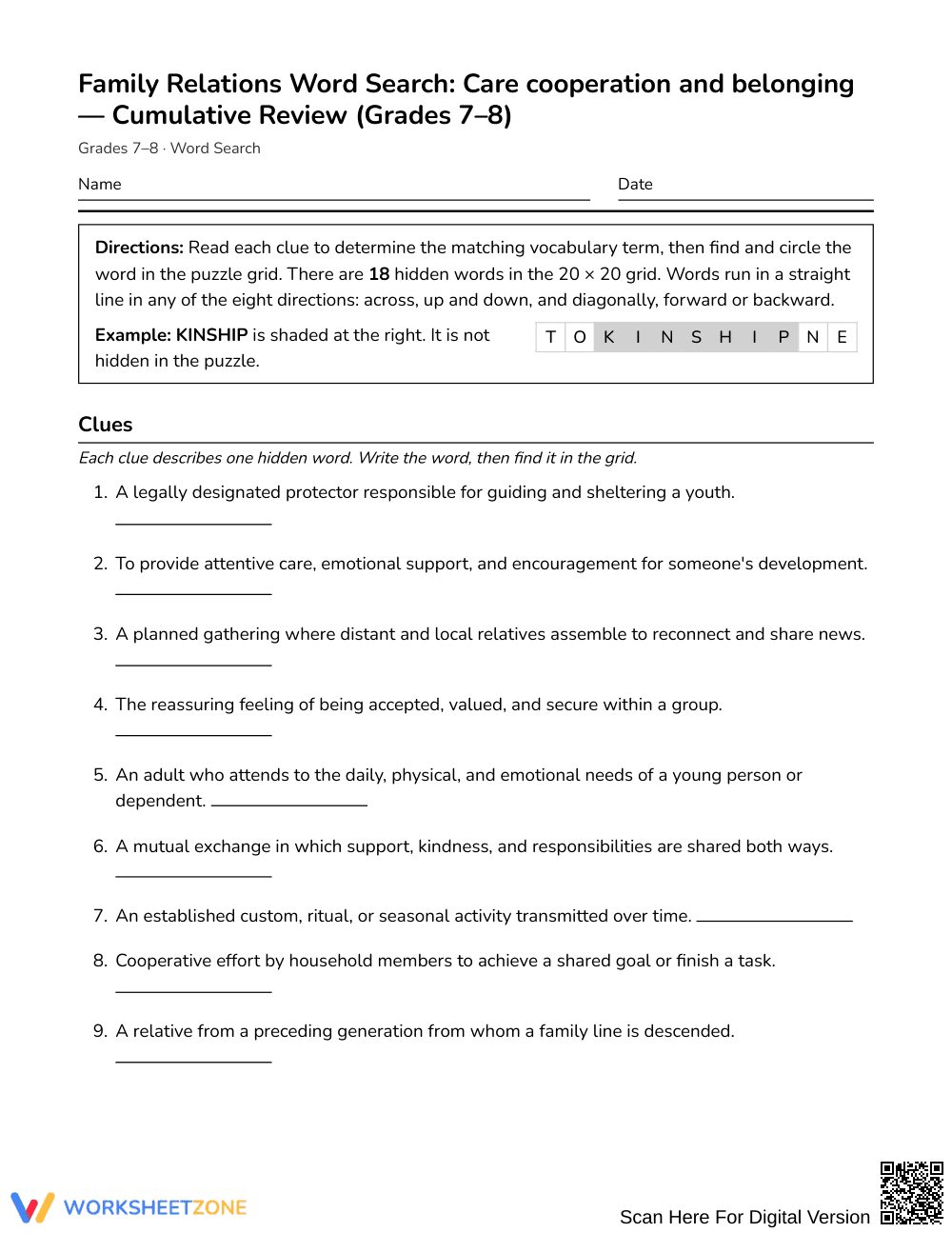
This Grades 7–8 vocabulary word search builds essential knowledge around family relations, care, cooperation, and belonging through meaningful definition matching. Students analyze 18 clue definitions to identify targeted terms before searching for them in an expanded letter grid. It reinforces relationship concepts, supports literacy development, and provides engaging independent practice.
At a Glance
- Grade: Grades 7–8 · Subject: English Language Arts (ELA)
- Standard: Not standards-assessed — vocabulary enrichment for middle school readers
- Skill Focus: Family relations, care, cooperation, and community belonging
- Format: 3 student pages · 18 words · Full answer key included · Printable PDF
- Best For: Vocabulary review, sub plans, and fast-finisher enrichment
- Time: 25–35 minutes
What's Inside
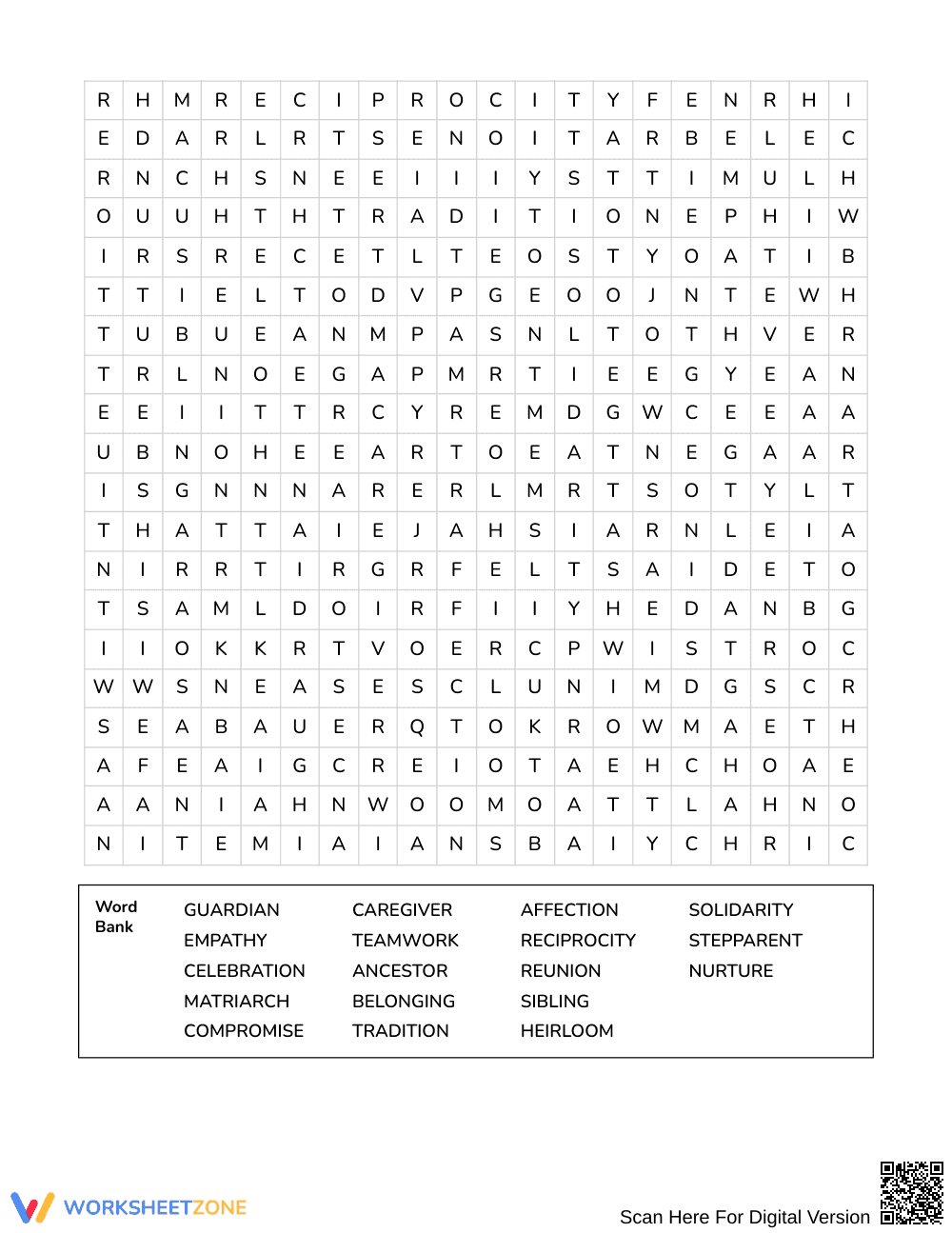
This 3-page word search activity provides an engaging vocabulary puzzle featuring 18 words centered on familial support, social bonds, and caregiving. Rather than scanning a simple word bank, students read 18 precise definitions covering terms such as reciprocity, solidarity, empathy, and matriarch to deduce each target word. The packet features a complete four-page answer key that clearly displays word locations for fast checking.
Puzzle Mechanics
Students work with a challenging 20 x 20 letter grid designed to reinforce word recognition and spelling. Each of the 18 vocabulary words is hidden across eight possible directions: north, northeast, east, southeast, south, southwest, west, and northwest. To find each term, students consult a comprehensive list of clues, identifying the matching vocabulary word before tracking it down within the grid.
Standards Alignment
This word search is designed specifically for vocabulary enrichment and is not aligned to a formal academic content standard. It emphasizes conceptual understanding, domain-specific terminology, and contextual definition recall to expand student communication skills across middle school English Language Arts units.
How to Use It
Introduce this word search after direct instruction on interpersonal themes in literature to consolidate key relationship concepts. It also works as a standalone activity for substitute lesson plans or mid-unit vocabulary review. During class completion, observe whether students read the clue definitions first or jump directly to the grid; prompt learners to verify definitions to ensure conceptual mastery. Most students complete the puzzle in 25 to 35 minutes.
Who It's For
This resource is crafted for Grades 7–8 students studying family dynamics, personal identity, and community structures in ELA. For students needing additional support, teachers can highlight the initial letters of select terms directly on the grid. Pair this word search with an introductory character analysis passage or family dynamics anchor chart to bridge vocabulary acquisition with literary comprehension.
Designed for Grades 7–8 English Language Arts, this 3-page word search provides targeted vocabulary enrichment focused on care, cooperation, and family belonging. Rather than functioning as a standard-aligned assessment, the resource enriches academic vocabulary through active retrieval across 18 specialized terms, including reciprocity, solidarity, and empathy. Students engage in contextual reasoning by matching detailed clue definitions to corresponding terms before locating them within a multi-directional 20 x 20 puzzle grid. According to Fisher & Frey (2014), intentional vocabulary exposure that pairs clear definitions with orthographic engagement significantly strengthens word consciousness and long-term semantic retention in adolescent learners. The inclusion of an explicit clue-to-term structure encourages students to process nuanced meanings rather than scanning for letters in isolation. With an included four-page answer key, this resource offers a reliable, low-prep tool for literacy centers, sub plans, and independent reinforcement.


