




























Complete Family Relations Word Search | Grades 7–8 ELA
Paste this activity's link or code into your existing LMS (Google Classroom, Canvas, Teams, Schoology, Moodle, etc.).
Students can open and work on the activity right away, with no student login required.
You'll still be able to track student progress and results from your teacher account.
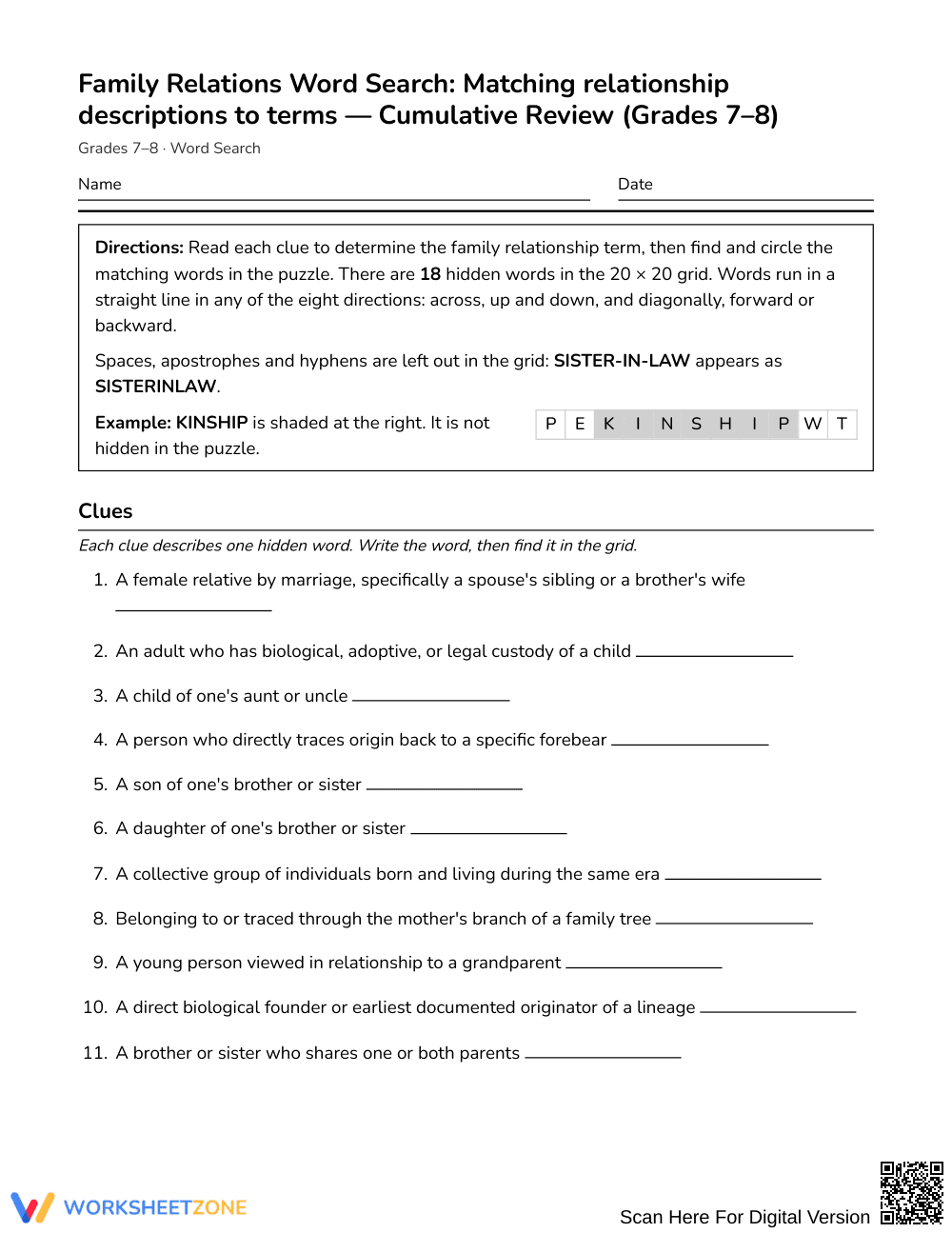
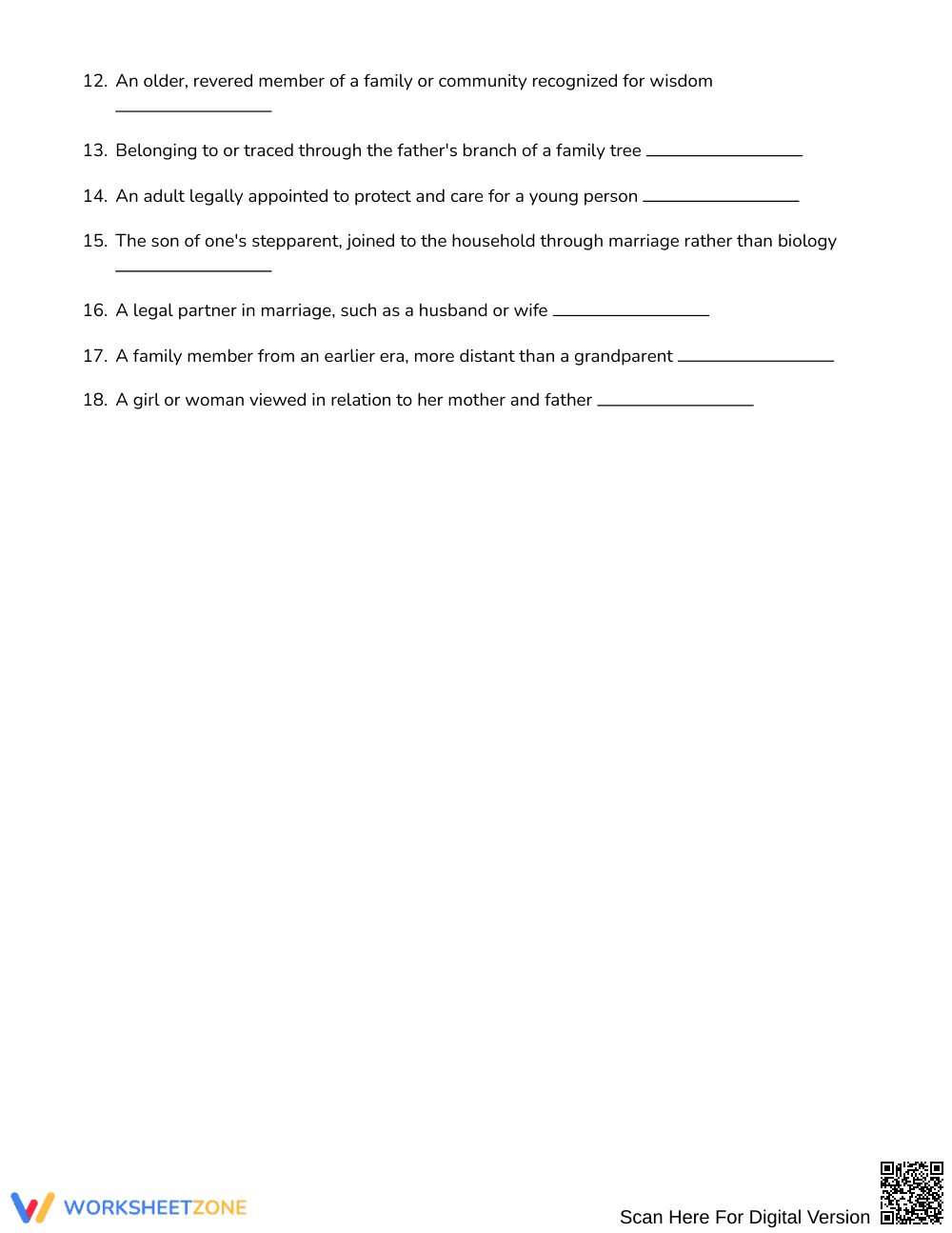
This Grades 7–8 vocabulary word search builds word consciousness and semantic precision by challenging students to connect descriptive definitions with formal kinship vocabulary. Students read eighteen contextual definitions, identify the corresponding family relationship terms, and locate each term within the letter grid, reinforcing precise word recognition, domain-specific spelling, and relational comprehension.
At a Glance
- Grade: Grades 7–8 · Subject: ELA
- Standard: Not standards-assessed — targeted vocabulary enrichment and review
- Skill Focus: Matching relationship descriptions to specialized kinship terms
- Format: 3 pages · 18 words · Complete 3-page answer key included · PDF document
- Best For: Middle school vocabulary reinforcement, sub plans, and independent work
- Time: 20–30 minutes of focused student practice
What's Inside
This 3-page printable resource includes an 18-word search puzzle paired with substantive definitional clues, accompanied by a dedicated 3-page answer key with circled solutions. Rather than merely scanning a list, students read thorough relationship descriptions to recall terms such as progenitor, descendant, paternal, and maternal before searching the puzzle.
Puzzle Mechanics and Structure
The puzzle features an expansive 20-by-20 letter grid designed to engage middle school learners in sustained visual scanning and spelling retrieval. Hidden vocabulary words run in all eight possible compass directions: north, northeast, east, southeast, south, southwest, west, and northwest. A shuffled word bank provides reference support, while the clue-driven format requires learners to actively verify definitions rather than passively copy letter strings.
Standards Alignment
This educational activity is designed specifically for vocabulary enrichment rather than formal standards assessment. While not tied to an individual state code, it supports cumulative middle school English Language Arts objectives by strengthening morphological awareness, definitional accuracy, and contextual word association across multisyllabic academic terms.
How to Use It
Deploy this activity as an engaging review station after direct instruction on character genealogies in literature, or utilize it as a low-stress bell ringer during a family heritage unit. During independent work time, observe whether students identify terms directly from the descriptive clues before looking at the word bank, noting which learners struggle to distinguish terms like ancestor and progenitor. Expect students to complete the puzzle in 20 to 30 minutes.
Who It's For
This word search is tailored for Grades 7–8 students developing advanced relational vocabulary. For struggling readers, teachers can highlight root words within the clues, while advanced learners can compose original sentences using each term. Pair this resource with a character family tree analysis during a complex novel study to bridge vocabulary acquisition with literary analysis.
Vocabulary enrichment activities that require matching relationship descriptions to terms promote robust lexical acquisition and orthographic memory in middle school classrooms. According to Fisher & Frey (2014), intentional vocabulary instruction yields the greatest retention when students engage in multiple exposures that connect conceptual definitions with active cognitive processing rather than isolated memorization. This Grades 7–8 word search operationalizes that principle by requiring learners to decode eighteen precise kinship descriptions, deduce the corresponding academic vocabulary words, and locate their letter patterns across an eight-directional grid. By transforming passive word searching into a clue-based retrieval task, the resource reinforces spelling patterns, structural morphology, and semantic distinctions among complex relational concepts such as progenitors, ancestors, and descendants. Teachers can effectively incorporate this printable vocabulary puzzle into literacy rotations, literary character studies, or independent practice routines to foster word consciousness, deepen reading comprehension, and support long-term semantic retention across diverse student cohorts.


