




























Views
Downloads



Complete Exponential Models Worksheet | Grade 11 Algebra II

Paste this activity's link or code into your existing LMS (Google Classroom, Canvas, Teams, Schoology, Moodle, etc.).
Students can open and work on the activity right away, with no student login required.
You'll still be able to track student progress and results from your teacher account.
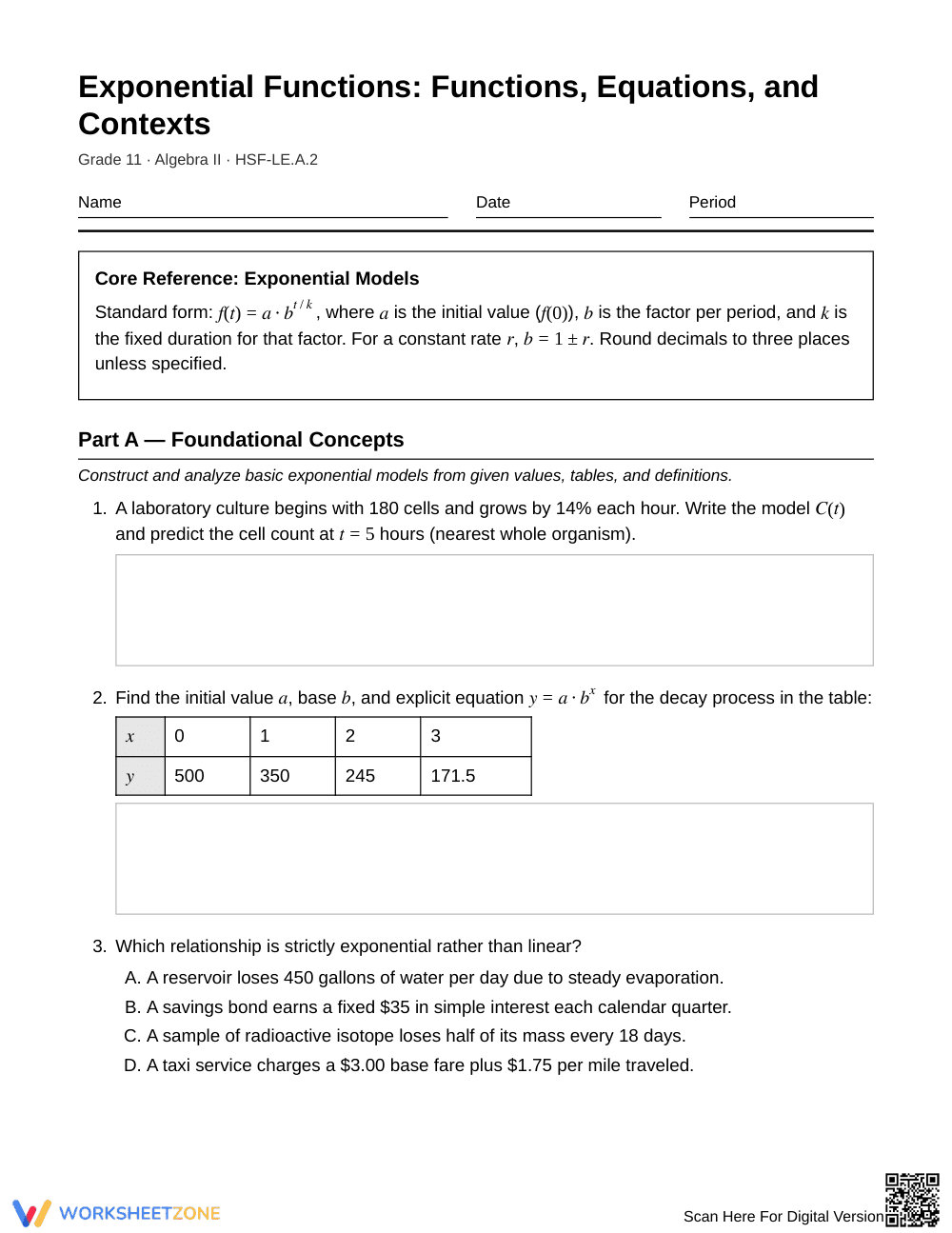
This comprehensive Algebra II worksheet equips Grade 11 students to construct, analyze, and apply exponential functions across diverse real-world contexts. Learners develop fluency transitioning between verbal scenarios, coordinate pairs, data tables, and algebraic formulas while mastering both continuous and discrete decay and growth models.
At a Glance
- Grade: 11 · Subject: Algebra II
- Standard:
HSF-LE.A.2— Construct linear and exponential functions given graphs, descriptions, or tables- Skill Focus: Exponential Functions and Contexts
- Format: 4 pages · 16 problems · Answer key included · PDF
- Best For: Guided modeling practice and skill synthesis
- Time: 45–60 minutes
What's Inside
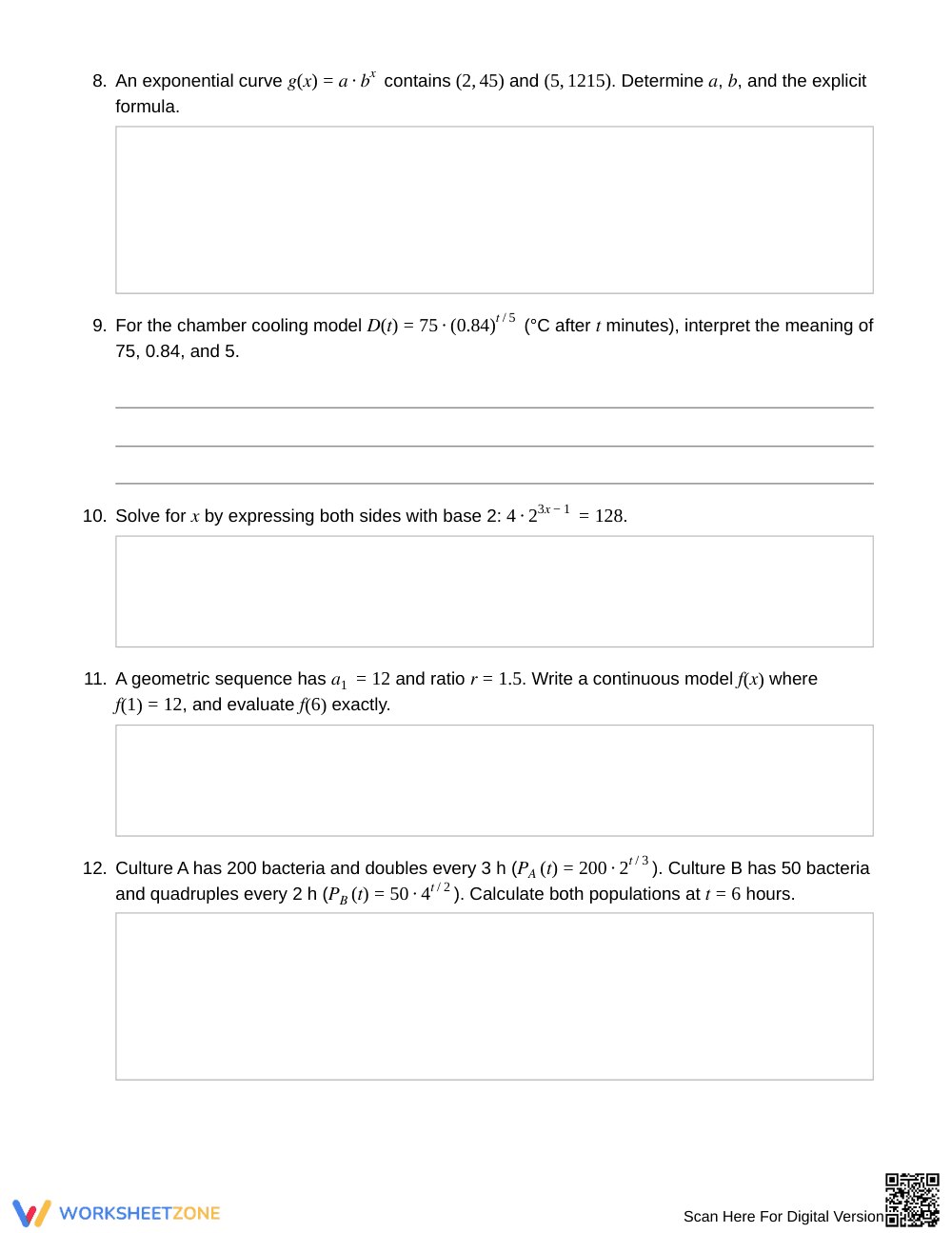
The 4-page printable document features 16 rigorous problems organized into three progressive sections, supported by a standard formula reference header defining initial values, growth factors, and time periods. It integrates multiple representations including data tables, coordinate graphs, base-equivalence equations, and multi-step word problems spanning biology, physics, and financial depreciation. A complete 2-page worked answer key provides immediate verification for all solutions.
Skill Progression
- Guided Practice (Part A — 4 Tasks): Foundational tasks prompt students to identify exponential behaviors versus linear models, derive equations from tables, and write basic growth formulas from direct verbal definitions.
- Supported Practice (Part B — 8 Tasks): Intermediate modeling problems require selecting algebraic methods to solve for base values, interpret rate parameters, extract points from graphs, and equate exponential bases.
- Independent Practice (Part C — 4 Tasks): Advanced synthesis prompts challenge students to construct multi-period decay functions, project real-world population growth, and evaluate contextual domains.
This structured progression reflects the gradual release of responsibility model, ensuring students master foundational parameter identification before tackling multi-step contextual modeling.
Standards Alignment
This resource aligns directly with `HSF-LE.A.2`, which requires students to construct linear and exponential functions, including arithmetic and geometric sequences, given a graph, a description of a relationship, or two input-output pairs. It also reinforces `HSF-LE.B.5` by requiring learners to interpret parameters within contextual decay and growth formulas. Both standard codes can be copied directly into lesson plans, IEP goals, or district curriculum mapping tools.
How to Use It
Deploy this worksheet directly after introducing the standard exponential form f(t) = a(b)^(t/k) during direct instruction. Use Part A and Part B for paired cooperative problem-solving, monitoring whether students correctly distinguish the growth factor base from the percentage rate of increase. Assign Part C as an independent formative check or summative exit task. Expected student completion time ranges between 45 and 60 minutes.
Who It's For
Designed for Grade 11 Algebra II students, this resource accommodates standard classes, honors preparation, and targeted intervention groups. Scaffolding embedded in the reference header assists struggling learners, while multi-step application items provide extension for advanced students. Pair this worksheet naturally with an anchor lesson on logarithmic solving or exponential graphing transformations.
Mastering exponential function construction under standard `HSF-LE.A.2` represents a pivotal milestone in secondary mathematics. According to research synthesized by Fisher & Frey (2014) on effective instructional scaffolding, structured problem progressions that transition deliberately from guided parameter identification to independent multi-step modeling significantly improve student retention of abstract algebraic principles. By confronting non-standard time periods, percentage changes, and contextual decay models within 16 targeted tasks, learners build conceptual flexibility across tabular, graphic, and verbal representations. The accompanying reference guides and step-by-step answer key support self-regulated error analysis, reinforcing mathematical reasoning required in advanced coursework such as Precalculus and AP Statistics. This resource establishes rigorous alignment with state standards while supporting diverse instructional settings through explicit modeling frameworks and clear procedural scaffolds.


