




























Views
Downloads



Complete Exponential Model Worksheet | Grade 11 Algebra II

Paste this activity's link or code into your existing LMS (Google Classroom, Canvas, Teams, Schoology, Moodle, etc.).
Students can open and work on the activity right away, with no student login required.
You'll still be able to track student progress and results from your teacher account.
This Grade 11 Algebra II worksheet helps students justify choosing an exponential model over a linear one in real-world contexts. Across 8 structured problems, students evaluate mathematical claims, test consecutive differences against equal ratios, and prove model validity using algebraic reasoning.
At a Glance
- Grade: 11 · Subject: Algebra II
- Standard:
HSF-LE.A.1— Prove that linear functions grow by equal differences and exponential functions by equal factors- Skill Focus: Justify an Exponential Model Choice
- Format: 5 pages · 8 problems · Answer key included · PDF
- Best For: High school advanced model evaluation practice
- Time: 45–60 minutes
What's Inside
This 5-page resource includes a criteria reference box alongside 8 multi-part problems. Students evaluate claims, analyze data tables, and construct proofs across three parts. A complete 2-page answer key provides step-by-step ratio tests, formulas, and explanatory solutions.
Skill Progression
- Guided practice (Problems 1–2): Students analyze claims regarding bacterial growth and asset depreciation, using the criteria box to identify constant differences versus constant percentage rates.
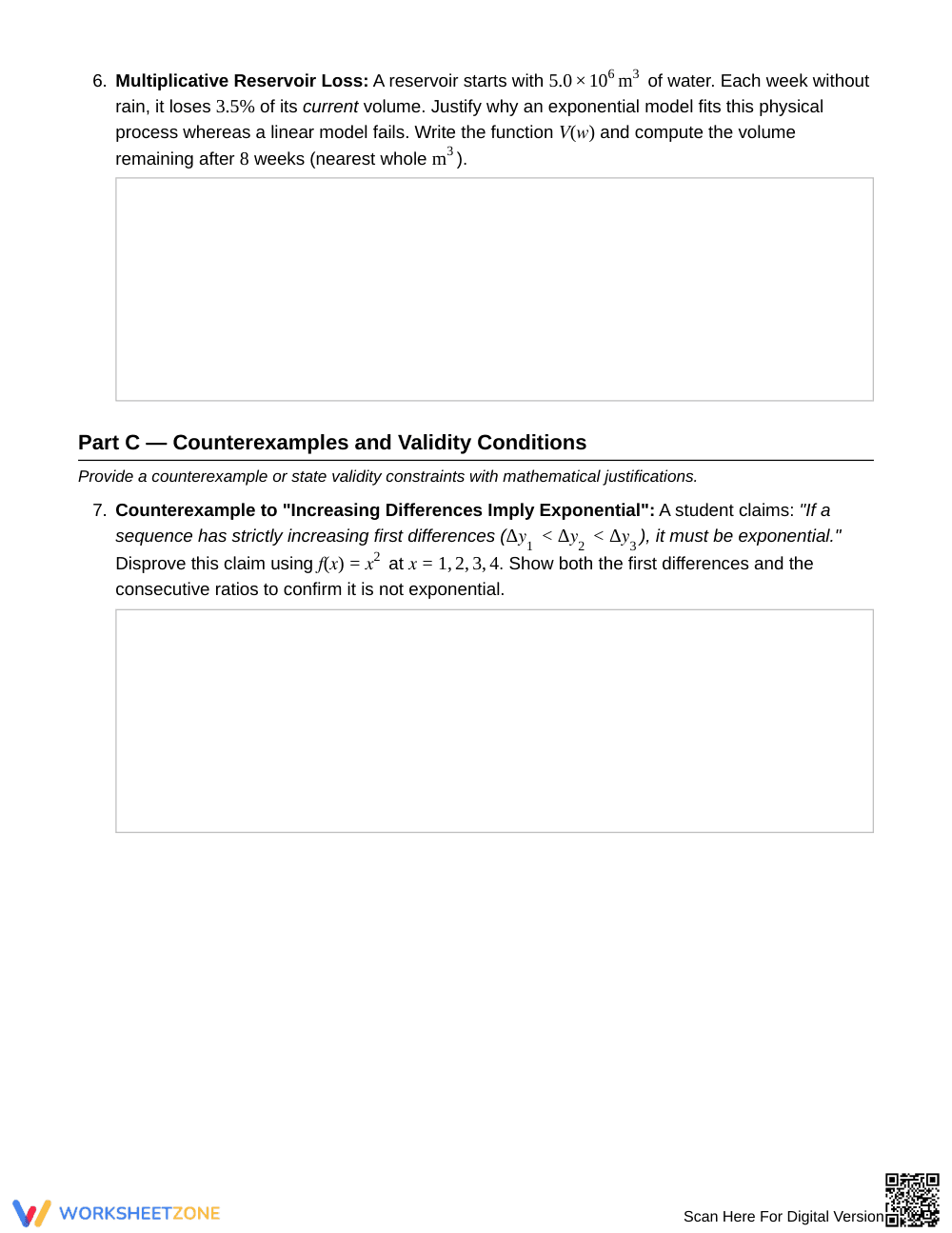
- Supported practice (Problems 3–6): Learners examine tables on drug clearance, compound interest, and lichen growth, computing multi-interval ratios and deriving growth parameters.
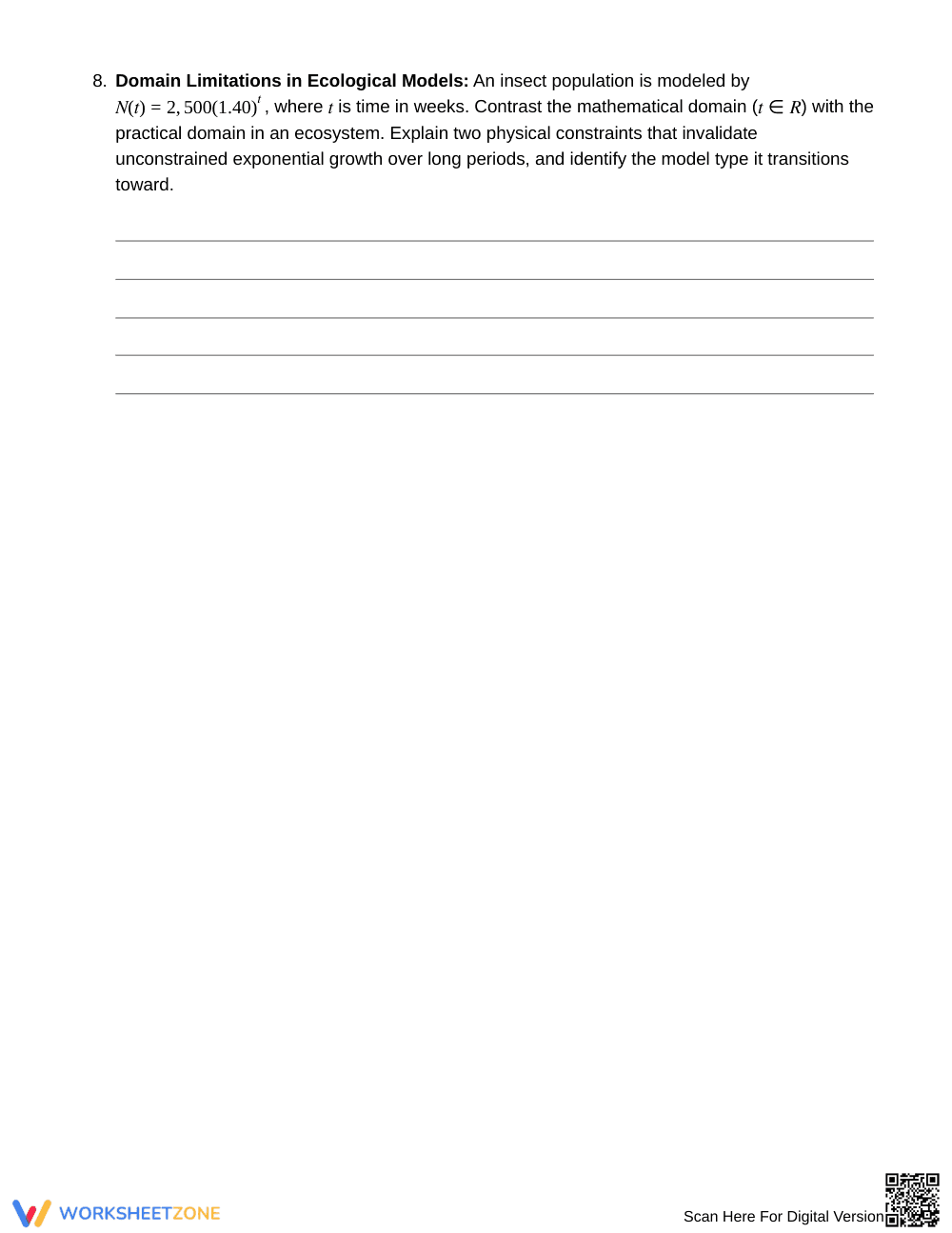
- Independent practice (Problems 7–8): Students build counterexamples using quadratic sequences and evaluate carrying capacity constraints in ecological populations.
This gradual-release structure guides students from evaluating claims to constructing independent mathematical arguments.
Standards Alignment
This worksheet aligns directly to HSF-LE.A.1, which requires students to prove that linear functions grow by equal differences over equal intervals, while exponential functions grow by equal factors over equal intervals. It also supports HSF-LE.A.1b by examining scenarios involving constant percent growth rates. Both standard codes can be copied directly into lesson plans, IEP goals, or district curriculum mapping tools.
How to Use It
Use this worksheet after direct instruction on exponential growth as structured classwork or an assessment. During group work, observe whether students check consecutive differences or ratios on discrete tables; testing differences on exponential data reveals misconceptions regarding additive change. The full set takes 45 to 60 minutes.
Who It's For
This resource is designed for eleventh-grade Algebra II and Precalculus students mastering function families. Support struggling learners by reviewing the reference criteria with graphing tools to contrast curves. Pair this activity with a follow-up lesson on logarithmic regression.
Mastering exponential model justification under standard HSF-LE.A.1 demands that high school students move beyond curve-fitting to verify mathematical structures. According to Fisher & Frey (2014), structured gradual-release frameworks significantly enhance student capacity to articulate disciplinary justifications and defend quantitative models. This 5-page Algebra II instructional resource equips eleventh-grade learners to distinguish additive growth from multiplicative scaling through consecutive ratio testing, algebraic derivation, and counterexample analysis. By systematically decomposing claims across 8 multi-tiered tasks, students learn to recognize constant percentage change, compute fractional growth factors, and establish domain boundaries in authentic physical contexts. The accompanying 2-page answer key details full ratio proofs and diagnostic reasoning, making the resource an ideal vehicle for developing rigorous mathematical argumentation. Educators can utilize these materials during guided practice or summative review to ensure high schoolers achieve lasting conceptual fluency with exponential functions.


