































Complete Error Analysis by 2s Worksheet | Grade 3 Math

Paste this activity's link or code into your existing LMS (Google Classroom, Canvas, Teams, Schoology, Moodle, etc.).
Students can open and work on the activity right away, with no student login required.
You'll still be able to track student progress and results from your teacher account.
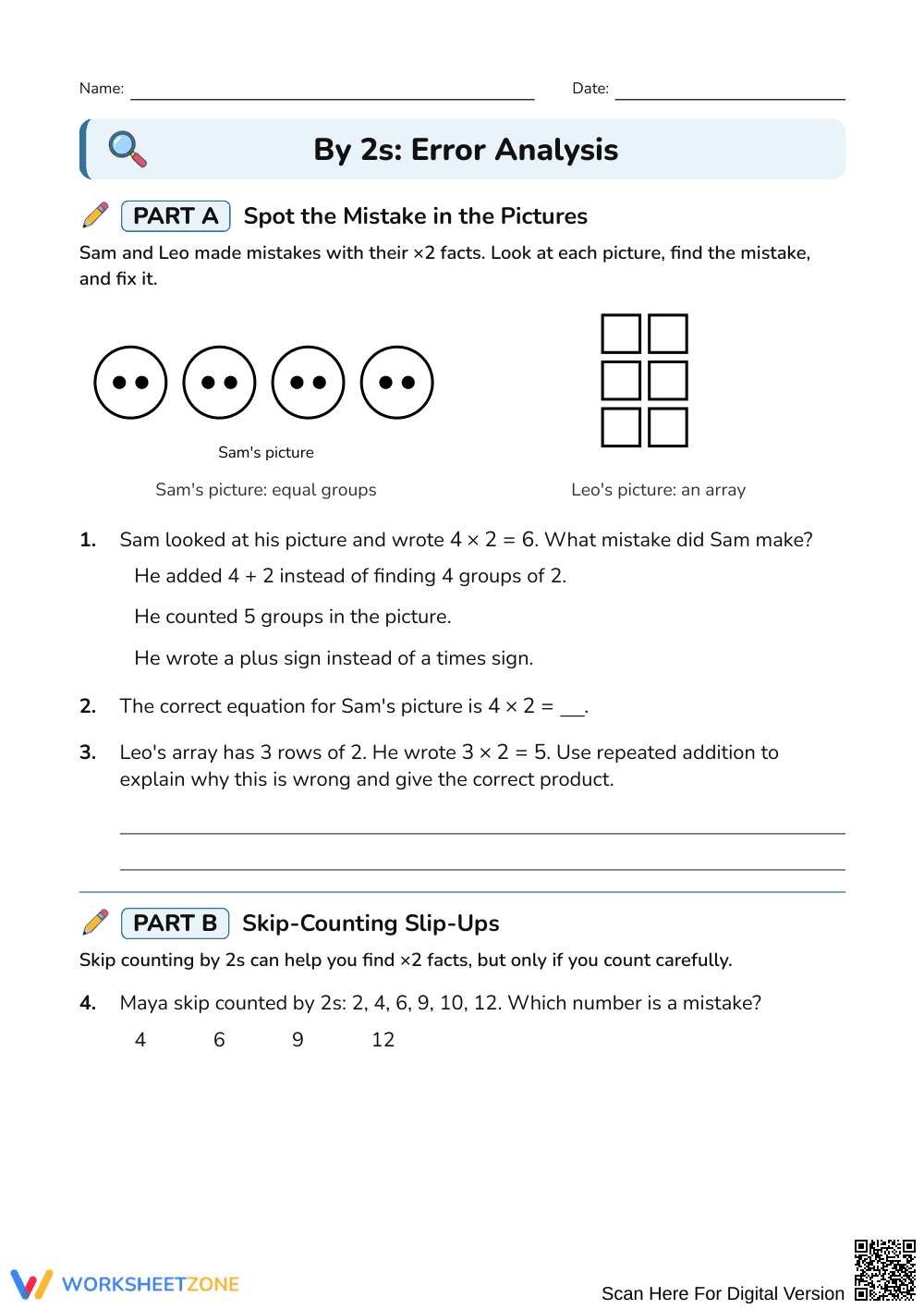
This Grade 3 error analysis worksheet helps students master multiplying by 2s by identifying, correcting, and explaining math mistakes. Learners examine equal groups, arrays, and skip-counting patterns to distinguish multiplication from addition. By analyzing errors rather than calculating products, third graders build conceptual mastery and prevent persistent multiplication errors.
At a Glance
- Grade: 3 · Subject: Math
- Standard:
3.OA.A.1— Interpret products of whole numbers as equal groups of objects- Skill Focus: Multiplication by 2 error analysis
- Format: 2 pages · 11 problems · Answer key included · PDF
- Best For: Formative assessment and targeted misconception intervention
- Time: 20–30 minutes
What's Inside
Across 2 student-facing pages, this resource presents 11 targeted tasks organized into three sections. Students evaluate visual models of equal groups and arrays, detect skip-counting errors, fix calculation tables, and solve an applied word problem. A complete 2-page answer key provides step-by-step reasoning alongside corrected equations for efficient grading.
Skill Progression
- Guided Practice (Part A, Problems 1–2): Visual models scaffold thinking as students identify factor addition errors in equal groups and arrays.
- Supported Practice (Part B, Problems 3–4): Number lines and sequences support students in isolating skip-counting errors and jump counts.
- Independent Practice (Part C, Problems 5–11): Students independently correct calculation tables, select valid equations, and justify a real-world bike problem.
This sequence implements gradual release, moving learners smoothly from scaffolded visual critiques to independent application.
Standards Alignment
This worksheet aligns with primary standard `3.OA.A.1`: Interpret products of whole numbers as equal groups of objects. The tasks also reinforce `3.OA.C.7` by building fluency with multiplication facts within 100 through systematic error correction. Both standard codes can be copied directly into lesson plans, IEP goals, or district curriculum mapping tools.
How to Use It
Use this worksheet after direct instruction on two-times facts for partner error analysis, or during small-group intervention for students confusing multiplication with addition. Observe whether students use repeated addition when explaining their array corrections. Students typically complete all 11 problems within 20 to 30 minutes.
Who It's For
This resource serves general education third graders, math intervention groups, and special education students practicing error monitoring. Pair this worksheet with an anchor chart displaying equal-groups models and number line jumps to support English learners and visual thinkers.
Grounding instructional design in the principles of Fisher & Frey (2014), this Grade 3 mathematics resource strengthens conceptual understanding of standard 3.OA.A.1 through structured error analysis. Rather than relying solely on repetitive calculation, analyzing student misconceptions requires learners to interpret products of whole numbers as equal groups and evaluate mathematical claims critically. According to Fisher & Frey (2014), intentional error reflection deepens cognitive processing by moving students through guided, collaborative, and independent phases of the gradual release of responsibility framework. Addressing the persistent tendency of third graders to confuse addition with multiplication, these 11 tasks require learners to identify errors in arrays, correct skip-counting breakdowns, and validate real-world multiplication equations. The structured prompts reinforce rigorous mathematical reasoning, enabling teachers to assess whether students truly comprehend multiplication as equal groupings rather than relying on rote fact memorization.


