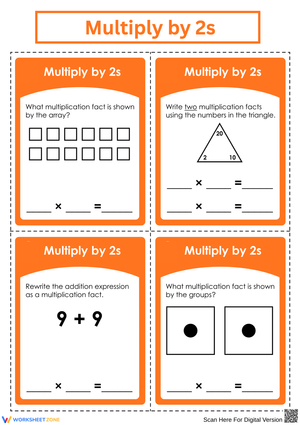
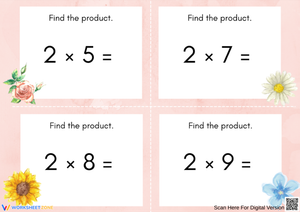
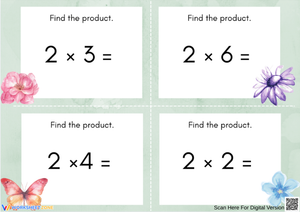
These by 2s worksheets give second and third graders structured, varied practice with the twos fact family — from array-based visual tasks to missing-factor problems to short word problems that require applying the doubling concept in context. Teachers get a ready-to-use set of standalone worksheets that cover the full range of practice formats without requiring any additional prep.
What Each Worksheet Targets
The set covers the twos facts from multiple entry points, because fluency built on a single format tends to be fragile. Students who can zip through a vertical drill page will sometimes stall on a problem like 2 × __ = 16, which asks them to reverse their thinking. Each worksheet addresses one or two specific skill modes:
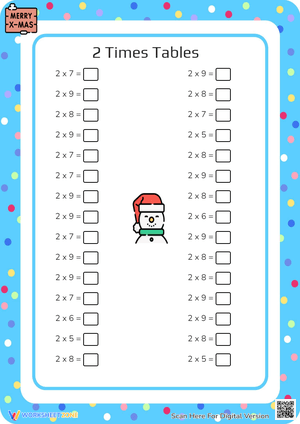
- Vertical and horizontal fact drills for building automatic recall across both orientations
- Missing-factor equations that introduce the inverse relationship between multiplication and division before students formally encounter that vocabulary
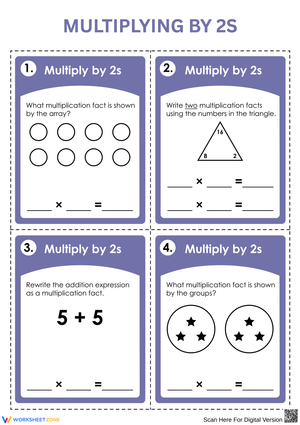
- Array tasks where students count rows and columns and record the corresponding equation — this concretizes what doubling actually means spatially
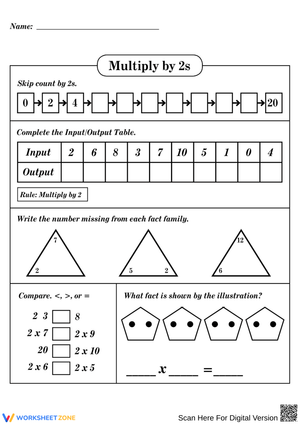
- Skip-count sequences that run alongside equations, reinforcing the connection between the number-line jumps students already know and the symbolic notation they're learning
- Short word problems framed around familiar, countable pairs — shoes, wheels, eyes — so students practice identifying when to multiply rather than just executing a given operation
The Doubling Connection and Why It Matters Pedagogically
By the time students encounter formal multiplication, most have spent a year drilling addition doubles. They can tell you that 7 + 7 = 14 without hesitation. The twos facts are the one fact family where that prior knowledge transfers almost perfectly — multiplying by 2 is doubling, full stop. Worksheets that make this connection explicit, rather than treating multiplication as an entirely new operation, reduce cognitive load at a moment when students are already managing new notation and vocabulary.
One approach worth building into early lessons: before distributing a worksheet, have students write the corresponding addition double beneath each multiplication equation. So next to 2 × 9, they write 9 + 9. The goal isn't to keep the scaffold forever — it's to give students a concrete bridge while the multiplication symbol is still unfamiliar. After a few sessions, ask them to mark only the problems where they still needed the addition double to find the answer. That annotation becomes quick formative data on who has crossed from calculation to recall.
Frequent Student Errors Worth Watching For and Correcting
The most common error isn't a calculation mistake — it's a conceptual one. Students confuse multiplying by 2 with multiplying by 10 or confuse the doubling rule with adding 2. A student who knows that 6 + 6 = 12 will occasionally write 2 × 6 = 8, because they added 2 to 6 rather than adding 6 to itself. The wording of the problem doesn't always prevent this; students who are rushing pattern-match on the 2 and add it rather than doubling the other factor.
Missing-factor problems surface a different error: students who see 2 × __ = 18 will sometimes write 16, subtracting 2 from 18 instead of halving it. This tells you the student doesn't yet have a stable model for what the equation is asking. Array worksheets are the most direct fix here — once a student has physically counted a 2 × 9 array, the structure of the problem becomes harder to misread. It also helps to say out loud, during class work time, "two groups of how many?" rather than "two times blank."
How to Work These Worksheets Into Your Lesson Plans
Most teachers find the strongest use for these during the 8–10 minutes at the start of the math block, after the lesson transition but before direct instruction begins. A single focused worksheet settles the room and gives students something to reference when the doubling strategy comes up again during the lesson itself. That said, the formats aren't all equivalent in difficulty, so sequencing matters: start students on the vertical drill and array worksheets in the first week, introduce missing-factor problems once accuracy on the straightforward facts is solid, and reserve word problems for independent practice after at least one whole-class lesson modeling how to identify the operation.
For math centers, the drill worksheets work well at a fluency station where students work independently. The word-problem and missing-factor worksheets are better suited to partner work or small-group settings where students can talk through their reasoning. One reliable structure: keep the array worksheet at a center alongside a set of square tiles so students can build before they record. The transition from manipulative to paper practice tends to go more smoothly when both are available in the same space.
Adjusting These Worksheets Across a Range of Learners
For students who need additional support, the array and skip-count worksheets are the appropriate starting point — they build meaning before demanding recall. Allow these students to keep a printed number line at their desk and to write the addition double beneath each problem as long as they need it. Remove those supports gradually, one at a time, rather than all at once.
Students who have already mastered basic twos recall need a different kind of practice. Give them the missing-factor and word-problem worksheets first, and then ask them to write a second related equation for each problem — the corresponding division fact, or a word problem of their own that uses the same numbers. This keeps the worksheet from being busywork while still keeping them in the same content the rest of the class is working on. Students who are far ahead can also work on the twos facts as an entry point into exploring patterns: why are all products of the twos facts even? That question leads somewhere useful.
Standard Alignment
These worksheets align directly with CCSS 3.OA.C.7, which requires students to fluently multiply and divide within 100. The twos facts are typically the first fact family addressed under this standard because the doubling strategy gives students a reliable, low-overhead method for deriving answers while automaticity is still developing. In second grade, the groundwork appears in 2.OA.C.4, where students build arrays and write multiplication equations — the array worksheets in this set connect backward to that standard, making them useful for introducing the concept before formal third-grade multiplication instruction begins. Teachers using these worksheets in late second grade should emphasize the array and doubling tasks; teachers using them in third grade will likely move faster toward the drill and missing-factor formats as fluency becomes the goal.
Frequently Asked Questions
Should timed or untimed practice come first?
Untimed practice belongs at the beginning, while students are still learning to apply the doubling strategy accurately. Timing a student who is still deriving answers measures anxiety as much as math knowledge. Once a student can complete a 20-problem drill accurately without any aids, short timed sessions become a reasonable tool for building speed. A good checkpoint: if a student finishes an untimed worksheet with no errors and reports that most problems felt immediate rather than calculated, they're ready for a gentle timed format.
How many problems per session is appropriate?
Fifteen to twenty problems in a focused 5–8 minute window produces better retention than a 40-problem sheet done in a longer sitting. The research on spaced retrieval practice supports shorter, more frequent practice over massed sessions. If students are visibly fatiguing — pencils slowing down, errors increasing toward the bottom of the worksheet — that's a sign the session is too long, not a sign students need more practice that day.
Are these worksheets useful for fourth-grade intervention?
Yes. Fourth graders who haven't secured the twos facts are usually missing the doubling concept rather than just needing more drill repetitions. The array and doubling-strategy worksheets from this set address that gap directly. Starting a struggling fourth grader on a timed drill sheet tends to confirm their difficulty rather than resolve it; the conceptual worksheets give them a working method first.













 Interactive Worksheet Maker
 Quiz Maker
 Word Search Maker
 Crossword Puzzle Maker
 Word Scramble Generator
 Sentence Scramble Generator
 Handwriting Worksheet Generator
 Name Tracing Generator
 Fill In The Blank Generator