




























Views
Downloads



Complete Energy Trace Worksheet | Grade 6 Science

Paste this activity's link or code into your existing LMS (Google Classroom, Canvas, Teams, Schoology, Moodle, etc.).
Students can open and work on the activity right away, with no student login required.
You'll still be able to track student progress and results from your teacher account.
Tracing how energy transforms across systems helps students master the law of conservation of energy. This Grade 6 physical science worksheet guides middle school learners to identify energy inputs, conversions, useful outputs, and waste heat in common devices. Students build rigorous scientific modeling skills while reinforcing core energy transfer concepts.
At a Glance
- Grade: 6 · Subject: Science
- Standard: Construct and interpret energy transfer models showing conservation during device operation
- Skill Focus: Tracing energy transformations through devices
- Format: 5 pages · 10 problems · Answer key included · PDF
- Best For: Mid-unit energy modeling practice
- Time: 40–50 minutes
This five-page worksheet features ten structured problems organized into three distinct parts, supported by two clear worked examples demonstrating a hair dryer and music box. The initial pages establish arrow notation for mapping energy chains, while a four-page answer key provides complete model diagrams and sample explanations for every prompt.
Skill Progression
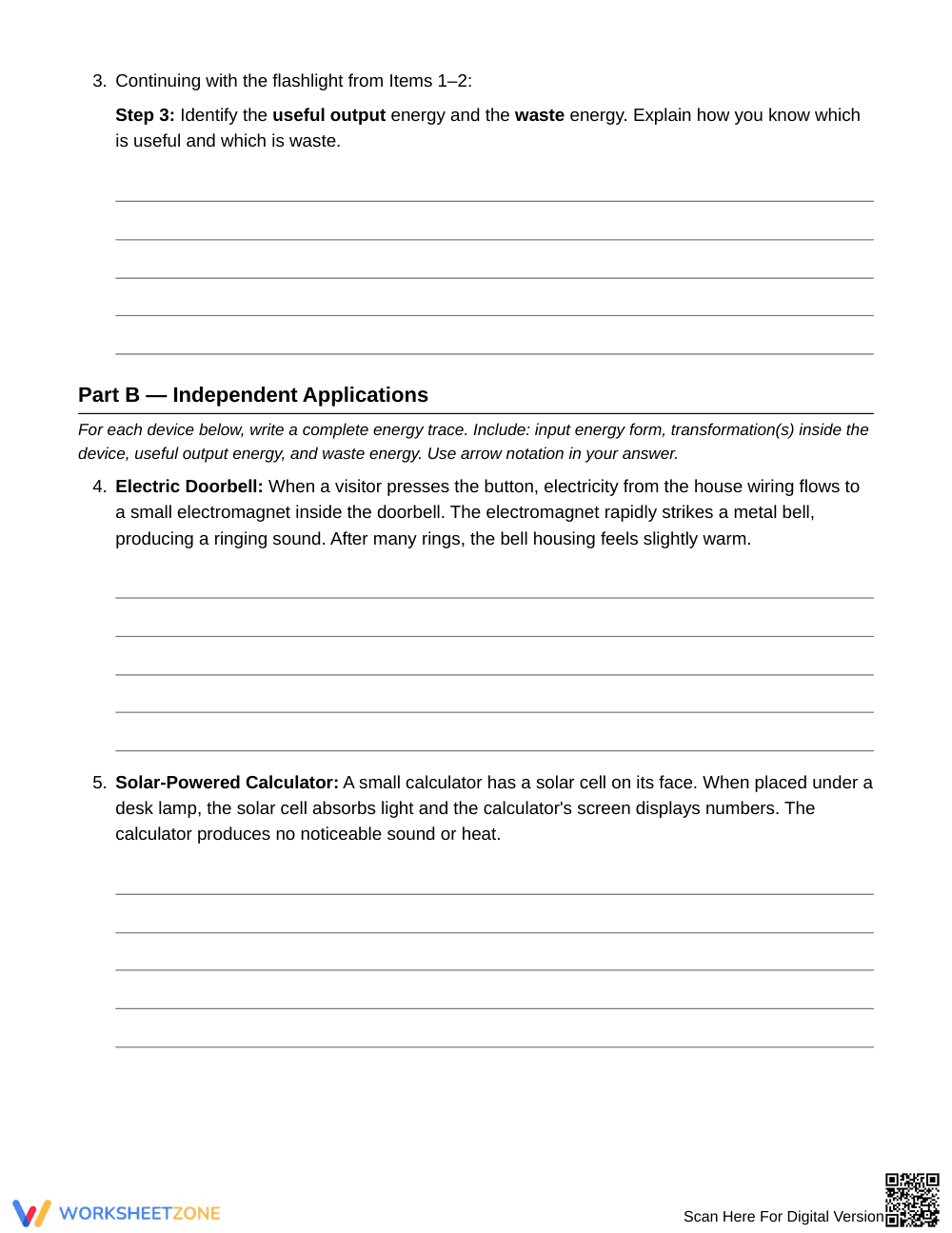
- Guided practice: Items 1–3 scaffold a three-step analysis of a flashlight, walking students through chemical storage, electrical flow, and light production.
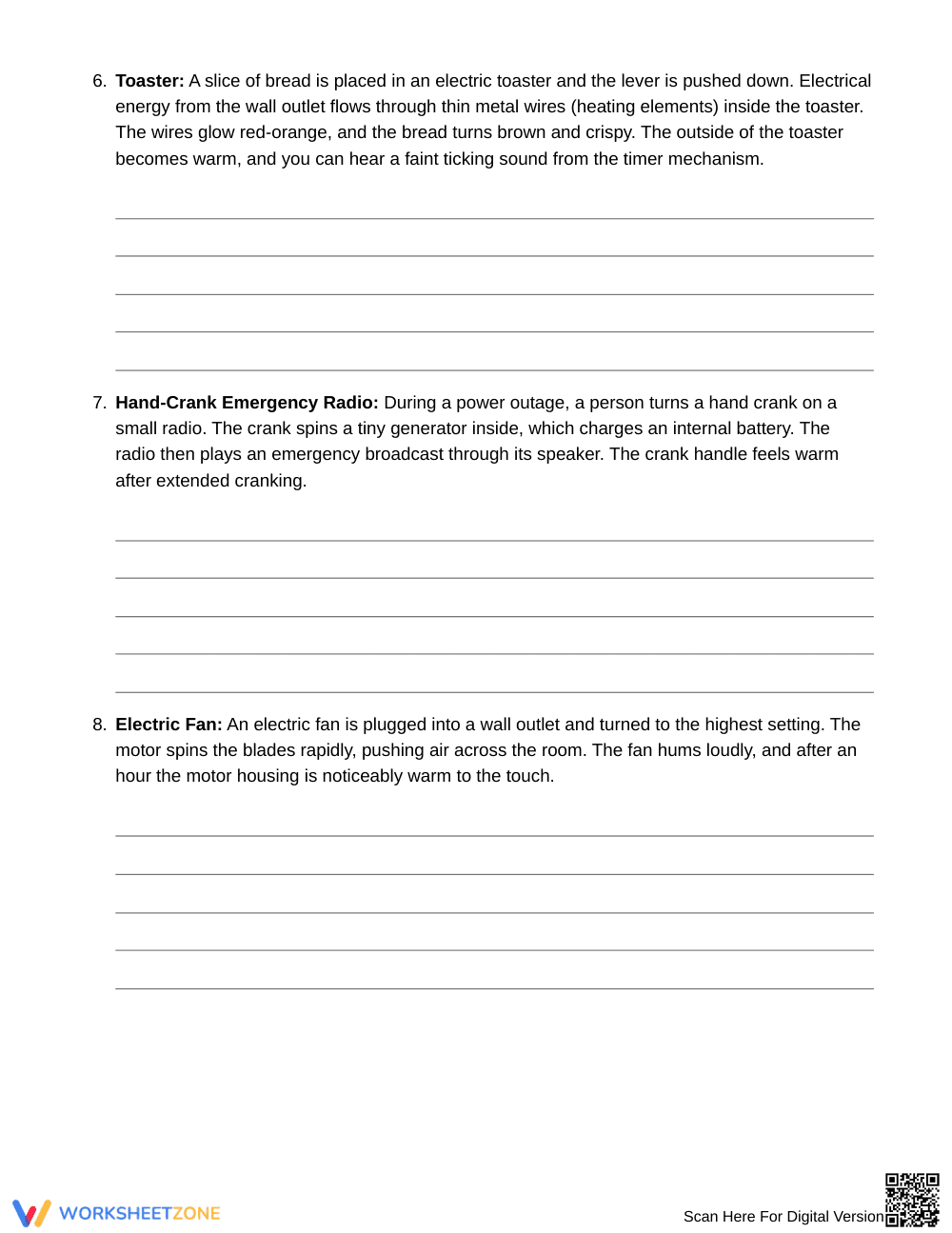
- Supported practice: Items 4–8 present five authentic devices—including a doorbell, toaster, and solar calculator—where students independently write full energy chains and distinguish useful work from waste heat.
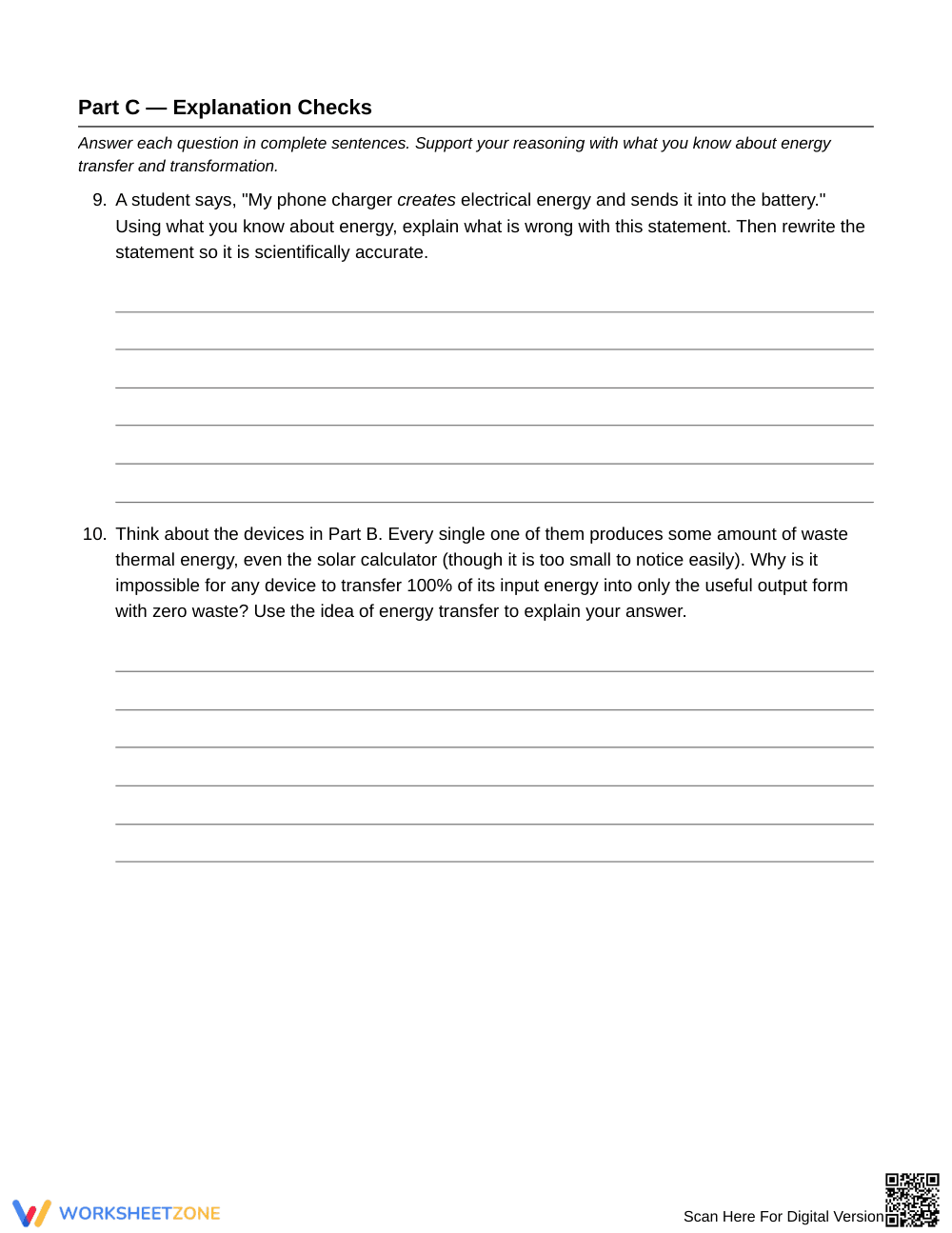
- Independent practice: Items 9–10 evaluate misconceptions regarding energy creation and prompt students to explain why 100% mechanical efficiency is physically impossible.
This sequence mirrors the gradual release of responsibility model, guiding learners from structured prompts toward independent conceptual mastery.
Standards Alignment
This worksheet aligns with middle school physical science standards requiring learners to track energy transfers and transformations through systems. Students demonstrate that total energy remains constant while identifying thermal dissipation in everyday machines. Both standard concepts can be copied directly into lesson plans, IEP goals, or district curriculum mapping tools.
How to Use It
Use this resource after introducing energy types, either as mid-unit guided practice or collaborative partner work. As students work, check whether they confuse intermediate device mechanisms with primary energy inputs. Expect full completion within 40 to 50 minutes of standard class time.
Who It's For
This practice set suits Grade 6 physical science classrooms, STEM interventions, and homeschool learners exploring energy dynamics. For optimal engagement, pair this worksheet with physical device demonstrations or a classroom energy forms anchor chart.
Research by Fisher & Frey (2014) highlights that structured cognitive modeling accelerates conceptual mastery in middle school science classrooms. Tracing energy inputs, transformations, useful outputs, and dissipated thermal waste gives sixth-grade students an empirical method for understanding the law of conservation of energy. By translating everyday appliances like toasters and doorbells into clear arrow notation diagrams, learners move beyond abstract definitions into actionable scientific modeling. The progression systematically reveals how chemical, electrical, and mechanical energy inputs invariably yield thermal dissipation due to friction and operational resistance. Analyzing these transformations addresses the prevalent student misconception that consumed energy simply vanishes upon device deactivation. Through guided flashlight decomposition and rigorous explanation checks, this 10-task worksheet reinforces critical analytical thinking and provides empirical evidence of student understanding across foundational physical science objectives.


