




























Views
Downloads
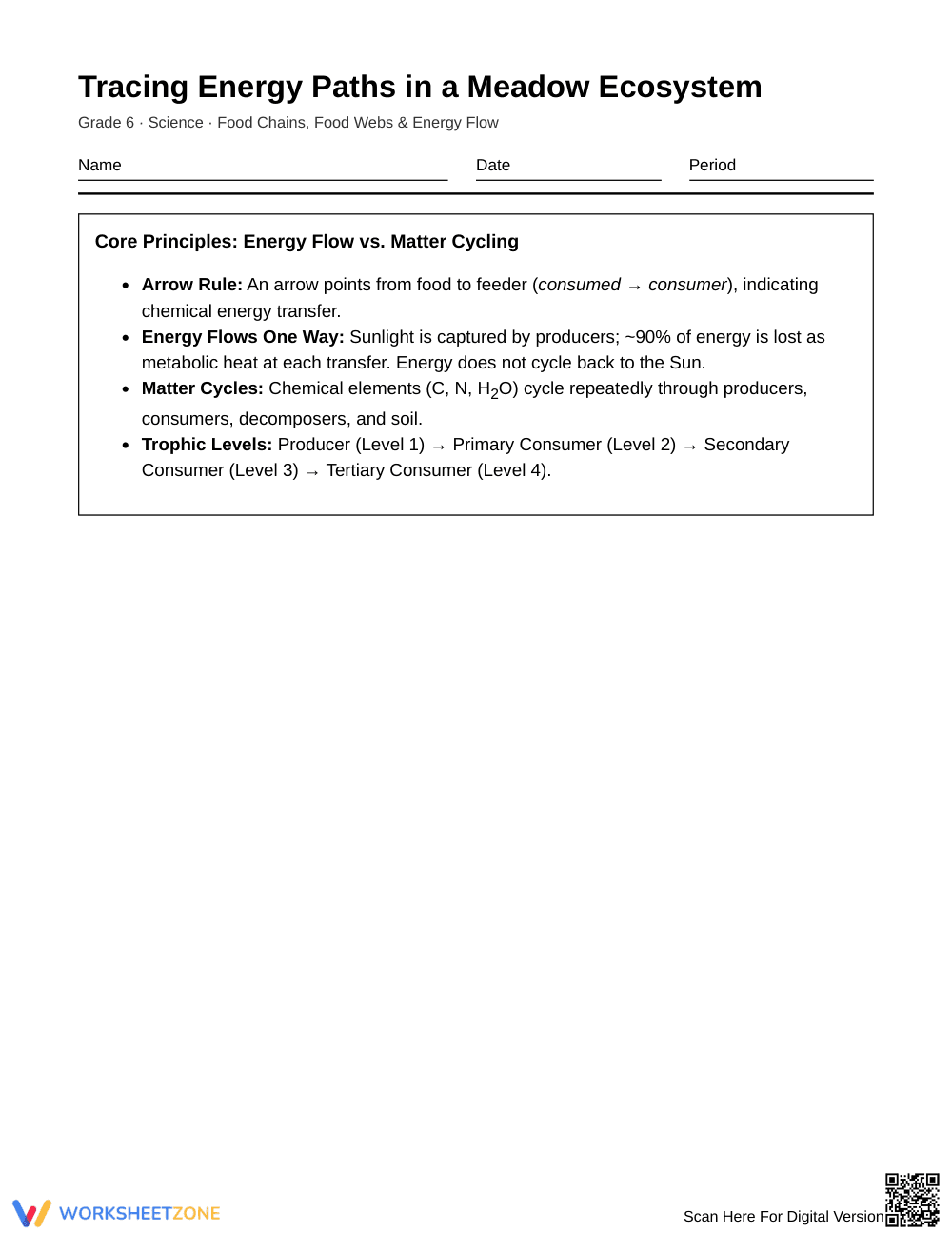
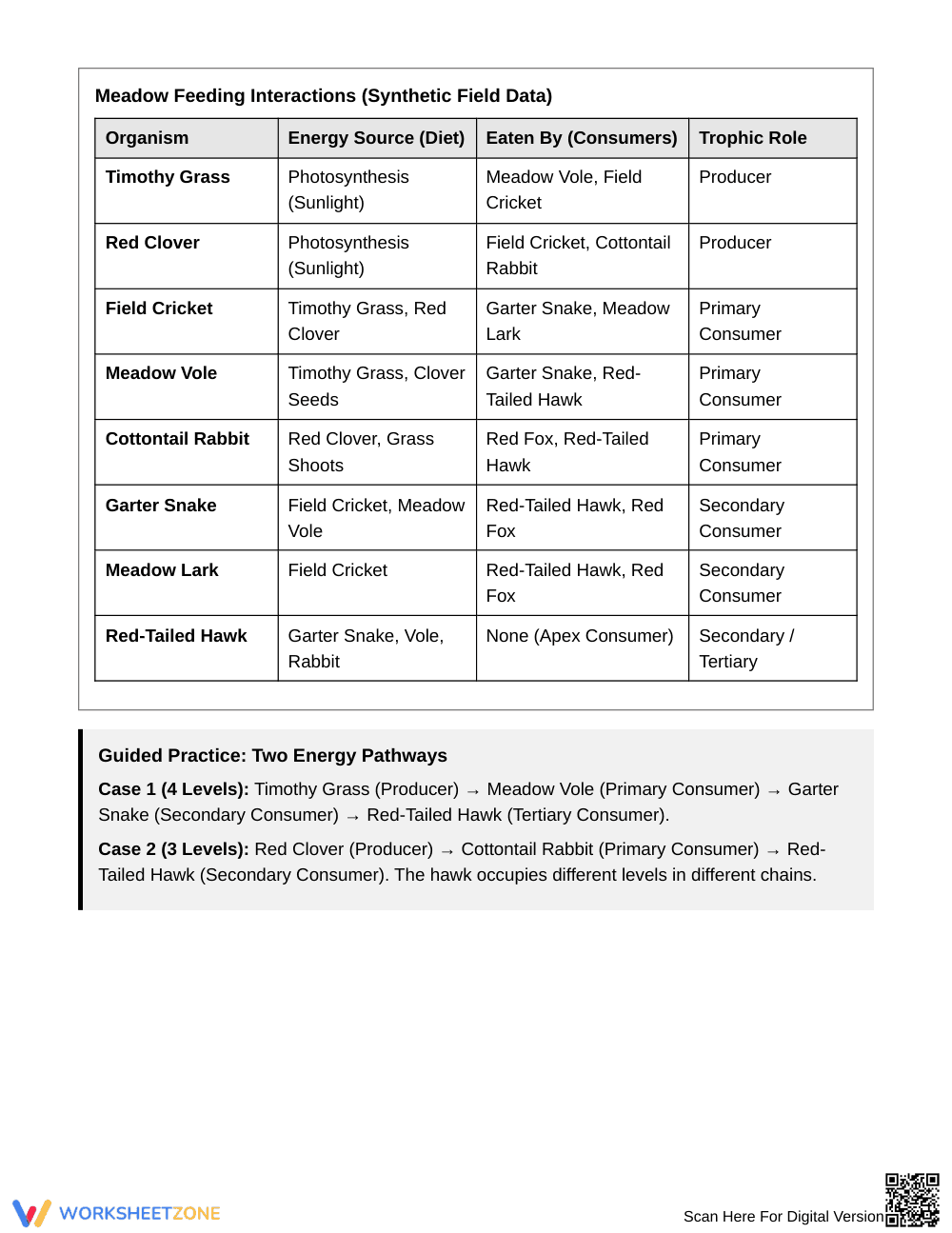
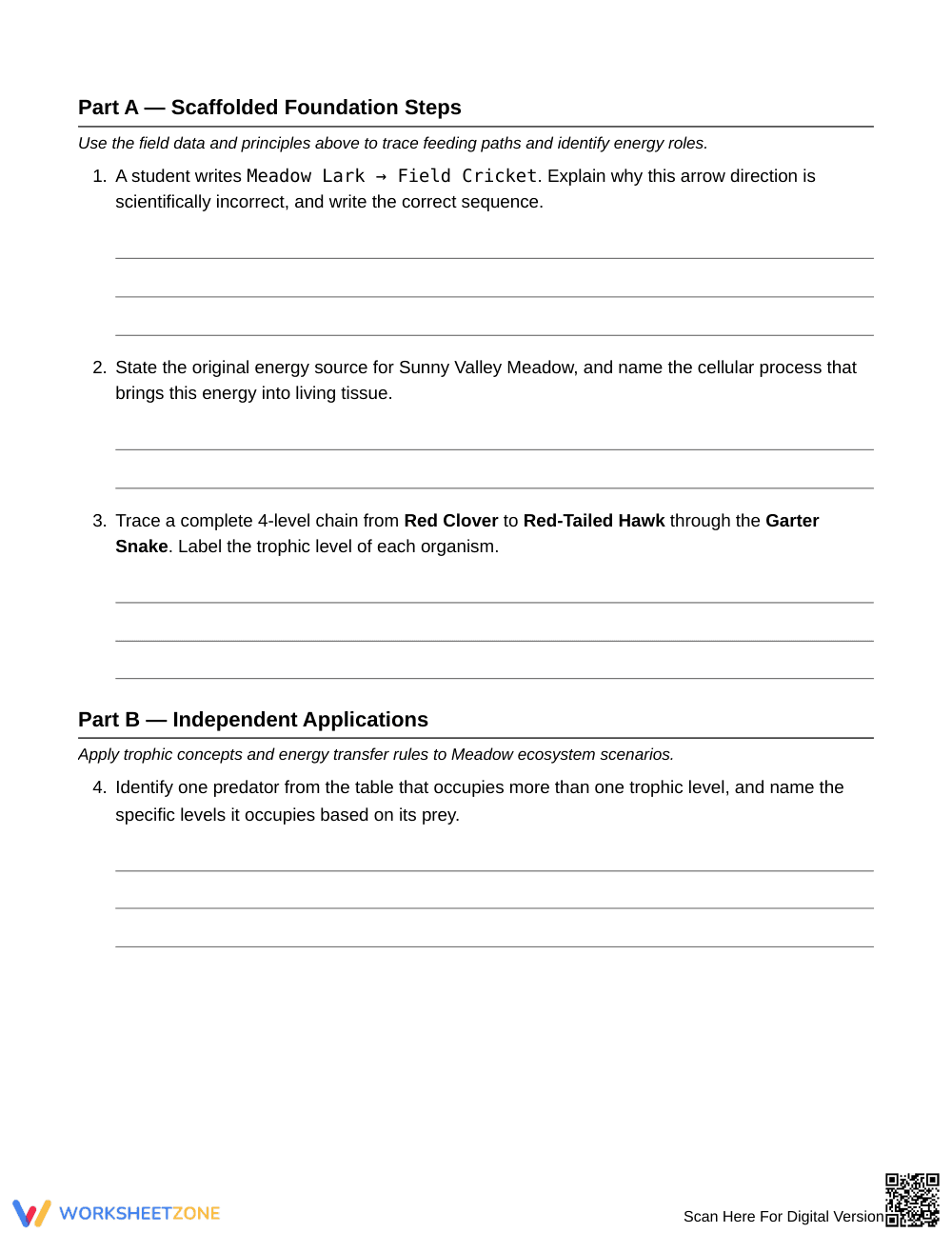
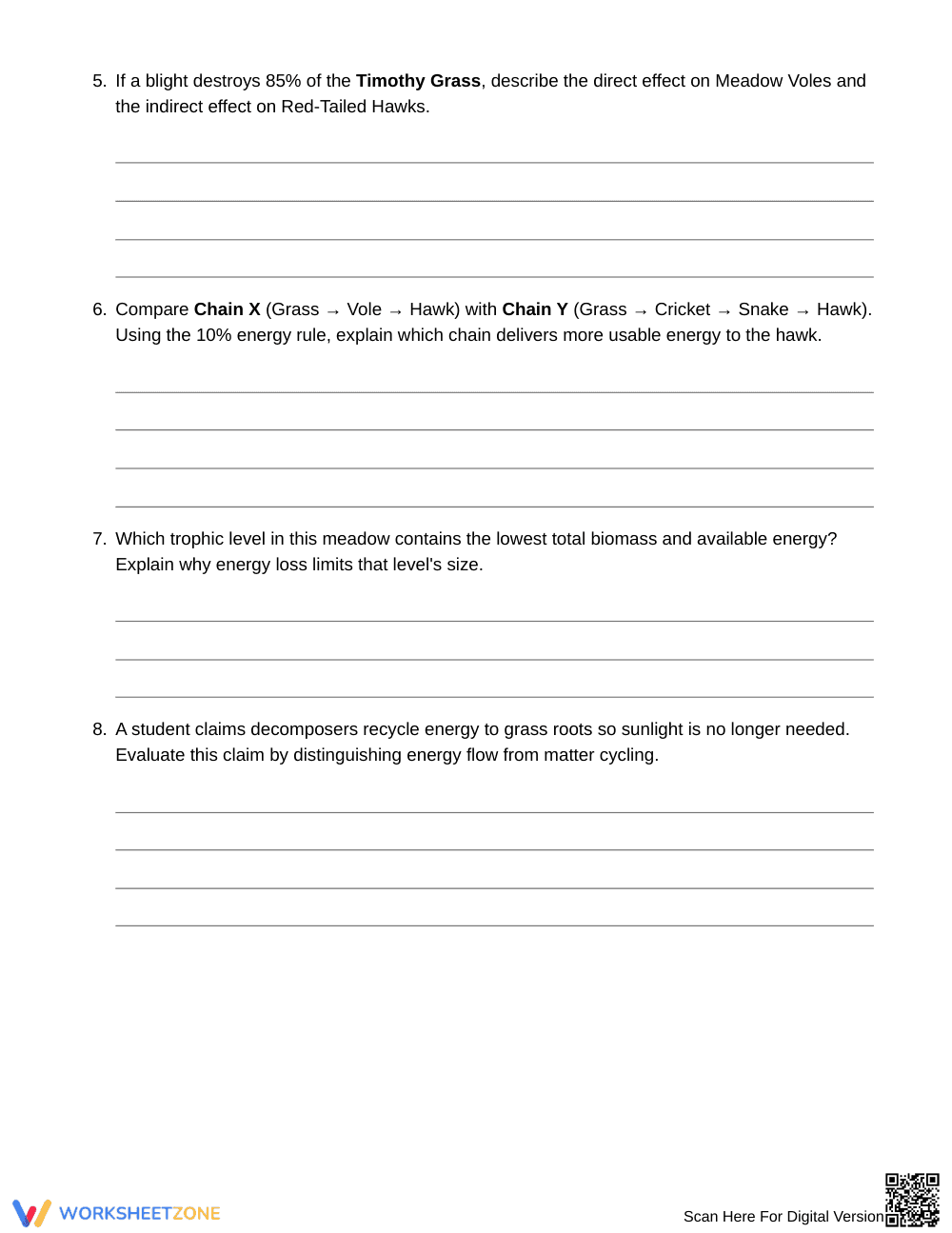


Complete Energy Paths Worksheet | Grade 6 Science

Paste this activity's link or code into your existing LMS (Google Classroom, Canvas, Teams, Schoology, Moodle, etc.).
Students can open and work on the activity right away, with no student login required.
You'll still be able to track student progress and results from your teacher account.
This Grade 6 science worksheet develops student mastery in tracing feeding pathways, classifying trophic levels, and tracking one-way energy transfer through an ecosystem. Working with realistic meadow field data, students analyze producer-to-consumer relationships, apply the 10 percent energy rule, and contrast chemical energy dissipation with closed-loop matter cycling across structured analytical tasks.
At a Glance
- Grade: 6 · Subject: Science
- Standard: Develop models to describe the cycling of matter and flow of energy among living and nonliving parts of an ecosystem
- Skill Focus: Tracing energy pathways and trophic roles in food webs
- Format: 5 pages · 10 problems · Answer key included · PDF
- Best For: Core instruction and formative skill checks
- Time: 35–45 minutes
What's Inside
The resource features a reference guide summarizing core ecological principles, a synthetic meadow interaction data matrix, 2 fully worked case studies, 10 open-response analysis tasks organized across 3 difficulty tiers, and a comprehensive 2-page answer key with model explanations.
Skill Progression
- Guided Practice (Part A, Problems 1–3): Students analyze arrow direction conventions, identify photosynthetic energy inputs, and trace a foundational 4-level energy chain using scaffolded reference data.
- Supported Practice (Part B, Problems 4–8): Learners apply trophic principles to multi-level consumers, evaluate population blights, calculate relative energy transfer across competing food chains, and debunk common misconceptions regarding decomposers.
- Independent Practice (Part C, Problems 9–10): Students synthesize food web complexity by predicting cascading effects of predator removal and justifying why interconnected webs represent natural ecosystems more accurately than isolated linear chains.
This sequence implements a gradual-release architecture, transitioning students from foundational diagram conventions to complex ecological systems analysis.
Standards Alignment
This activity aligns with middle school life science standards requiring students to develop models describing the flow of energy and matter cycling among living and nonliving ecosystem components. Students track how radiant solar energy transforms into chemical energy and flows through producers and consumers. This content specification can be copied directly into lesson plans, IEP goals, or district curriculum mapping tools.
How to Use It
Deploy this worksheet after direct instruction on trophic pyramids and food webs. It serves effectively as mid-unit guided practice or an independent checkpoint. For formative assessment, examine student responses to Part A Problem 1; students who invert consumer arrows can be promptly redirected before beginning multi-tier trophic calculations. Expected completion time is 35 to 45 minutes.
Who It's For
This worksheet is designed for general Grade 6 life science students, with built-in reference tables and worked examples supporting English language learners and students with IEP accommodations. It pairs naturally with an introductory laboratory activity modeling energy loss or an interactive food web diagramming lesson.
Middle school science instruction requires structured practice to correct persistent misconceptions regarding energy transfer, specifically the confusion between cyclic matter pathways and unidirectional thermodynamic energy loss. According to empirical findings in Fisher & Frey (2014), instructional frameworks that pair explicit reference schemas with tiered problem sets produce significant measurable gains in scientific reasoning and graphical literacy. This 5-page resource equips Grade 6 learners to analyze synthetic field data, evaluate trophic levels across 10 targeted tasks, and trace energy movement through complex meadow networks. By grounding abstract ecological principles in concrete predator-prey scenarios, students develop rigorous conceptual models aligned with contemporary life science performance expectations.


