




























Complete Encouragement Word Search | Grades 6–7 Behavior
Paste this activity's link or code into your existing LMS (Google Classroom, Canvas, Teams, Schoology, Moodle, etc.).
Students can open and work on the activity right away, with no student login required.
You'll still be able to track student progress and results from your teacher account.
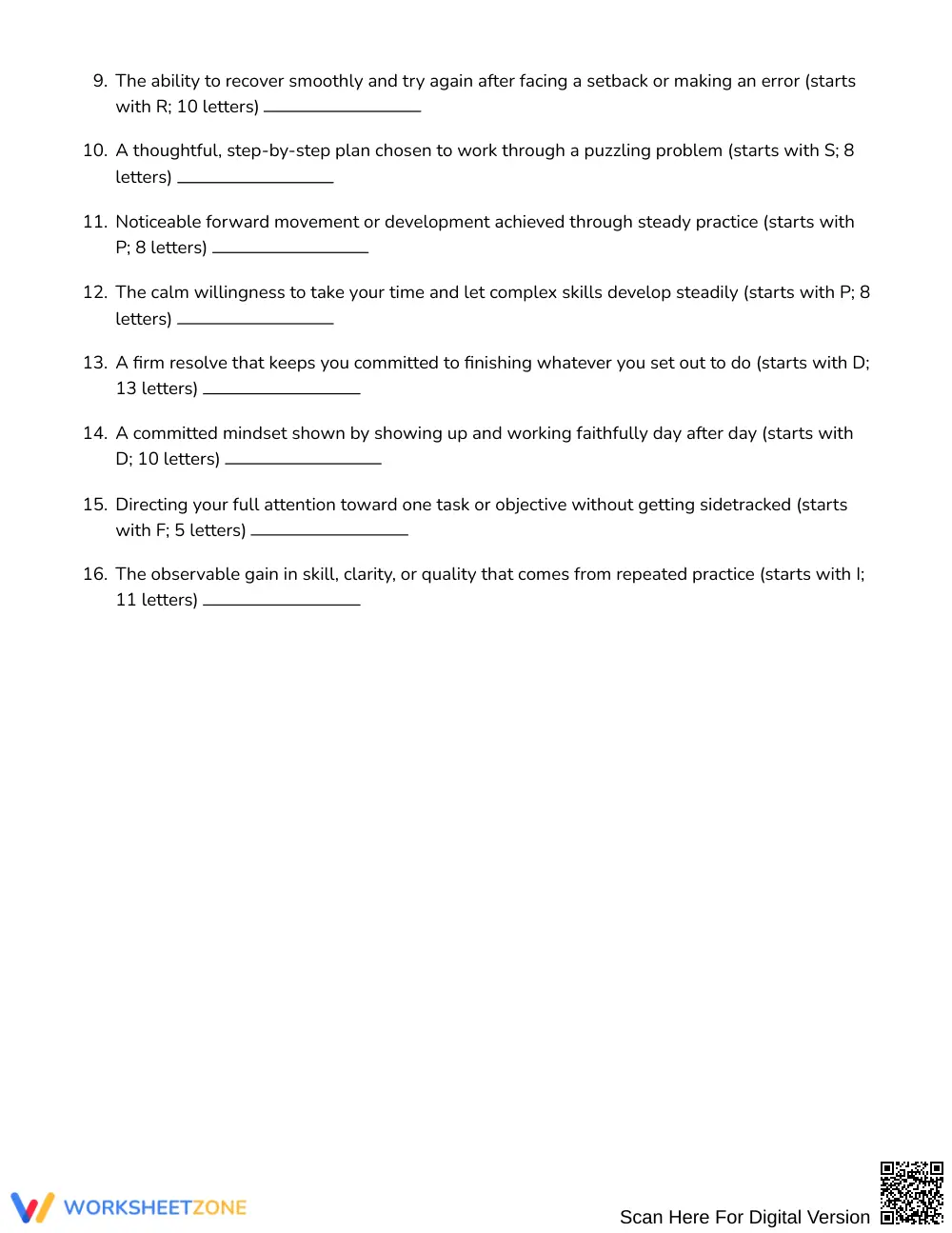
This Grades 6–7 word search reinforces the vocabulary of offering specific encouragement through targeted social skills practice. Students read context clues to identify 16 purposeful encouragement concepts, including persistence, effort, and resilience, before locating each hidden term. The activity transforms standard vocabulary drill into an engaging challenge that promotes growth-oriented communication.
At a Glance
- Grade: Grades 6–7 · Subject: Behavior Worksheets
- Standard: Not standards-assessed — vocabulary enrichment
- Skill Focus: Offering specific encouragement
- Format: 3 pages · 16 words · Answer key included · PDF
- Best For: Advisory, homeroom, or social skills practice
- Time: 25–35 minutes
What's Inside
This 3-page printable activity challenges students without providing a pre-printed word bank. Instead, learners review 16 distinct definitions that describe constructive feedback, dedication, and problem-solving actions. After deducing each target term from its clue, students search for the term across the letters. A comprehensive 4-page answer key is included, featuring solved clues and highlighted grid coordinates for efficient verification.
Puzzle Structure
This activity utilizes an 18 x 18 letter grid to provide an appropriate level of cognitive challenge for middle school learners. The 16 target words run across eight possible directions: North, Northeast, East, Southeast, South, Southwest, West, and Northwest. Because there is no visible word bank, students must actively retrieve vocabulary from definitions before searching forward, backward, and diagonally through the grid.
Standards Alignment
This resource serves as targeted vocabulary enrichment and social-emotional learning practice, and it is not aligned to an academic content standard. It specifically supports behavioral health, classroom culture, and peer communication by teaching students the language required to deliver praise rooted in process, resilience, and personal determination.
How to Use It
Introduce this word search after a mini-lesson on delivering actionable peer praise, or assign it during homeroom advisory as a reflective independent task. While students work, circulate to observe whether they accurately identify terms like "initiative" and "refinement" based solely on definitions, noting students who require scaffolding with root words or prefixes. Most middle schoolers complete the clue solving and search within 25 to 35 minutes.
Who It's For
This resource is tailored for Grades 6–7 students in general education advisories, small-group counseling, or targeted social skills interventions. For emerging readers, educators can highlight initial letters or display a shared anchor chart of growth-mindset phrases. Pair this puzzle with an active role-play scenario where students practice speaking the 16 encouragement terms aloud to praise a peer’s work.
Vocabulary acquisition in behavioral domains relies on active cognitive processing rather than passive word recognition. According to research synthesized by Fisher & Frey (2014), engaging students in generative vocabulary tasks—such as defining abstract concepts through contextual clues before locating them in print—significantly deepens semantic retention and transferable language use. This Grades 6–7 word search targets the skill of offering specific encouragement by requiring students to deduce 16 essential terms from contextual clues rather than copying from an existing word list. Target concepts such as persistence, progress, and resilience are embedded across an 18 by 18 letter grid running in eight directions. By linking deliberate vocabulary retrieval directly to social-emotional behaviors, this instructional resource equips adolescents with the precise terminology necessary to provide meaningful, process-oriented peer feedback across daily academic discussions and collaborative partner projects.


