
































Complete Element Trends Worksheet | Grades 9-12 Science

Paste this activity's link or code into your existing LMS (Google Classroom, Canvas, Teams, Schoology, Moodle, etc.).
Students can open and work on the activity right away, with no student login required.
You'll still be able to track student progress and results from your teacher account.
This high school science worksheet engages students in applying periodic table patterns, atomic structures, and chemical reactions to real-world phenomena. Moving from foundational periodic trends to emission spectroscopy and thermochemical calculations, learners build conceptual understanding and quantitative skills across 24 structured tasks.
At a Glance
- Grade: Grades 9–12 · Subject: Science
- Standard: High School Physical Science — Relate periodic trends and electron structure to chemical properties
- Skill Focus: Periodic trends, atomic models, and chemical reactions
- Format: 4 pages · 24 problems · Answer key included · PDF
- Best For: Chemistry review and guided application
- Time: 45–60 minutes
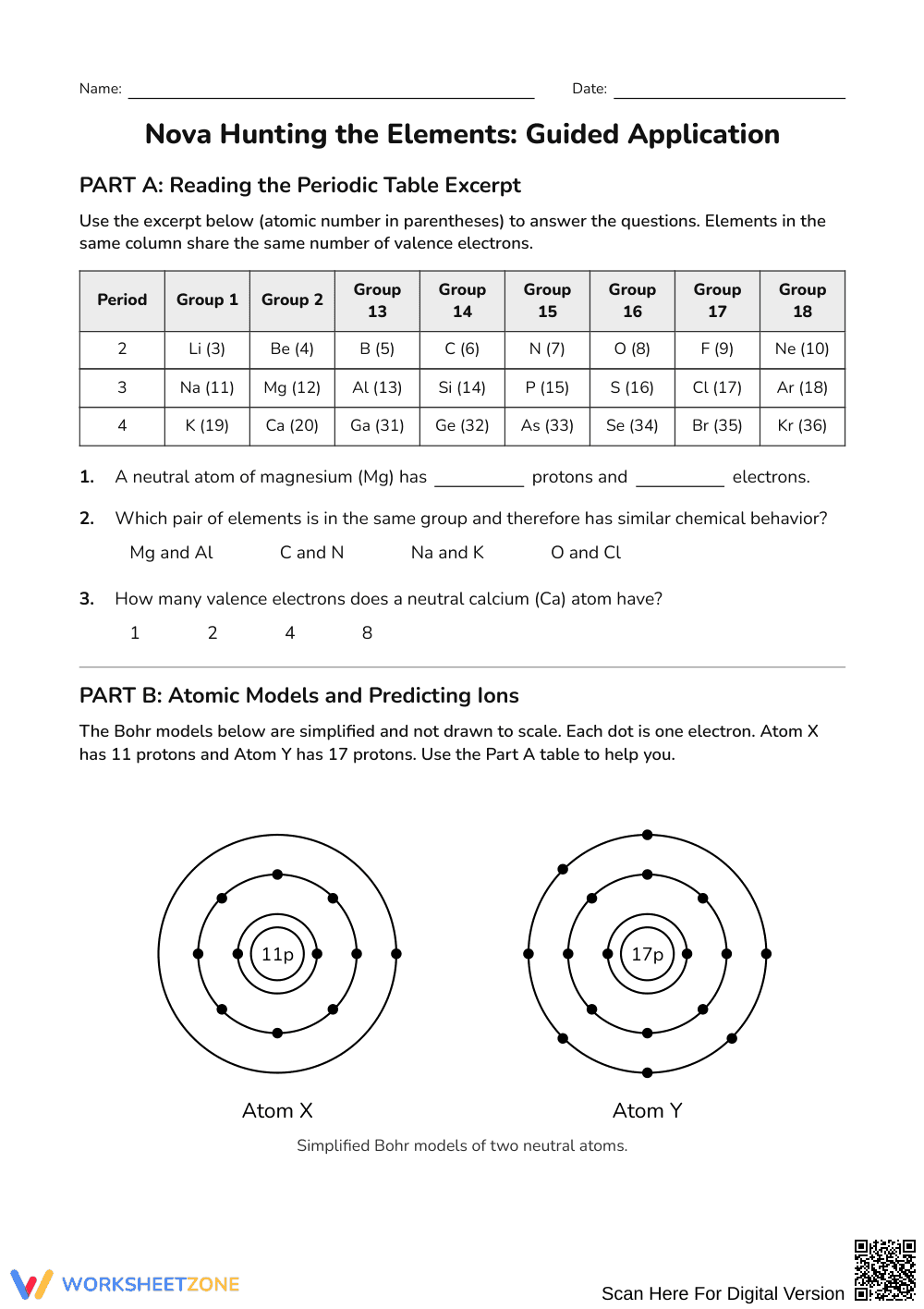
Inside this 4-page resource, students navigate five scaffolded parts featuring data analysis, Bohr models, and stoichiometry problems. Integrated tables, reference equations, and flame test data provide structural support. A complete 4-page answer key provides step-by-step mathematical solutions and clear explanatory responses for every prompt.
Skill Progression
- Guided Practice (Parts A & B): Students complete 8 tasks using periodic table excerpts and Bohr models to identify valence electrons, predict ion charges, and write neutral ionic formulas.
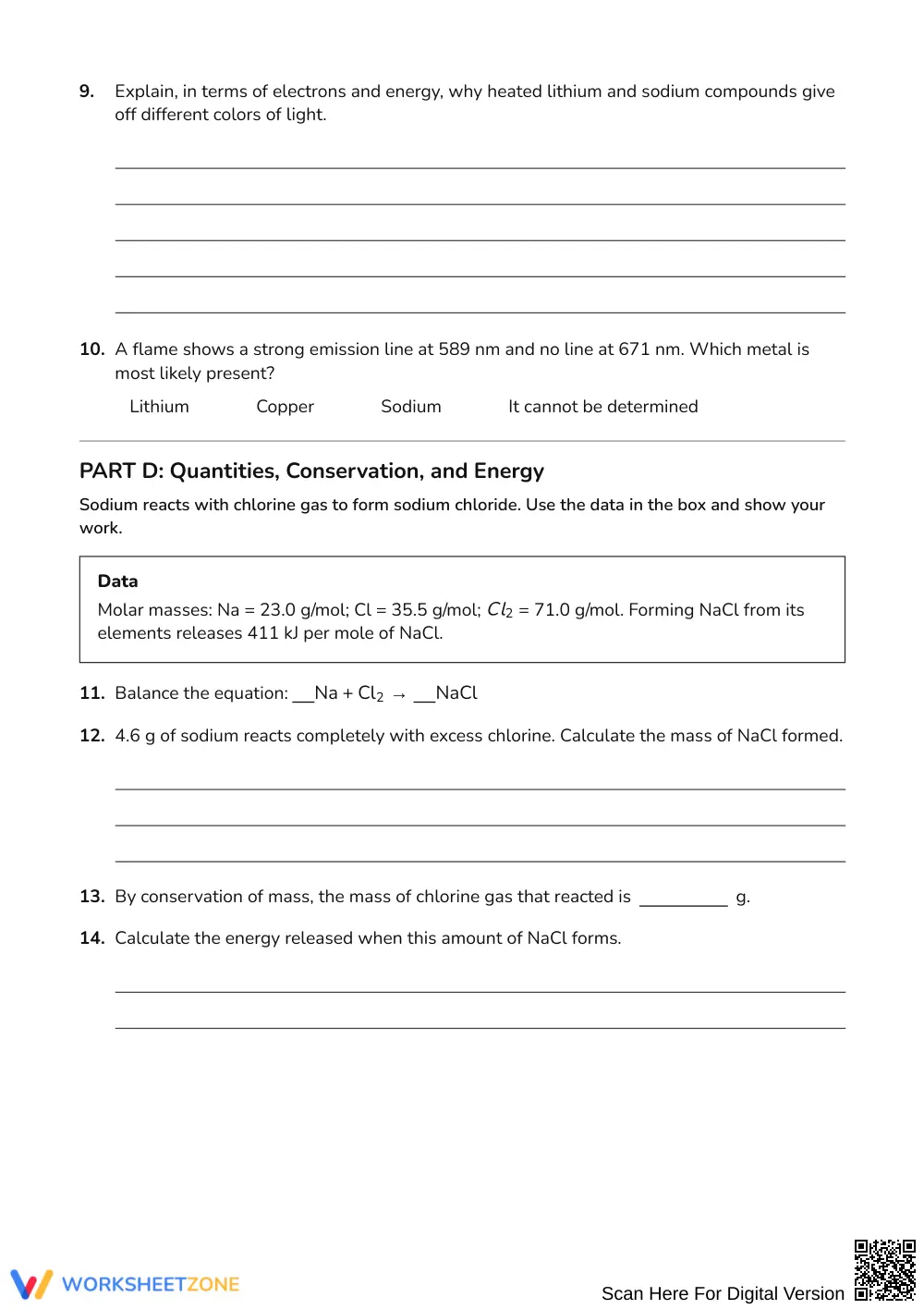
- Supported Practice (Part C): Learners solve 6 problems linking flame emission wavelengths to photon energies and atomic energy transitions.
- Independent Practice (Parts D & E): Students complete 10 problems balancing reactions, calculating mass-energy quantities, and justifying ionization energy trends.
This sequence embodies gradual-release instruction, transitioning students from initial recall to independent scientific analysis.
Standards Alignment
This worksheet aligns with high school physical science standards for atomic structure and chemical reactions. Students use periodic trends to predict chemical behavior and apply conservation of mass and energy to thermochemical equations. Both standard descriptions can be copied directly into lesson plans, IEP goals, or district curriculum mapping tools.
How to Use It
Assign this worksheet following instruction on periodic trends or as a follow-up to NOVA's "Hunting the Elements" documentary. For formative assessment, examine students' Part B ion predictions; learners who justify charges using octet stability are ready for the quantitative stoichiometry in Part D. Typical completion requires 45 to 60 minutes of individual or paired work.
Who It's For
This worksheet supports high school chemistry and physical science students seeking structured practice with atomic behavior. Built-in reference data scaffolds developing learners, while multi-step calculations challenge advanced students. Pair this activity with a laboratory flame test or periodic table anchor chart.
High school chemistry instruction demands that students connect observable chemical properties to submicroscopic atomic interactions. According to Fisher & Frey (2014), purposeful gradual-release frameworks that transition from guided modeling to independent data analysis significantly improve conceptual retention and problem-solving automaticity in secondary science. This 4-page worksheet puts that research into practice through 24 structured problems spanning periodic table organization, valence electron arrangements, ionic compound formation, flame emission spectroscopy, and thermochemical stoichiometry. Students calculate photon energies from empirical wavelengths, balance chemical equations, and apply conservation principles to mass and enthalpy changes. By uniting qualitative trend predictions with quantitative calculations, this assignment prepares learners for advanced scientific analysis and mastery of secondary physical science objectives. The accompanying 4-page answer key provides comprehensive solutions and explanations, making it an exceptionally reliable instructional tool for rigorous chemistry classrooms.


