
































Complete Elastic Outcomes Worksheet | Grade 12 Physics

Paste this activity's link or code into your existing LMS (Google Classroom, Canvas, Teams, Schoology, Moodle, etc.).
Students can open and work on the activity right away, with no student login required.
You'll still be able to track student progress and results from your teacher account.
This Grade 12 physics worksheet guides students through analyzing elastic and inelastic outcomes across twelve collision scenarios. Learners determine post-impact velocities, quantify mechanical energy loss, and calculate impulse from discrete and time-dependent force profiles. The structured practice builds computational fluency in one-dimensional linear momentum conservation.
At a Glance
- Grade: 12 · Subject: Physics (Mechanics)
- Standard: Apply conservation of momentum and energy to analyze one-dimensional elastic and inelastic collisions
- Skill Focus: Analyze Elastic and Inelastic Outcomes
- Format: 5 pages · 12 structured problems · Full answer key included · PDF printable
- Best For: Advanced mechanics unit review, honors physics, and exam prep
- Time: 45–60 minutes total completion time
What's Inside
The 5-page worksheet includes 12 physics problems across three parts, plus a 2-page complete answer key. A reference header supplies standard momentum, impulse integral, and kinetic energy formulas. Problems cover numerical collision solving, triangular force pulses, spring separations, and calculus-based force profiles.
Skill Progression
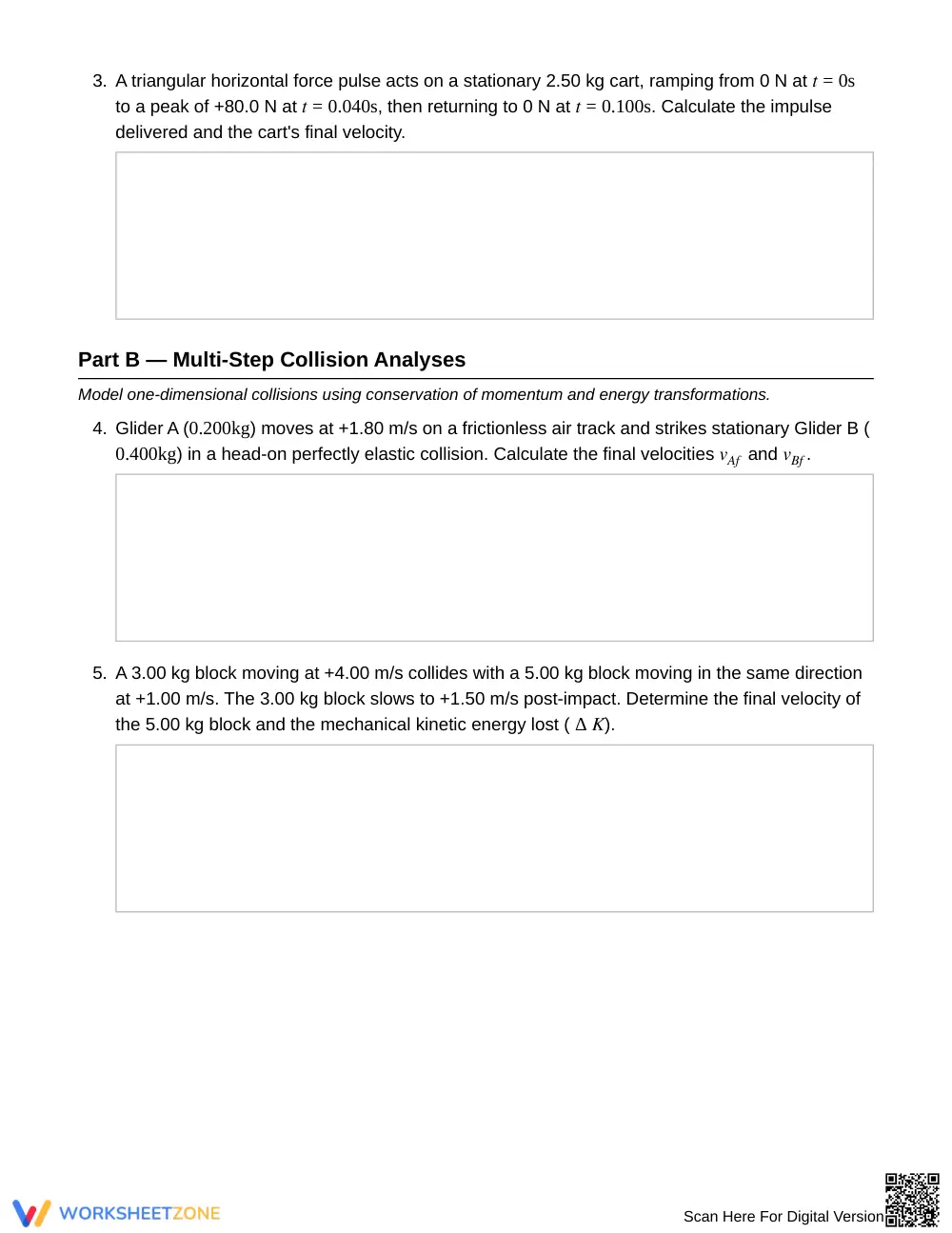
- Guided practice (Part A, 3 problems): Direct calculations of impulse, inelastic coupling, and triangular force pulses with scaffolded formulas.
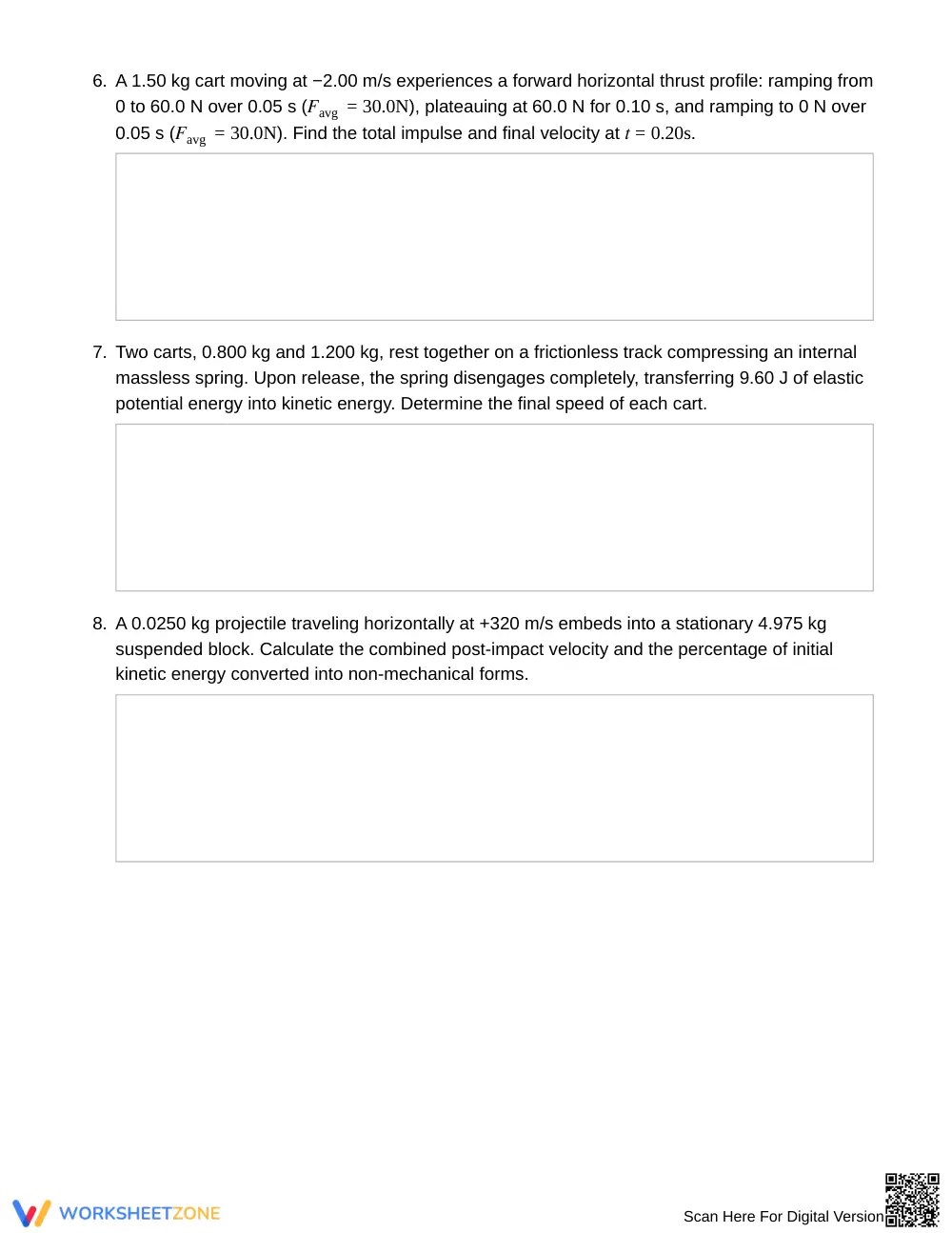
- Supported practice (Part B, 6 problems): Multi-step collision modeling combining momentum and energy conservation across head-on impacts, ballistic collisions, and spring releases.
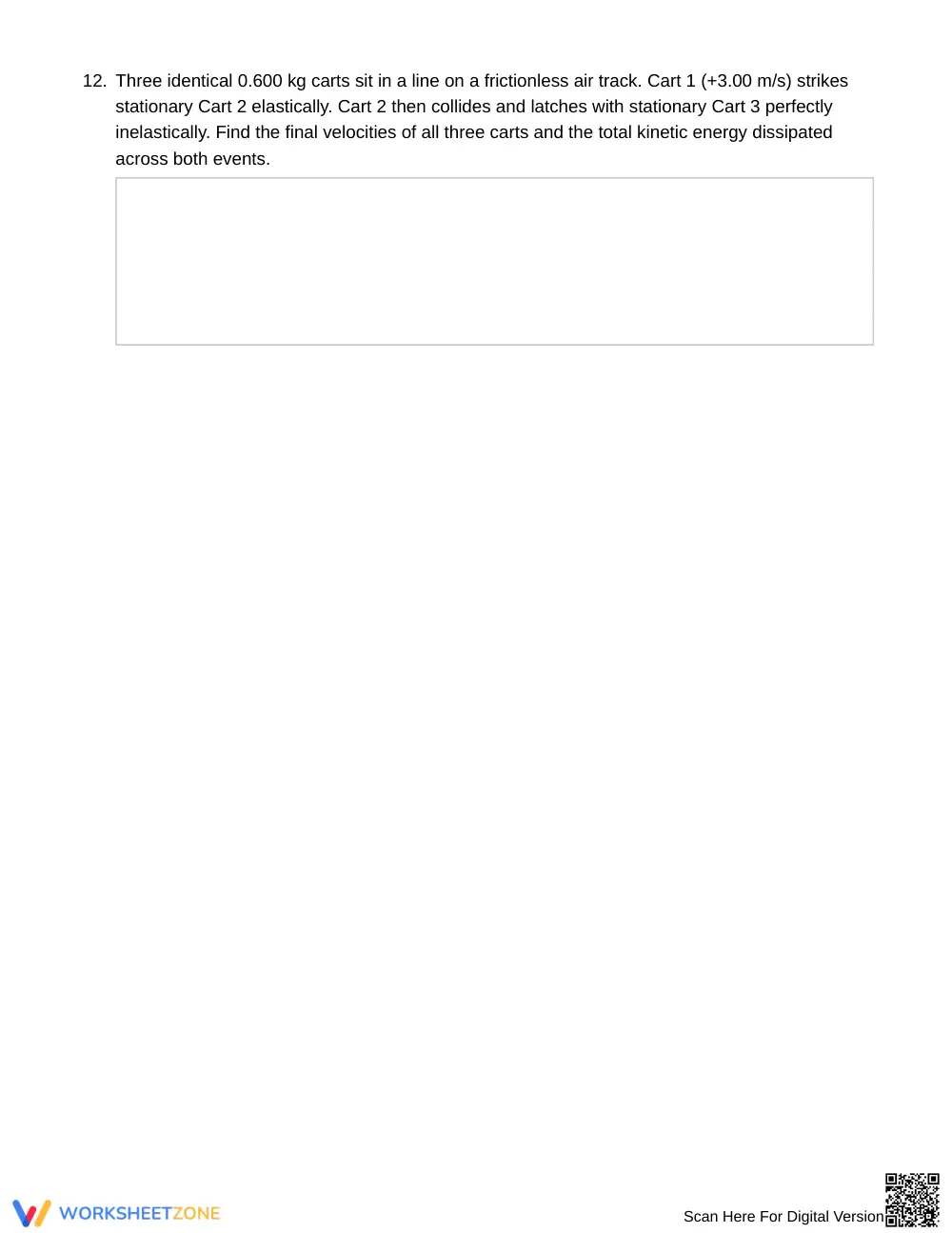
- Independent practice (Part C, 3 problems): Advanced synthesis involving time-dependent force integrals, nuclear scattering, and multi-stage interactions.
This sequence follows a gradual-release model, moving students from single-concept calculations to multi-body mechanical analysis.
Standards Alignment
Aligned with high school advanced mechanics standards: students evaluate isolated systems to compute impulse, solve one-dimensional elastic and inelastic collisions, and quantify mechanical energy loss. Supporting concepts address force-time integration for variable forces. Both standard codes can be copied directly into lesson plans, IEP goals, or district curriculum mapping tools.
How to Use It
Assign this worksheet after direct instruction on linear momentum and energy transformations. Use Parts A and B for peer problem-solving to contrast elastic and inelastic collisions. Formative assessment tip: verify students preserve directional signs in velocity vectors before computing kinetic energy. Part C works well as an independent review or homework assignment taking 45 to 60 minutes.
Who It's For
Built for Grade 12 AP and honors physics students mastering mechanics. Differentiate by directing emerging learners to reference formulas while assigning Part C integrals to advanced students. Pair this set with collision-cart laboratory investigations to connect analytical equations with experimental data.
This Grade 12 physics resource builds student competency in analyzing elastic and inelastic collision outcomes through structured quantitative problem-solving. By calculating linear momentum conservation, mechanical energy loss, and impulse delivered by variable force profiles, learners develop systematic approaches to isolating closed systems. According to Fisher & Frey (2014), structured cognitive scaffolding combined with targeted gradual-release protocols significantly strengthens conceptual transfer and mathematical modeling in advanced secondary STEM coursework. The five-page sequence presents twelve rigorous problems, beginning with foundational impulse-momentum equations and progressing to multi-body interactions such as ballistic pendulums, spring-loaded cart separations, and time-dependent integral equations. Complete worked solutions on the two-page answer key allow instructors to monitor analytical missteps and verify sign conventions across one-dimensional collision trajectories efficiently, reinforcing critical diagnostic feedback during independent study sessions, targeted mechanics remediation, or AP Physics exam preparation.


