































Complete Ecosystem Energy Flow Worksheet | Grade 6 Science

Paste this activity's link or code into your existing LMS (Google Classroom, Canvas, Teams, Schoology, Moodle, etc.).
Students can open and work on the activity right away, with no student login required.
You'll still be able to track student progress and results from your teacher account.
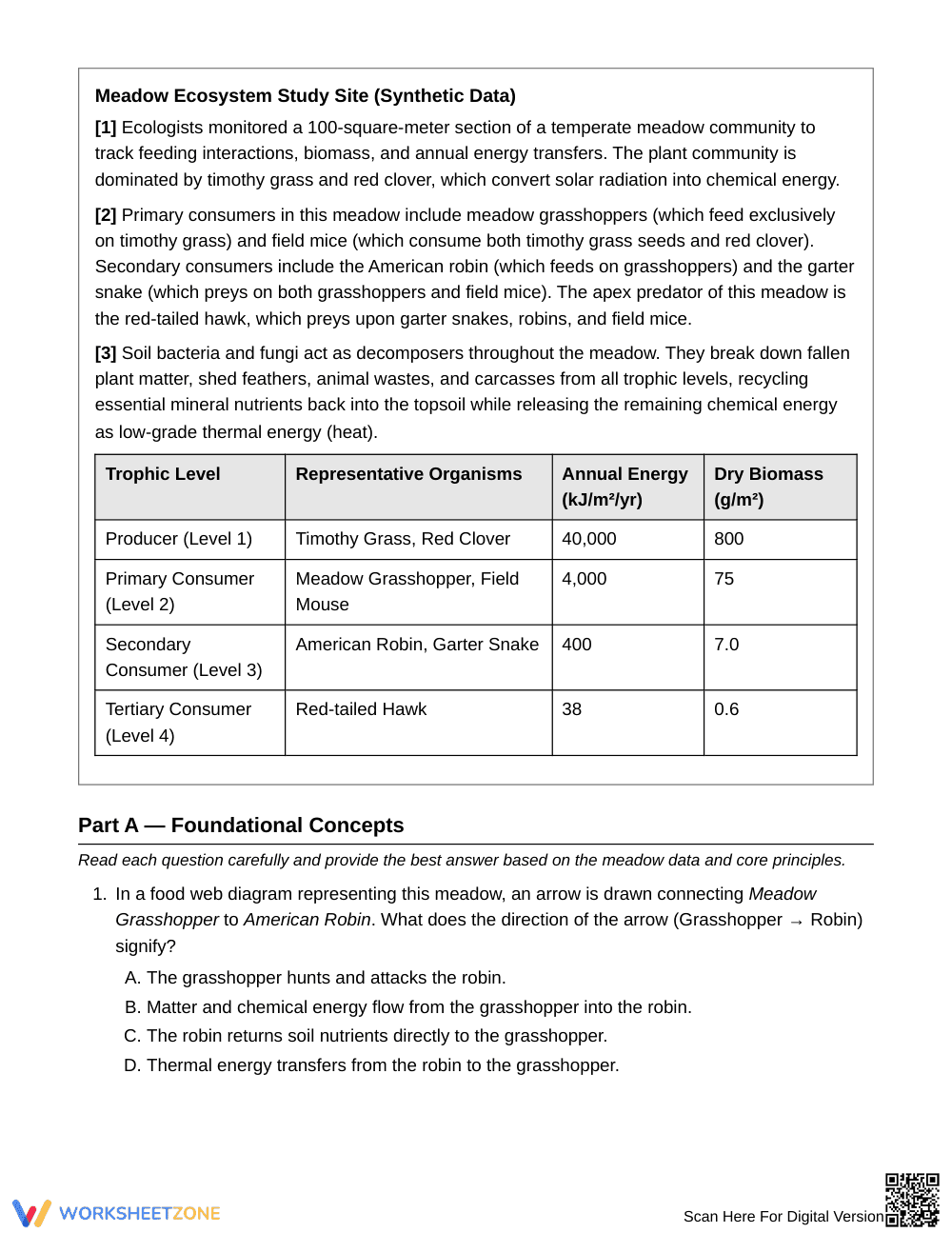
This Grade 6 science worksheet builds student mastery of food chains, food webs, and energy pyramids through structured ecological data analysis. Students trace energy transfer and matter cycling across a meadow community, calculating energy losses and evaluating claims. Twelve rigorous problems develop scientific comprehension and quantitative reasoning.
At a Glance
- Grade: 6 · Subject: Science
- Standard: Model energy transfer and matter cycling among living and nonliving ecosystem parts
- Skill Focus: Food chains, food webs, and trophic energy pyramids
- Format: 5 pages · 12 problems · Comprehensive answer key included · PDF
- Best For: Mid-unit formative assessment, classwork, or independent practice
- Time: 40–50 minutes
What's Inside
The 5-page packet provides a meadow ecosystem case study with synthetic biomass and energy tables across four trophic levels. Students complete multiple-choice conceptual checks, draw food chains, calculate trophic efficiency percentages, and write scientific explanations. A 3-page answer key provides complete calculations and model responses.
Skill Progression
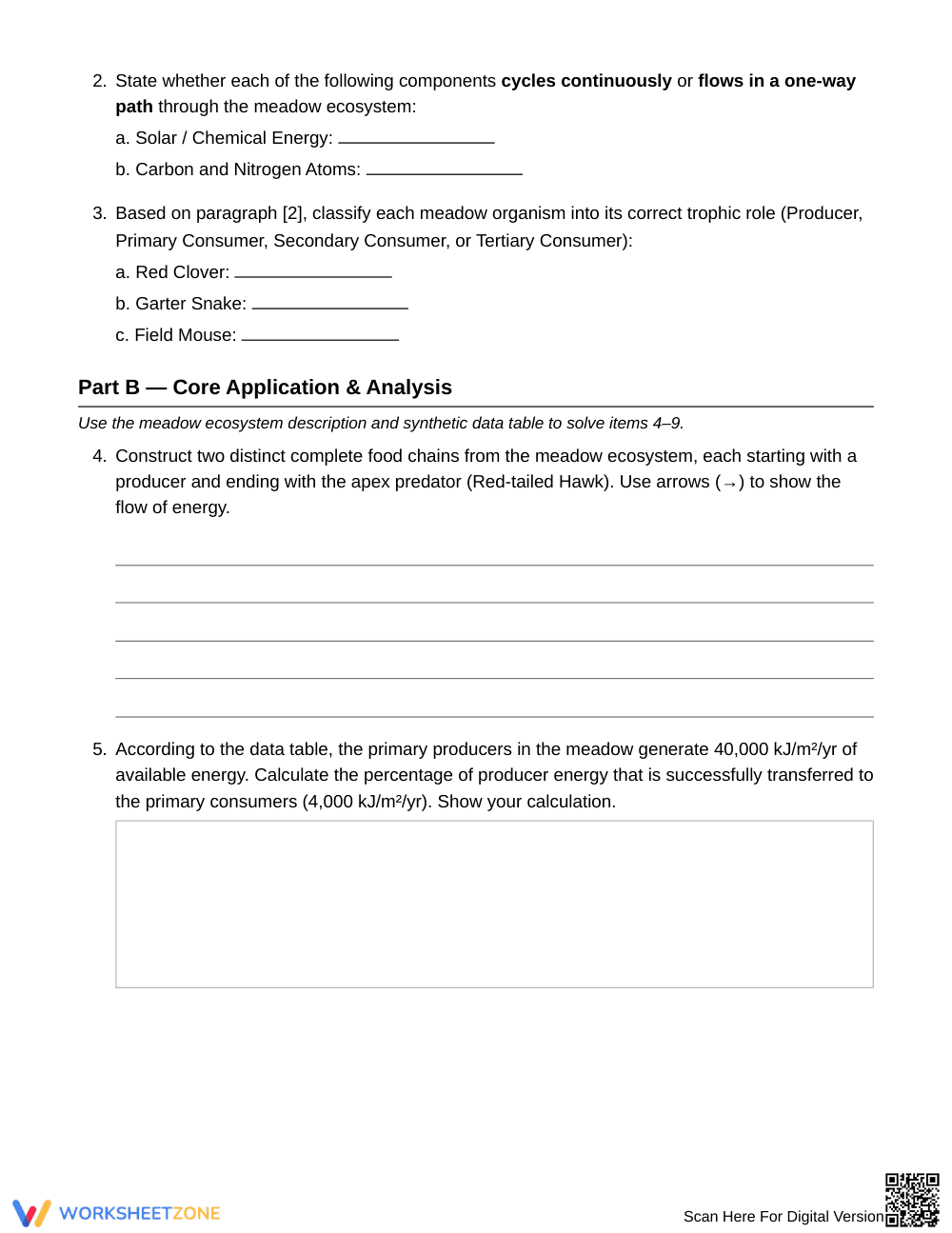
- Guided Practice (Items 1–3): Students identify energy arrow directions, differentiate matter cycling from one-way energy flow, and classify meadow organisms into trophic roles.
- Supported Practice (Items 4–9): Learners diagram food chains, calculate a 10% trophic efficiency percentage, explain biomass loss, evaluate decomposers, and predict population shifts after ecosystem disruptions.
- Independent Practice (Items 10–12): Students critique an energy pyramid misconception, apply thermodynamic limits to trophic levels, and contrast the long-term fates of carbon atoms versus solar energy.
This structure follows a gradual-release framework, advancing students from foundational recall to rigorous ecological synthesis.
Standards Alignment
This worksheet aligns with middle school life science standards requiring students to develop models describing the cycling of matter and flow of energy among organisms. The tasks emphasize that atoms cycle continuously while chemical energy dissipates as heat. Educators can paste this alignment into lesson plans, IEP goals, or district curriculum maps.
How to Use It
Assign this worksheet following direct instruction on trophic dynamics. Use item 5 as a formative checkpoint to ensure students calculate trophic transfer percentages accurately before attempting multi-step problems in item 8. Expect students to finish the 12 problems in 40 to 50 minutes.
Who It's For
This resource serves Grade 6 science students studying ecology. Scaffolds such as reference principles and data tables support emerging bilingual learners and Tier 2 intervention groups. Pair this worksheet with an interactive food web simulation or energy pyramid lesson.
Ecosystem science education requires middle school students to master the foundational distinction between matter cycling and unidirectional energy flow. According to research synthesized by Fisher & Frey (2014) on effective instructional scaffolding, structured shifts from foundational concept recognition to quantitative analysis and evidence-based justification significantly enhance conceptual retention in middle school science. This worksheet operationalizes that instructional progression across 12 targeted items using an authentic meadow ecosystem data set. By calculating trophic transfer efficiencies, constructing multi-tiered food chains, and evaluating biological misconceptions about energy pyramid geometries, Grade 6 learners develop measurable proficiency in modeling ecosystem energy dynamics. The resource links quantitative biomass metrics directly to biological principles such as cellular respiration and heat dissipation. Teachers utilizing this rigorous curriculum tool receive verified instructional materials that reinforce standards-aligned ecological literacy while assessing student ability to analyze empirical scientific phenomena with precision.


