
































Complete Dynamic Symbolism Worksheet | Grade 9 English I

Paste this activity's link or code into your existing LMS (Google Classroom, Canvas, Teams, Schoology, Moodle, etc.).
Students can open and work on the activity right away, with no student login required.
You'll still be able to track student progress and results from your teacher account.
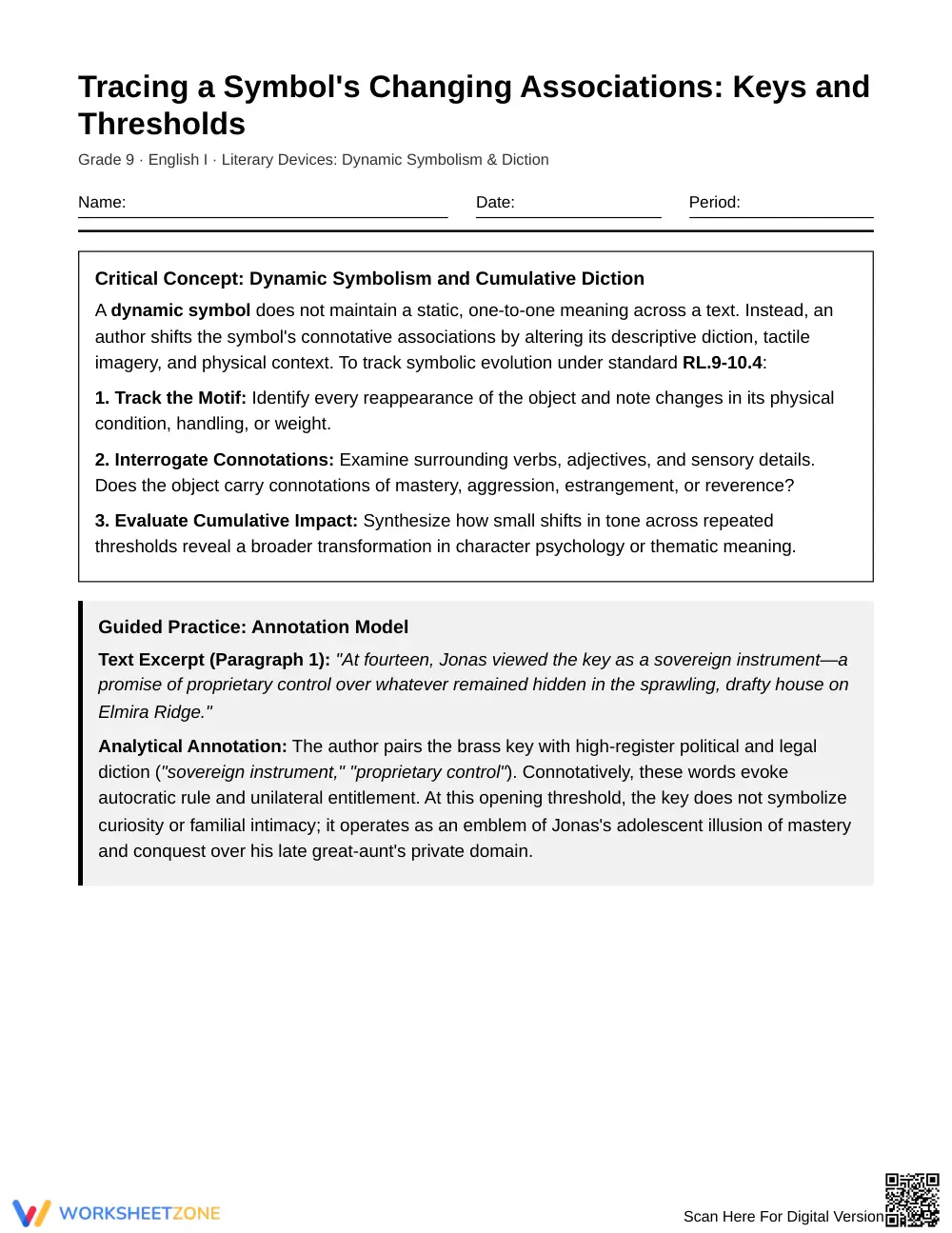
This Grade 9 English I worksheet trains students to trace how an author alters a symbol's meaning across a narrative using shifting diction. Through structured analysis of an original story, high school readers unpack dynamic symbolism, evaluate connotative weight, and construct evidence-based literary arguments.
At a Glance
- Grade: 9 · Subject: English I
- Standard:
RL.9-10.4— Determine figurative and connotative meanings and analyze cumulative impact on tone- Skill Focus: Trace a Symbol's Changing Associations
- Format: 6 pages · 10 problems · Answer key included · PDF
- Best For: Close reading analysis and literary synthesis
- Time: 45–60 minutes
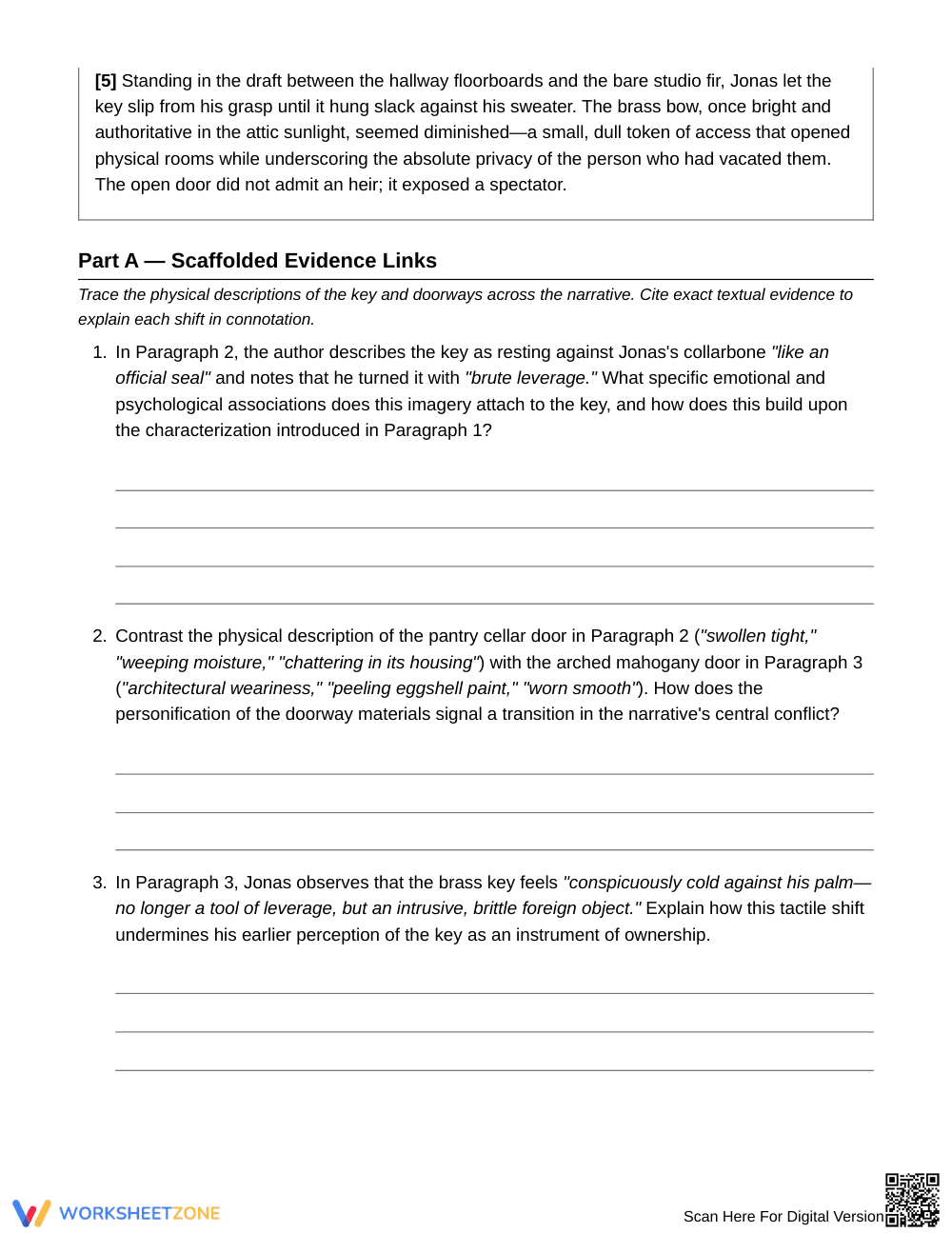
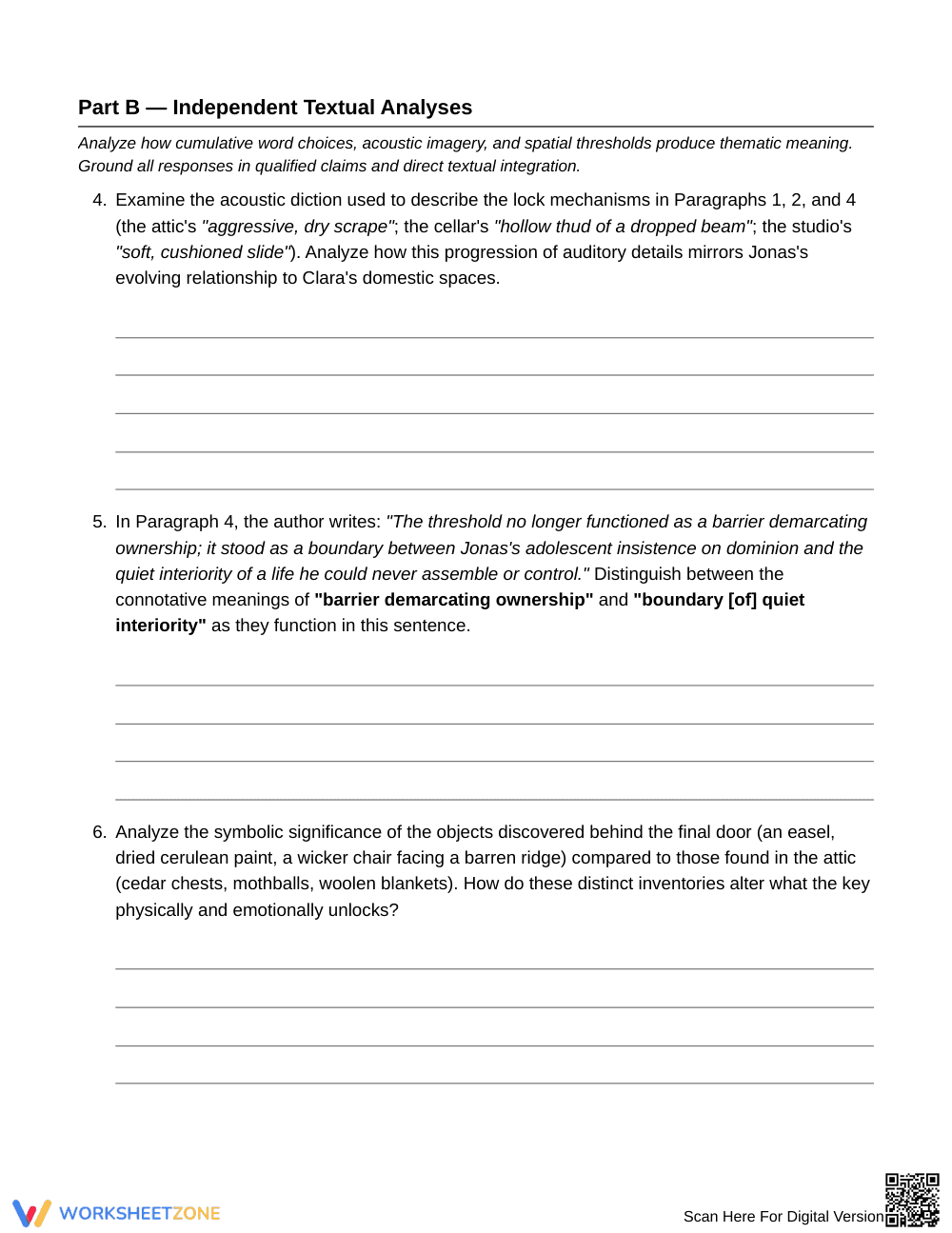
This 6-page printable resource includes the full text "The Thresholds of Elmira Ridge," a modeled annotation exemplar, and 10 analytical tasks. A 4-page answer key provides complete model annotations, sample written responses, and detailed rationale for each question.
Skill Progression
- Guided practice: A conceptual box and teacher-modeled annotation demonstrate how political diction establishes initial symbolic meaning.
- Supported practice: Part A offers 3 scaffolded prompts prompting students to cite tactile, spatial, and acoustic details tracing symbolic shifts.
- Independent practice: Parts B and C present 5 analytical prompts, a synthesis essay, and 2 multiple-choice checks on cumulative diction.
This structure utilizes an I Do, We Do, You Do gradual-release model to build independent analytical mastery.
Standards Alignment
This worksheet directly addresses primary standard `RL.9-10.4`: Determine the meaning of words and phrases as they are used in text, including figurative and connotative meanings, and analyze cumulative word choice impacts. It also supports `RL.9-10.1` through rigorous textual citation requirements. Both standard codes can be copied directly into lesson plans, IEP goals, or district curriculum mapping tools.
How to Use It
Assign this worksheet following direct instruction on figurative language or as a 45-to-60-minute formative assessment. As a formative check, observe whether students identify how descriptive modifiers transform the protagonist's attitude toward the key across paragraphs.
Who It's For
Designed for Grade 9 English I students, this activity supports on-level and advanced readers. Differentiate by pre-highlighting contrasting sensory words in the text, pairing this activity with an anchor chart on connotative diction.
According to Fisher & Frey (2014), structured close reading routines that isolate how authors craft dynamic motifs empower high school students to move beyond surface-level comprehension into sophisticated textual critique. This worksheet operationalizes standard `RL.9-10.4` by guiding Grade 9 English I learners through a deliberate analysis of figurative language, tactile imagery, and cumulative diction. Rather than treating literary symbols as fixed equations, students investigate how an author actively reshapes an object's connotative weight across repeated narrative thresholds. The 10 included analytical tasks require students to track sensory details, articulate character psychology, and construct evidence-based interpretive claims. By pairing teacher modeling with scaffolded textual analysis and rigorous independent synthesis, this resource provides an instructional framework that deepens high school literacy skills, reinforces rigorous textual evaluation, and fosters independent analytical mastery across complex literary works.


