


























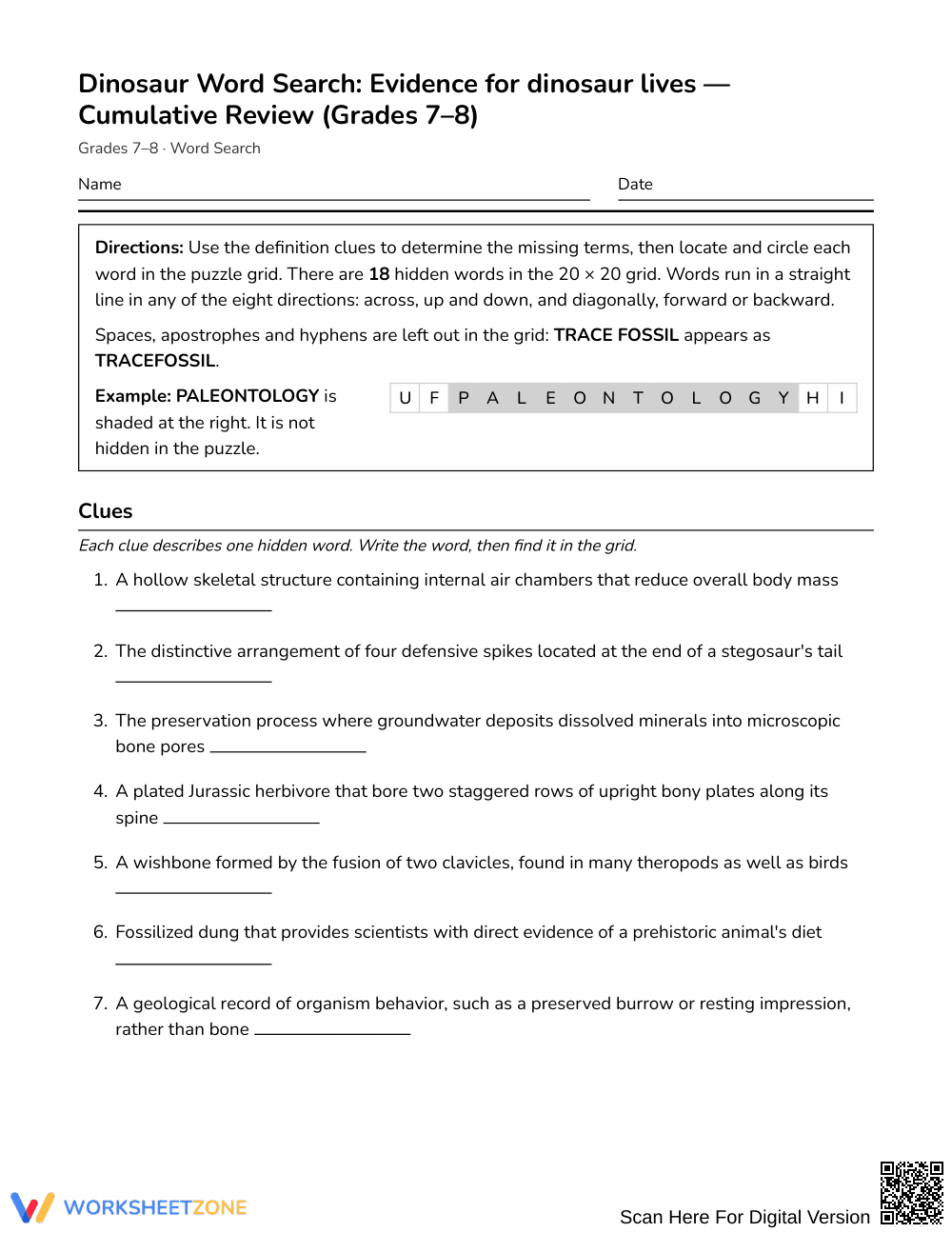


Complete Dinosaur Evidence Word Search | Grades 7–8 Science
Paste this activity's link or code into your existing LMS (Google Classroom, Canvas, Teams, Schoology, Moodle, etc.).
Students can open and work on the activity right away, with no student login required.
You'll still be able to track student progress and results from your teacher account.
This science word search reinforces paleontology vocabulary centered on evidence for dinosaur lives. Designed for Grades 7–8, the activity challenges students to analyze 18 clues covering trace fossils, skeletal adaptations, and excavation processes. Students match definitions to scientific terms before searching the puzzle grid, strengthening content comprehension.
At a Glance
- Grade: Grades 7–8 · Subject: Science (Fossils and Paleontology)
- Standard: Not standards-assessed — vocabulary enrichment
- Skill Focus: Evidence for dinosaur lives and paleontology vocabulary
- Format: 3 pages · 18 words · 4-page answer key included · PDF
- Best For: Cumulative vocabulary review, fast finishers, and independent unit reinforcement
- Time: 20–30 minutes
The 3-page printable activity features 18 hidden vocabulary terms embedded in a letter grid. Rather than simply scanning for pre-listed spellings, students read scientific definition clues describing fossil formation, anatomical structures, and diagnostic traces. A shuffled word bank offers reference support as students identify terms like coprolite, gastrolith, taphonomy, and thagomizer. A complete 4-page answer key provides clear grid overlays showing exact letter placements for rapid verification.
This vocabulary activity functions as a content-driven puzzle testing term recall and visual scanning. The word search features a 20 by 20 grid containing 18 hidden terms running in all eight compass directions: north, northeast, east, southeast, south, southwest, west, and northwest. Words read forward, backward, or diagonally. Because the word bank is shuffled, learners read the 18 definition clues to deduce each concept before locating it among overlapping letters.
This resource serves as targeted vocabulary enrichment and is not aligned to an assessed state standard. It reinforces essential paleontology terminology—including sediment layers, biostratigraphy, pneumatic bones, and osteoderms—supporting secondary science units on fossil evidence, prehistoric ecosystems, and evolutionary history.
Deploy this word search during an introductory vocabulary session, as an anchor activity for early finishers, or during cumulative review. For a collaborative review, have students work in pairs to identify the 18 terms from definition clues before finding words in the grid. During independent completion, observe whether students deduce terms from clues or rely on word bank letter patterns. The activity takes 20 to 30 minutes.
This activity is designed for middle school science classes in Grades 7–8 studying earth history, fossils, and prehistoric life. To support developing readers, teachers can highlight word roots in the shuffled bank. Advanced learners can extend the activity by classifying all 18 terms into trace evidence, skeletal anatomy, or preservation processes. Pair this puzzle with an introductory fossil lab or an anchor chart on geologic time.
Science vocabulary acquisition requires repeated contextual exposure and active cognitive processing rather than passive rote memorization. According to Fisher & Frey (2014), intentional word study activities that combine definitional reasoning with visual search support long-term domain-specific lexical retention. This 18-word paleontology puzzle operationalizes that research by requiring students in Grades 7–8 to analyze descriptive definition clues for concepts such as taphonomy, biostratigraphy, and permineralization before executing search routines across a 20 by 20 grid. Connecting conceptual descriptions to scientific terminology reinforces academic language, strengthening students' ability to comprehend complex informational texts on fossilization and prehistoric life. Furthermore, such active problem solving stimulates sustained attention, fostering academic persistence during independent practice and collaborative review sessions. Clue-driven vocabulary tasks effectively bridge the gap between initial direct instruction and independent scientific literacy, ensuring students retain critical academic terminology across multi-week science units.


