




























Views
Downloads



Complete Density Discrepancy Worksheet | Grade 8 Science

Paste this activity's link or code into your existing LMS (Google Classroom, Canvas, Teams, Schoology, Moodle, etc.).
Students can open and work on the activity right away, with no student login required.
You'll still be able to track student progress and results from your teacher account.
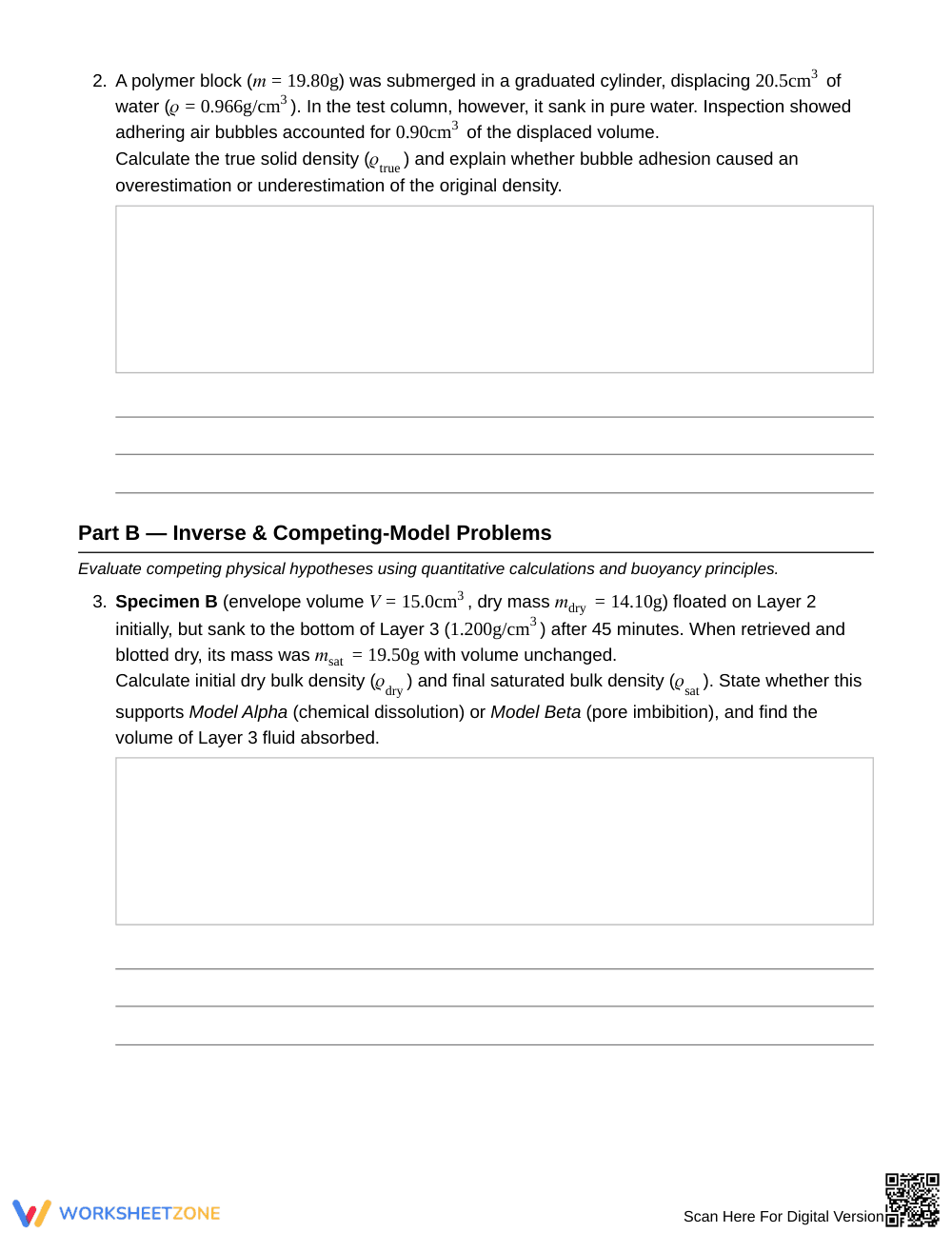
This physical science worksheet equips Grade 8 students to resolve experimental density anomalies through mathematical modeling and error analysis. Learners evaluate six multi-step scenarios involving multi-layer fluid columns, bubble bias, and fluid absorption to defend why unexpected sinking or floating behaviors uphold physical laws.
At a Glance
- Grade: 8 · Subject: Science
- Standard:
Physical Science— Analyze and interpret data on characteristic properties of substances- Skill Focus: Reconcile an Apparently Inconsistent Floating Observation
- Format: 4 pages · 6 problems · Answer key included · PDF
- Best For: Buoyancy mastery and lab error analysis
- Time: 45–60 minutes
This 4-page worksheet contains six quantitative tasks across three analytical sections. Students use a 3-layer density reference column (oil, water, glycerol) and uncertainty formulas to calculate density bounds, evaluate bubble-induced displacement errors, model fluid absorption in porous solids, and review work with a two-page answer key.
Skill Progression
- Guided practice (Part A, Problems 1–2): Students apply uncertainty bounds and volume displacement corrections to identify systematic air bubble bias with formula support.
- Supported practice (Part B, Problems 3–5): Learners evaluate competing physical models, calculating dry versus saturated densities and interfacial fluid equilibrium without prompts.
- Independent practice (Part C, Problem 6): Students write a Claim-Evidence-Reasoning response refuting misconceptions about characteristic properties.
This progression uses the gradual-release model to move students from error calculation to scientific argumentation.
Standards Alignment
This worksheet aligns with middle school physical science standards for analyzing and interpreting data on characteristic properties like density. Supporting expectations include modeling how volume displacement affects floating behavior. Both standard codes can be copied directly into lesson plans, IEP goals, or district curriculum mapping tools.
How to Use It
Use this resource after direct instruction on density and Archimedes' principle. In small groups, assign Part A to resolve experimental discrepancies. For formative assessment, check Part B calculations to ensure students distinguish bulk from saturated density. Students complete all 6 tasks in 45 to 60 minutes.
Who It's For
This resource is designed for Grade 8 physical science students and advanced middle school learners needing rigorous calculation practice. Pair this worksheet directly with a 3-layer density column demonstration or buoyancy lab.
Targeting middle school physical science standards, this 4-page density worksheet provides 6 structured analytical tasks designed to reconcile counterintuitive floating and sinking phenomena. Students apply mathematical uncertainty formulas, investigate systematic displacement errors, and differentiate between dry bulk, saturated, and skeletal material densities across multi-layer fluid columns. According to Fisher & Frey (2014), structured cognitive progressions that move systematically from guided quantitative modeling to defended Claim-Evidence-Reasoning arguments significantly improve conceptual retention in complex science domains. By confronting common misconceptions—such as assuming unexpected sinking invalidates density as a characteristic property—learners develop robust critical thinking and quantitative error analysis skills. The included 2-page answer key provides full mathematical derivations, boundary values, and exemplar scientific explanations, making this resource an effective tool for rigorous middle school laboratory integration and standards-aligned physical science mastery.


