































Complete Day of the Dead Word Search | Grades 7–8 ELA

Paste this activity's link or code into your existing LMS (Google Classroom, Canvas, Teams, Schoology, Moodle, etc.).
Students can open and work on the activity right away, with no student login required.
You'll still be able to track student progress and results from your teacher account.
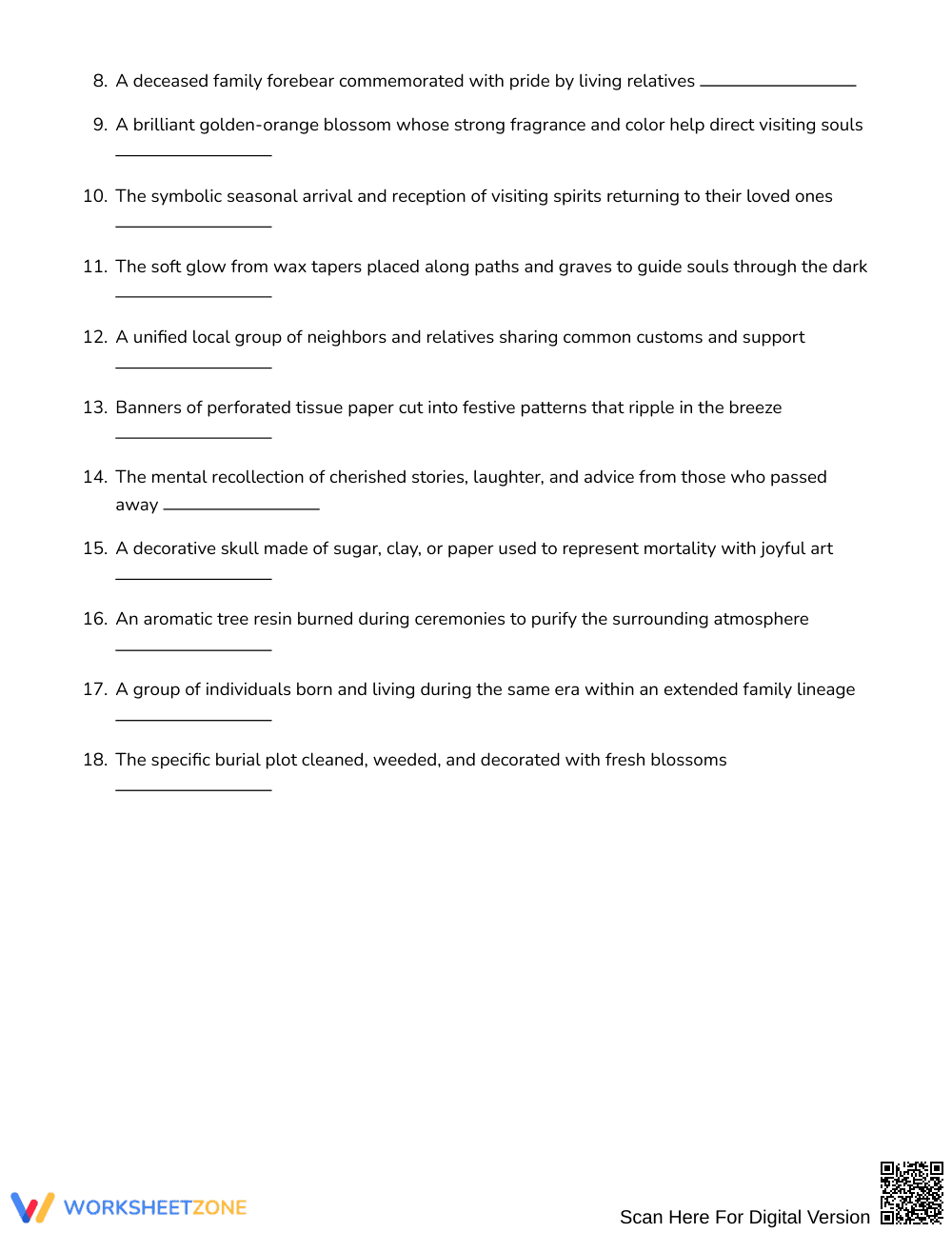
This cultural vocabulary word search reinforces 18 key terms related to Day of the Dead traditions and remembrance for middle school students. Students read descriptive clues to identify terms like ofrenda, cempasúchil, and calavera before finding them in the puzzle grid. The activity strengthens contextual vocabulary and cultural literacy without requiring prep work.
At a Glance
- Grade: Grades 7–8 middle school · Subject: English Language Arts (ELA)
- Standard: Not standards-assessed — vocabulary enrichment
- Skill Focus: Cultural vocabulary: people, places, and remembrance
- Format: 3 printable pages · 18 hidden words · Complete answer key included · PDF format
- Best For: Cultural vocabulary review, seasonal units, and independent enrichment
- Time: 25–35 minutes
What's Inside
This 3-page printable activity features 18 vocabulary terms paired with descriptive clues instead of a standard list. Students read each definition to determine the target word before searching the puzzle. The resource includes a complete 4-page answer key showing exact letter coordinates for easy self-checking or teacher review.
Puzzle Mechanics and Structure
The activity centers on a 20 x 20 letter grid designed for middle school learners. Hidden terms run in eight directions: North, Northeast, East, Southeast, South, Southwest, West, and Northwest. Rather than providing an alphabetized list, the worksheet includes a shuffled word bank paired with clues, requiring learners to connect definitions to terms prior to scanning.
Standards Alignment
This resource serves as targeted vocabulary enrichment and cultural exploration; it is not aligned to a specific standard. Instead of assessing discrete test standards, the puzzle emphasizes contextual comprehension, domain-specific terminology, and morphological familiarity across seasonal cultural traditions.
How to Use It
Deploy this activity during an autumn cultural unit or following direct instruction on regional traditions. Assign the puzzle as a collaborative partner exercise where students solve clues together before finding terms, or use it as an engaging independent sub plan. Observe whether students solve definitions conceptually before searching. Completion typically takes 25 to 35 minutes.
Who It's For
This worksheet is tailored for students in Grades 7–8 in ELA or world humanities classes. For emerging bilingual learners, pair the clues with an illustrated anchor chart of cultural artifacts. For advanced students, challenge them to use five terms in an explanatory paragraph. It pairs naturally with informational texts about Mexican cultural heritage.
Direct exposure to domain-specific vocabulary within thematic contexts strengthens reading comprehension and long-term memory. Research by Fisher & Frey (2014) on secondary literacy emphasizes that intentional vocabulary acquisition occurs most effectively when students encounter terms across varied instructional formats, combining contextual definitions with active task engagement. This 18-word review puzzle reinforces robust semantic networks around cultural remembrance, family lineage, and community customs without isolating words from their descriptive meanings. By requiring middle school students in Grades 7–8 to analyze detailed clues prior to locating target vocabulary across an eight-directional 20 x 20 grid, the task promotes deliberate cognitive processing rather than passive scanning. Such structured word study reinforces academic language, supports orthographic mapping, and deepens cross-cultural background knowledge essential for comprehending complex informational texts across secondary English Language Arts curricula.


