































Complete Dalton's Law Worksheet | Grades 9-12 Science

Paste this activity's link or code into your existing LMS (Google Classroom, Canvas, Teams, Schoology, Moodle, etc.).
Students can open and work on the activity right away, with no student login required.
You'll still be able to track student progress and results from your teacher account.
This Dalton's Law worksheet guides high school chemistry students through targeted misconception and error analysis. Students evaluate flawed claims, analyze particle models, and calculate mole fractions. Across 22 structured items, learners correct common mistakes and build conceptual and quantitative mastery of gas mixtures.
At a Glance
- Grade: Grades 9–12 · Subject: Science (Chemistry)
- Standard: Gas Laws — Calculate partial pressures and explain gas mixtures using particle models
- Skill Focus: Dalton's Law error analysis and mole fractions
- Format: 4 pages · 22 problems · Answer key included · PDF
- Best For: Post-lecture misconception remediation and review
- Time: 45–60 minutes
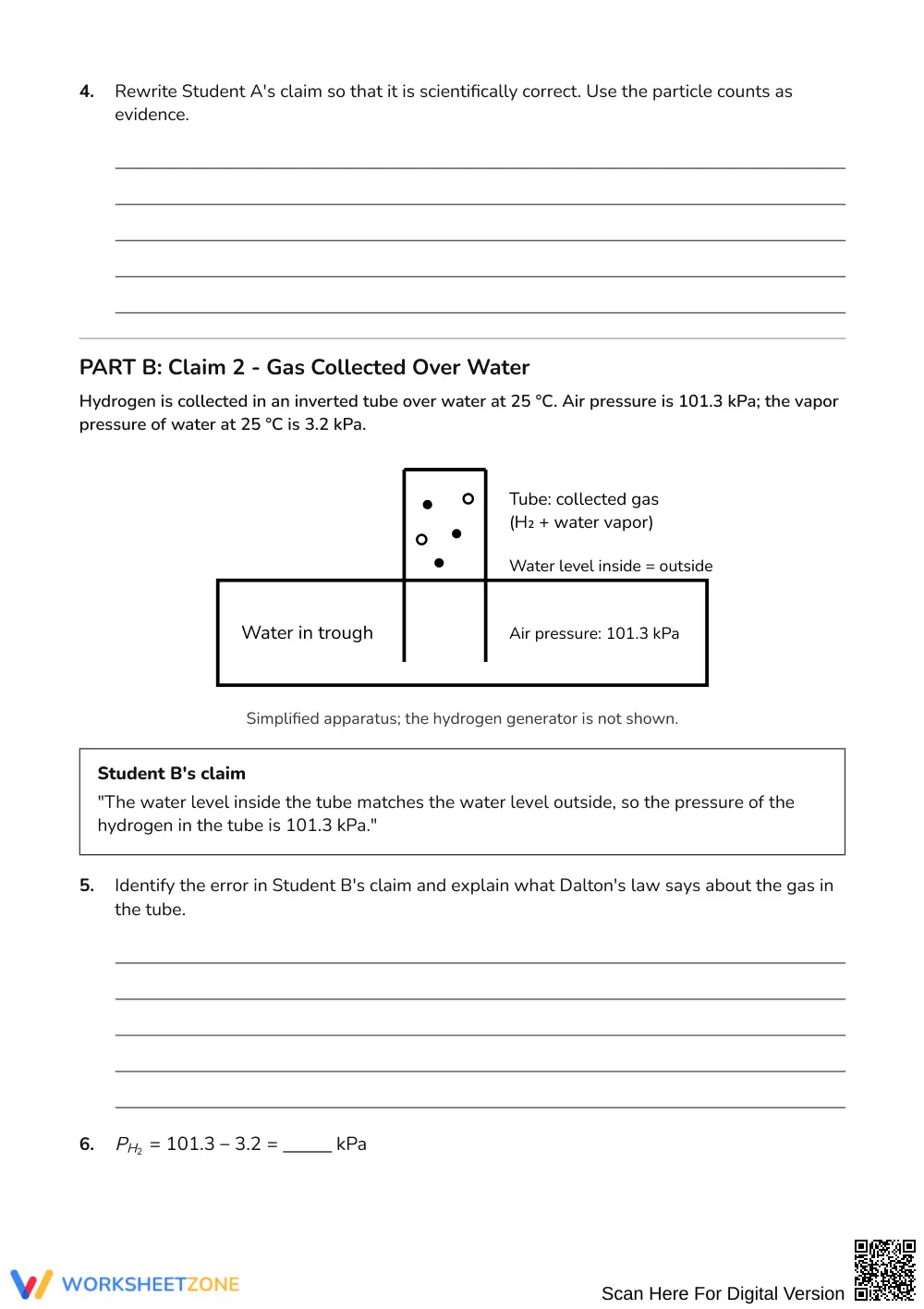
This 4-page worksheet presents 22 tasks organized into four misconception scenarios: equal pressure assumptions, vapor pressure in water collection, thermal expansion effects, and mole fraction ratio errors. Students analyze diagrams, interpret data tables, and write scientific explanations. A comprehensive 4-page answer key provides complete mathematical setups.
Skill Progression
- Guided practice (Tasks 1–6): Part A uses particle models to debunk equal-sharing assumptions, prompting students to calculate partial pressures using mole fractions.
- Supported practice (Tasks 7–15): Parts B and C guide students through water vapor corrections in gas collection and temperature effects on gas mixtures.
- Independent practice (Tasks 16–22): Part D tasks students with diagnosing formula ratio errors and explaining collision dynamics independently.
This structure follows the gradual release model from visual scaffolding to independent conceptual justification.
Standards Alignment
This resource addresses high school chemistry standards governing the kinetic molecular theory of gases and mixture pressure calculations. Students use mathematical representations and particle models to calculate partial pressures and justify system behavior under changing conditions. Teachers can copy these learning objectives directly into unit plans or IEP goals.
How to Use It
Use this worksheet after direct instruction on gas laws as an error-analysis workshop or test review. As students work, check Part B to confirm they subtract vapor pressure before calculating moles. Expect completion within 45 to 60 minutes.
Who It's For
Designed for Grades 9–12 general, honors, and AP Chemistry students tackling gas laws. Scaffolding supports developing learners, while conceptual justifications challenge advanced students. Pair this with a direct instruction lesson on kinetic molecular theory.
According to research on cognitive scaffolding and error reflection by Fisher & Frey (2014), engaging students in analyzing non-examples and authentic misconceptions produces deeper conceptual understanding than traditional repetitive drills. This Grade 9–12 chemistry worksheet operationalizes that instructional model through Dalton's Law of Partial Pressure, requiring high school students to evaluate flawed claims, calculate mole fractions, and justify gas behavior at the particulate level across 22 rigorous problems. By prompting learners to diagnose why an equal-split assumption fails, how water vapor alters total pressure in pneumatic collection, and why ratio errors distort partial pressure calculations, the resource transforms passive formula memorization into active diagnostic reasoning. This pedagogical approach strengthens quantitative problem solving and solidifies the particulate nature of matter, making this 4-page student activity and its matching 4-page answer key an effective standards-aligned tool for secondary chemistry classrooms.


