































Complete Creative Play Word Search | Grade 3 ELA

Paste this activity's link or code into your existing LMS (Google Classroom, Canvas, Teams, Schoology, Moodle, etc.).
Students can open and work on the activity right away, with no student login required.
You'll still be able to track student progress and results from your teacher account.
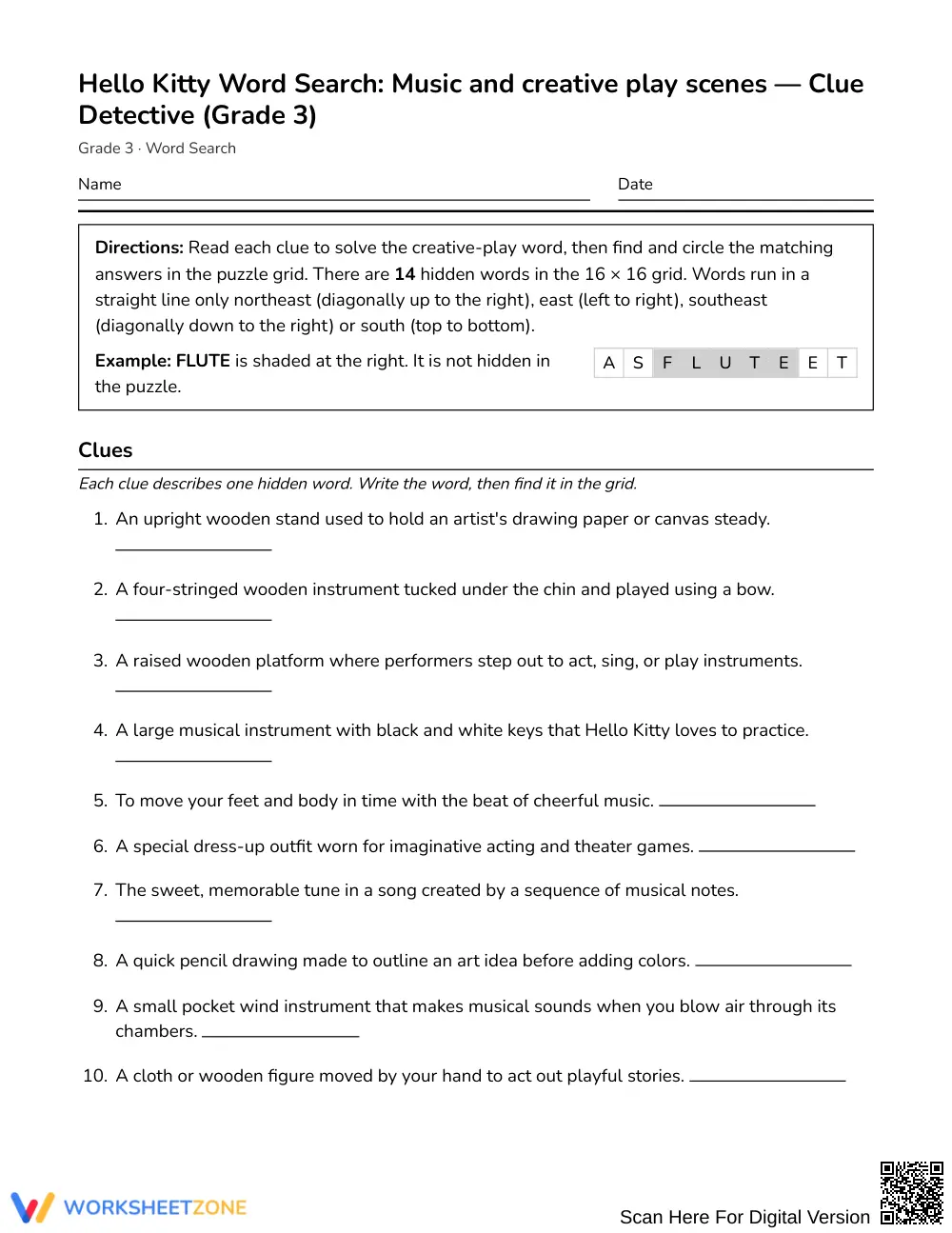
This Grade 3 English Language Arts word search builds essential arts vocabulary through clue-based word identification. Students read descriptive definitions of creative play and musical performance terms to deduce target vocabulary words before locating them in the puzzle grid. The activity reinforces semantic memory, spelling patterns, and context clue reading skills.
At a Glance
- Grade: Grade 3 · Subject: English Language Arts
- Standard: Not standards-assessed — vocabulary enrichment
- Skill Focus: Music and creative play vocabulary
- Format: 3 pages · 14 words · Answer key included · PDF
- Best For: Vocabulary enrichment and early finishers
- Time: 20–30 minutes
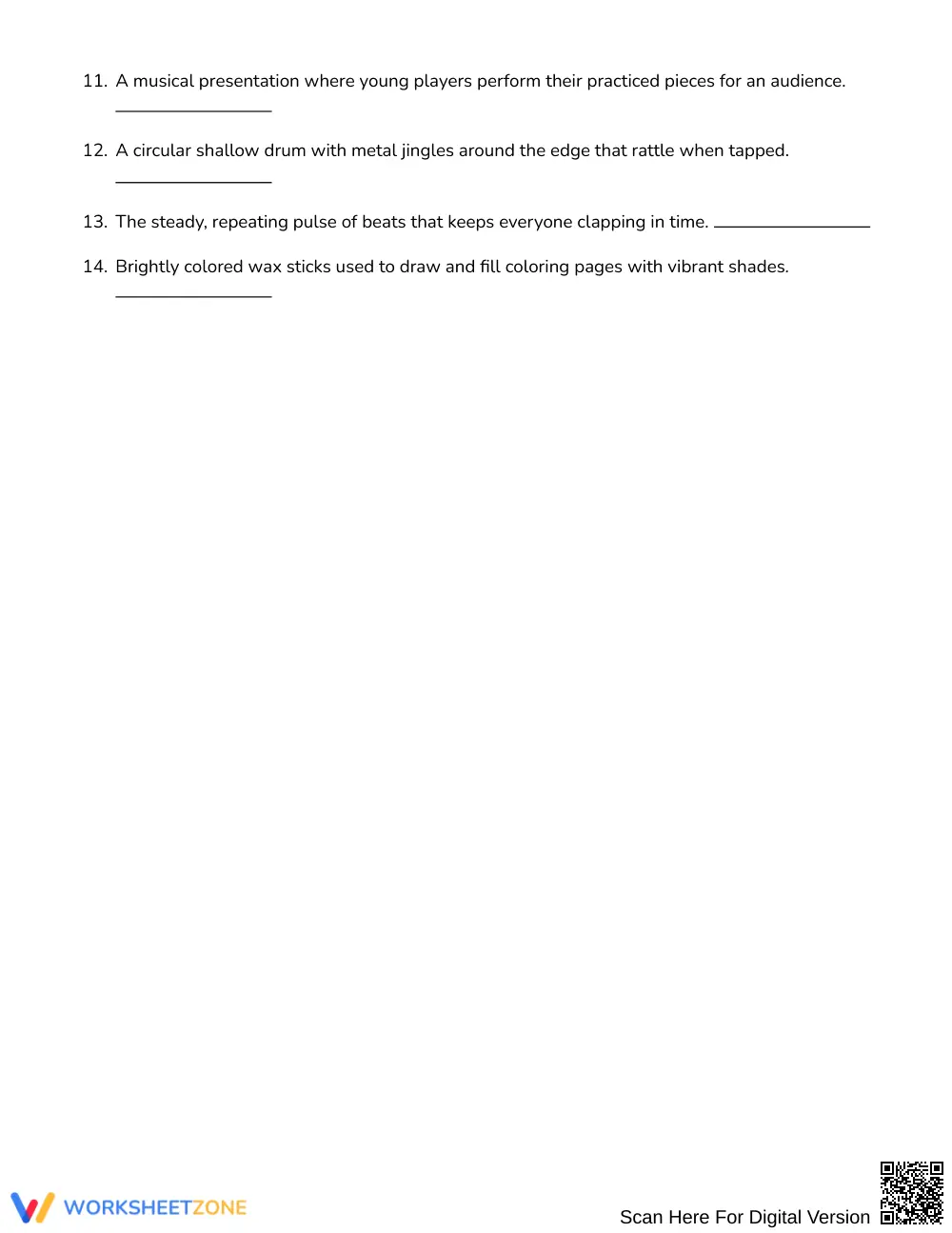
This resource spans 3 pages designed for clear reading and student engagement, accompanied by a 3-page full-size answer key. Instead of a basic word bank, each of the 14 words features a descriptive clue that challenges learners to identify instruments, theatrical props, and fine arts concepts before hunting for each term.
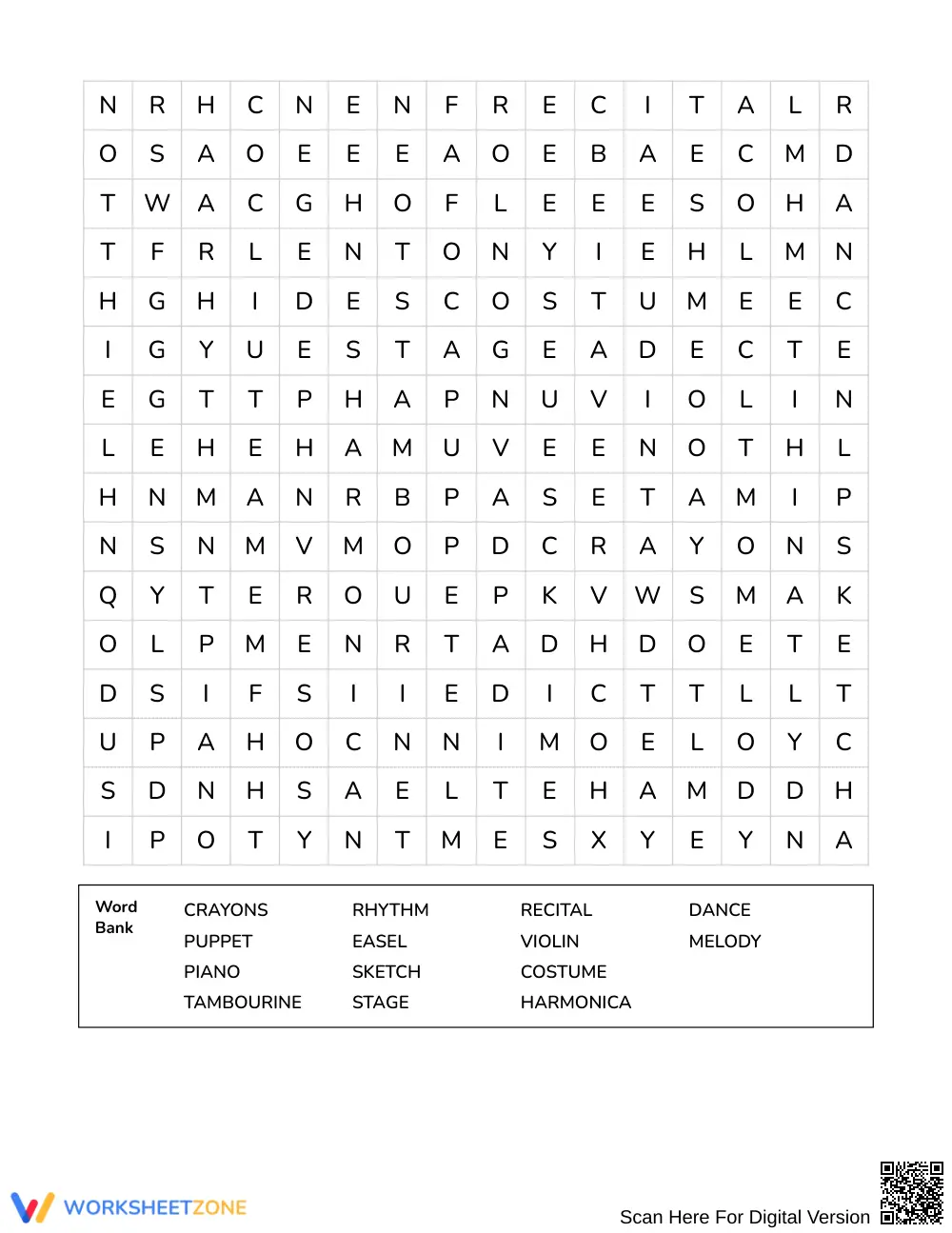
The puzzle is built upon a 16 by 16 letter grid designed specifically for third-grade readers. Hidden words run in four distinct directions: northeast, east, southeast, and south. Rather than scanning aimlessly, students consult shuffled clue definitions to determine target vocabulary such as harmonica, recital, and costume, combining reading comprehension directly with spatial word searching.
This activity provides targeted vocabulary enrichment and is not aligned to a specific academic standard. It supports domain-specific language acquisition in music and the arts, helping third graders develop expressive vocabulary and context decoding skills that strengthen broader literacy and reading comprehension routines across disciplines.
Introduce this word search after direct instruction on context clues or during an arts-integrated literacy unit. For independent work, students read each clue silently, write their predicted word, and search the 16 by 16 grid. Alternatively, use it during small-group literacy centers where peers read clues aloud. Formatively observe whether students deduce words from definitions before searching or rely solely on letter matching. Expect completion in 20 to 30 minutes.
This word search is designed for Grade 3 elementary learners expanding their descriptive vocabulary in creative arts. It offers accessible engagement for developing readers through clear clue definitions and moderate grid density. Pair this puzzle with an arts-themed informational read-aloud or a dramatic play writing station to reinforce target terms in expressive writing.
Vocabulary acquisition research highlights the instructional value of pairing definitional clues with active retrieval tasks during elementary literacy instruction. According to Fisher & Frey (2014), intentional word exposure embedded within engaging, context-rich tasks significantly strengthens semantic associations and long-term lexical retention among developing readers. This 3-page Grade 3 word search emphasizes vocabulary enrichment across 14 arts and music terms, including instruments, performance settings, and creative tools. By requiring students to read detailed descriptive clues rather than copying an explicit list, the activity promotes active cognitive retrieval and syntactic reasoning. The structured 16 by 16 letter grid directs spatial tracking across four search orientations, reinforcing orthographic awareness and phonemic decoding. Educators can efficiently deploy these 14 clue-driven tasks within literacy centers, quiet independent study, or arts integration units to build confident readers with rich expressive vocabularies.


