































Complete Cost Expressions Worksheet | Grade 6 Math

Paste this activity's link or code into your existing LMS (Google Classroom, Canvas, Teams, Schoology, Moodle, etc.).
Students can open and work on the activity right away, with no student login required.
You'll still be able to track student progress and results from your teacher account.
Mastering equivalent algebraic expressions helps Grade 6 students connect abstract variables to real-world spending decisions. This four-page worksheet delivers ten targeted problems where learners apply the distributive property to model group purchases, convert between factored and expanded cost forms, and analyze budget constraints with clarity and precision.
At a Glance
- Grade: 6 · Subject: Math
- Standard:
6.EE.A.3— Apply properties of operations to generate equivalent linear expressions- Skill Focus: Rewriting Cost Expressions
- Format: 4 pages · 10 problems · Answer key included · PDF
- Best For: Core instruction and independent practice
- Time: 40–50 minutes
What's Inside
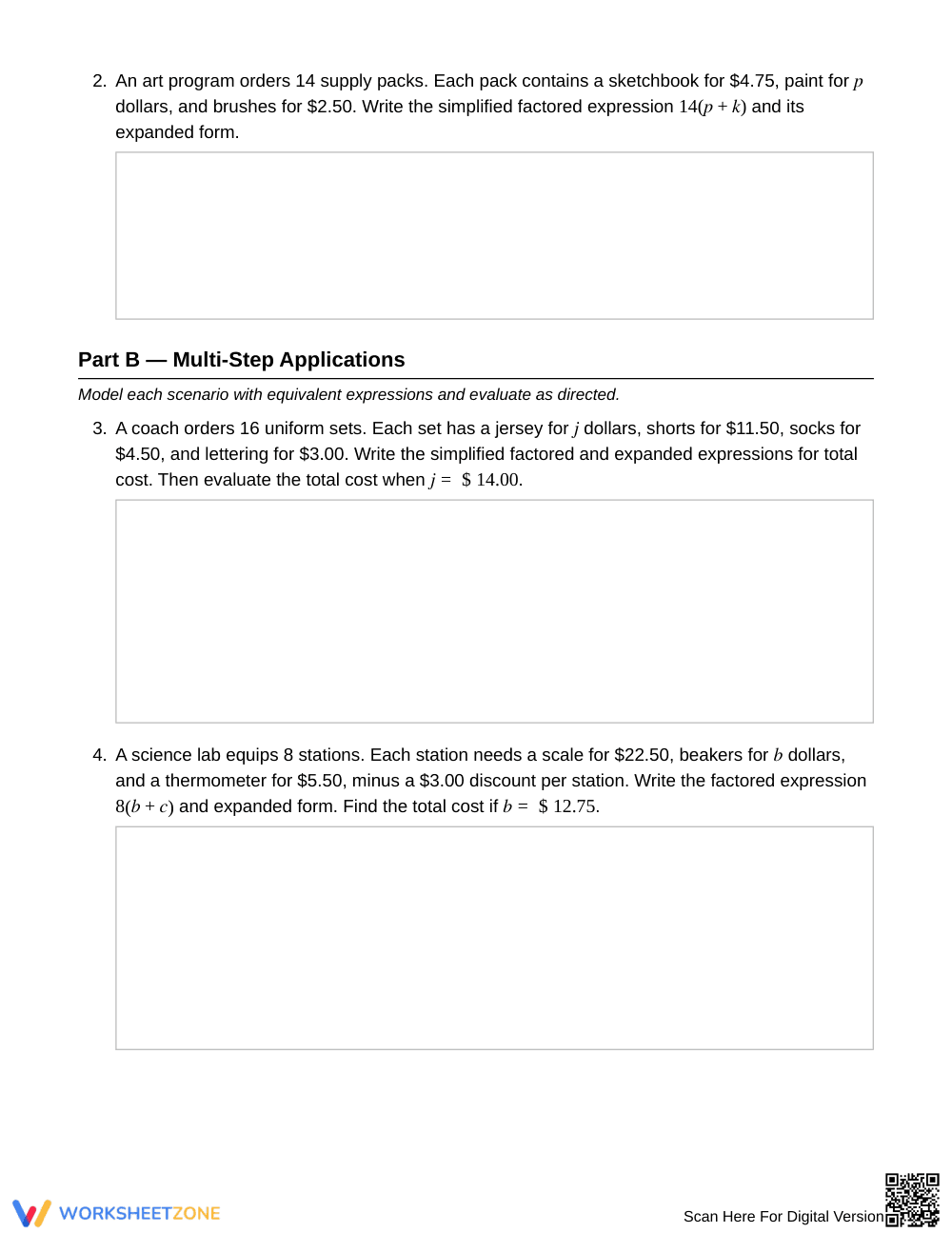
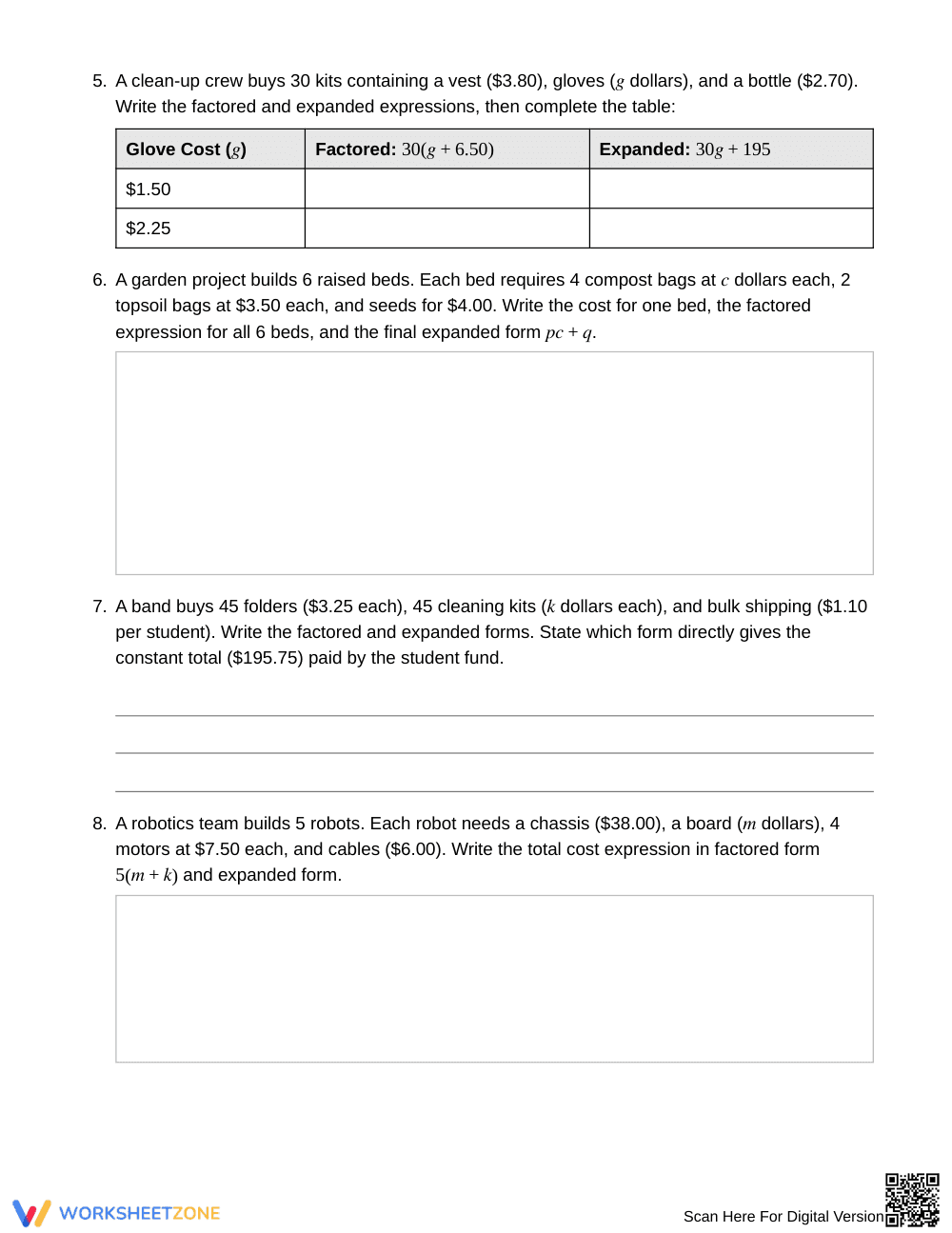
This resource features a clear core concept reference box with a modeled example, two direct contextual modeling tasks, six multi-step contextual applications with evaluation tables, and two budget-constraint decision problems. A comprehensive two-page answer key provides complete algebraic steps and contextual interpretations for every item.
Skill Progression
- Guided Practice (Part A, 2 tasks): Direct modeling prompts guide students to translate group purchases into factored and expanded forms while defining constant terms.
- Supported Practice (Part B, 6 tasks): Multi-step problems require students to combine like terms within parentheses, expand expressions, and evaluate costs using tabular values.
- Independent Practice (Part C, 2 tasks): Open-ended scenarios challenge learners to write inequality constraints and compare competing pricing structures algebraically.
This structured progression follows the gradual-release framework, moving learners smoothly from basic expression translation to multi-step financial decision-making.
Standards Alignment
This worksheet directly targets 6.EE.A.3: Apply properties of operations to generate equivalent expressions. Students also draw on supporting standard 6.EE.B.6 to represent real-world quantities using variables in financial contexts. Both standard codes can be copied directly into lesson plans, IEP goals, or district curriculum mapping tools.
How to Use It
Implement this worksheet during or immediately after direct instruction on the distributive property. For a mid-unit lesson, work through the modeled example as a whole group before assigning Part A and Part B for partner collaboration (25–30 minutes). Use Part C as an independent exit ticket or extension task (15 minutes). As a formative check, observe whether students distribute the multiplier to every term inside the grouping symbols or omit the constant term.
Who It's For
This activity is designed for Grade 6 general mathematics classrooms, Tier 2 algebra intervention groups, and accelerated Grade 5 learners. Pair this printable with an interactive whiteboard visual model of area representations before transitioning students to abstract cost formulas.
According to EdReports 2024, high-quality mathematics instructional materials must balance conceptual understanding with procedural fluency and contextual applications. This Grade 6 worksheet addresses standard 6.EE.A.3 by teaching students to generate equivalent expressions through the distributive property within meaningful financial scenarios. Translating real-world purchasing situations into factored and expanded forms enables students to understand the structural meaning of mathematical terms rather than merely following rote calculation steps. By analyzing constants and variable terms across ten structured tasks, learners build durable algebraic reasoning skills that support future work with linear equations and inequalities. The gradual progression from direct modeling to constraint analysis ensures rigorous standards alignment while providing necessary instructional scaffolds for diverse learners. Teachers can rely on this resource to assess expression equivalence accurately and prepare students for state assessments.


