




























Views
Downloads
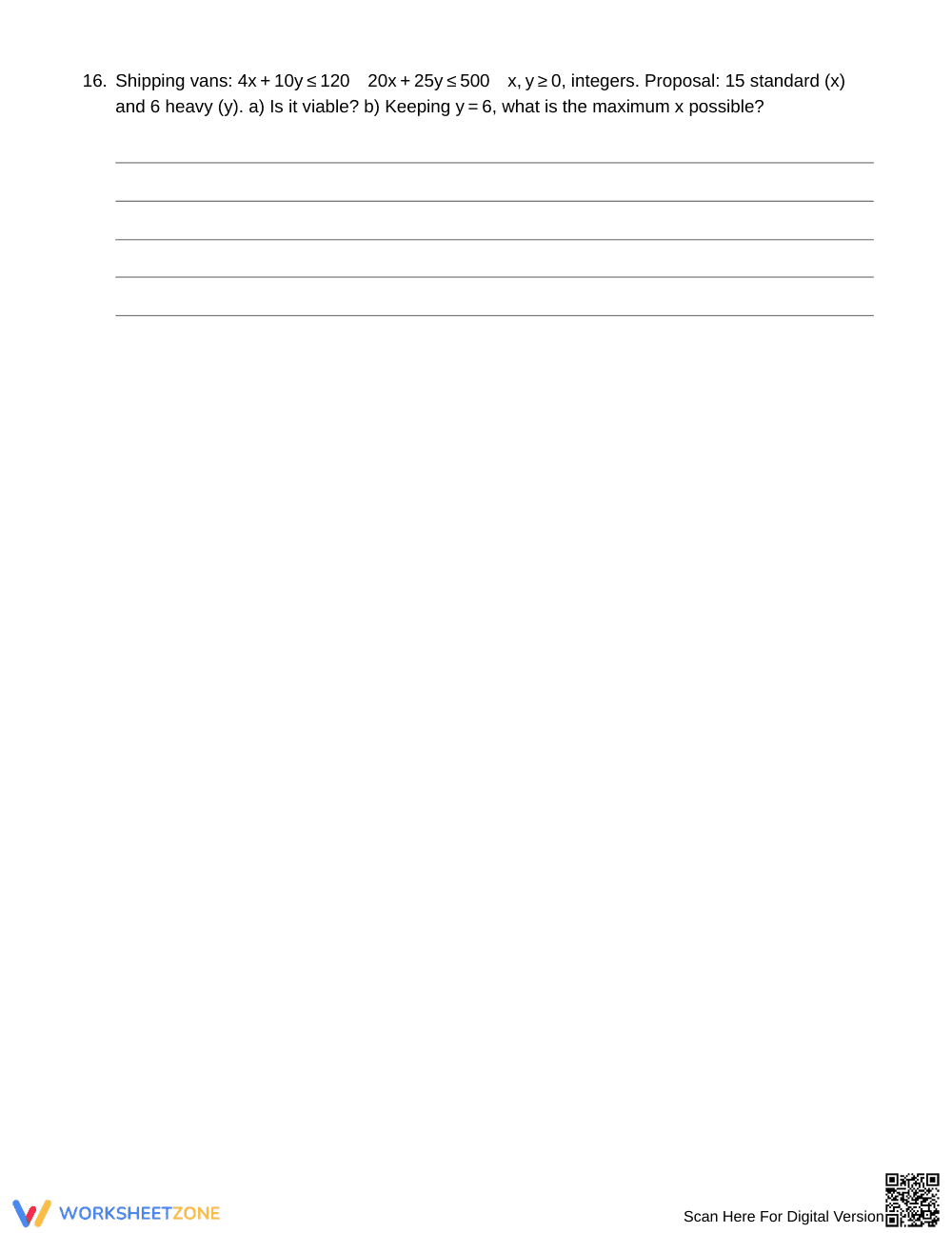

Complete Constraint Systems Worksheet | Grade 9 Algebra I

Paste this activity's link or code into your existing LMS (Google Classroom, Canvas, Teams, Schoology, Moodle, etc.).
Students can open and work on the activity right away, with no student login required.
You'll still be able to track student progress and results from your teacher account.
This Grade 9 Algebra I worksheet equips students to model linear inequality systems from real-world constraints and interpret feasible regions. Learners translate contextual limits into inequalities, calculate boundary intersections, and determine whether coordinate solutions represent viable outcomes across business, agricultural, and production scenarios.
At a Glance
- Grade: 9 · Subject: Algebra I
- Standard:
HSA-CED.A.3— Represent constraints with inequalities and interpret viable solutions in context- Skill Focus: Mix Constraint Writing and Region Interpretation
- Format: 5 pages · 16 problems · Answer key included · PDF
- Best For: Systems of inequalities modeling practice
- Time: 45–60 minutes
What's Inside
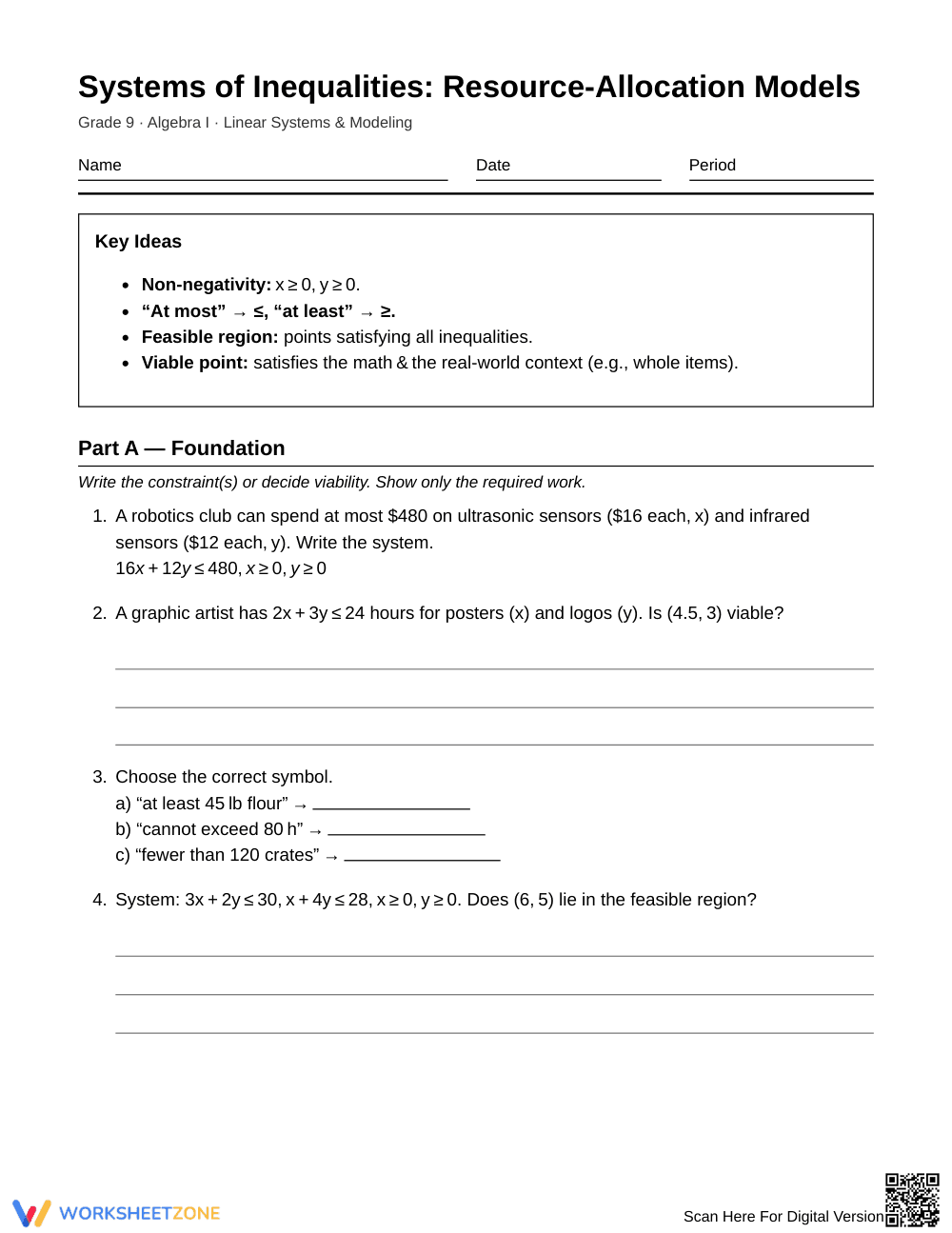
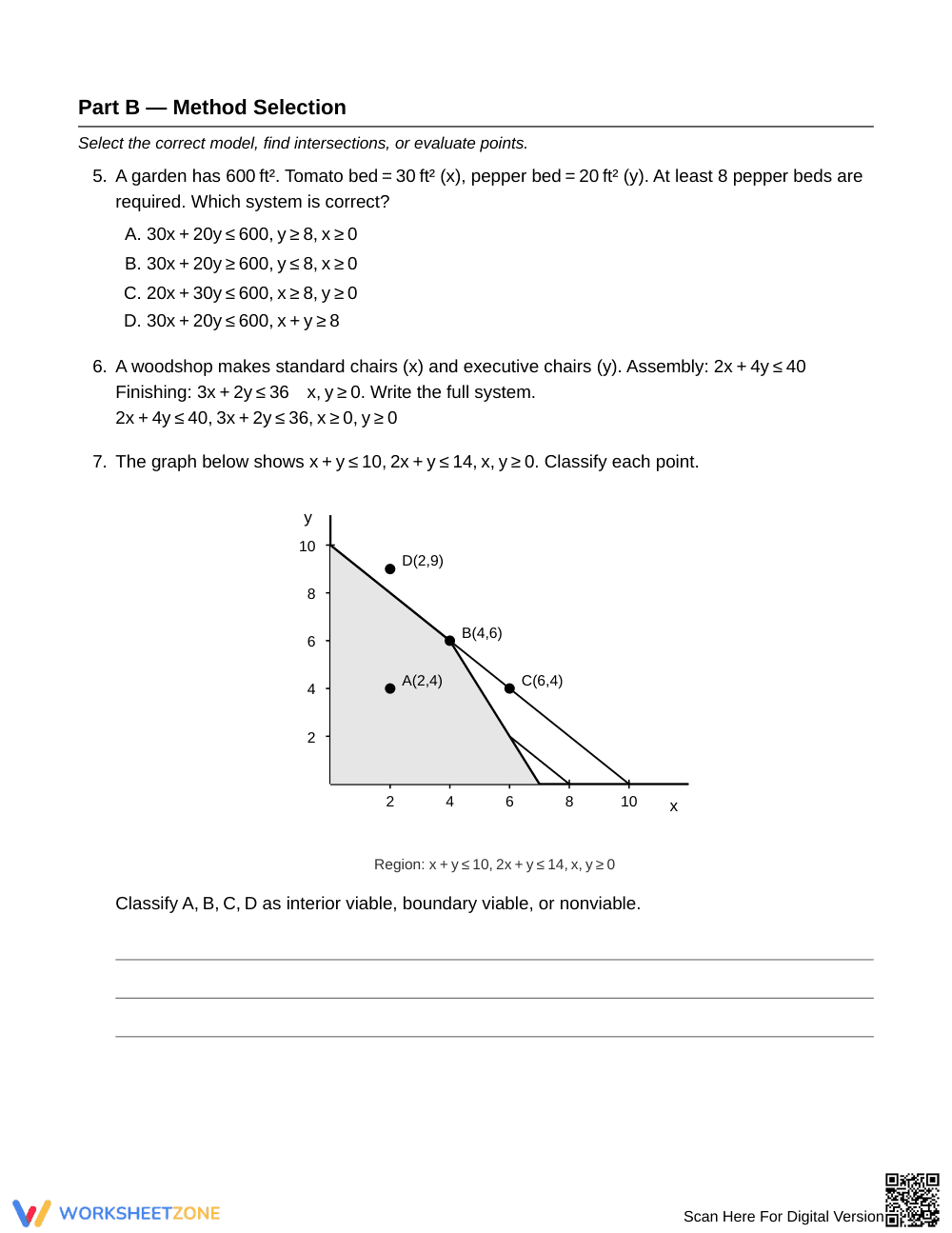
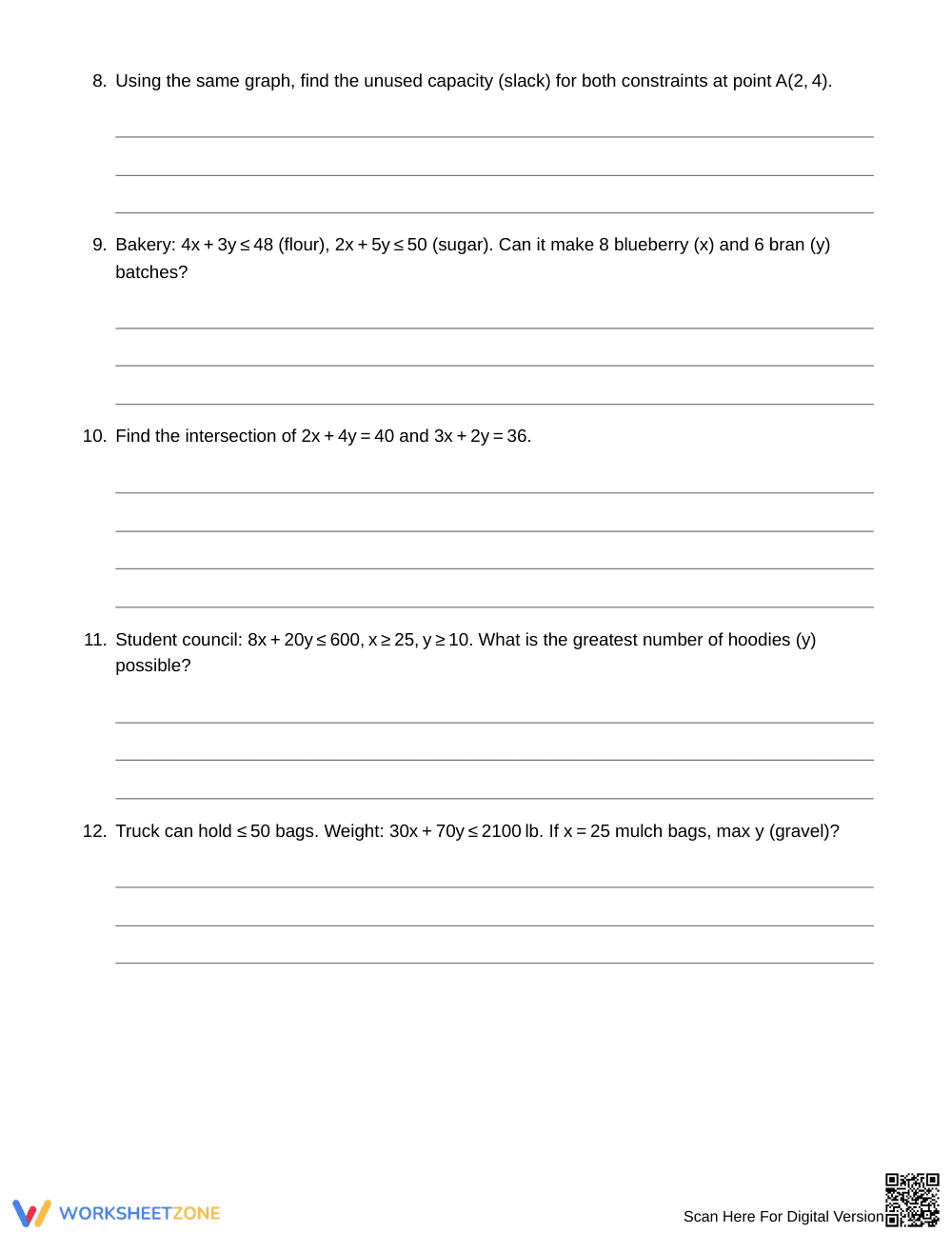
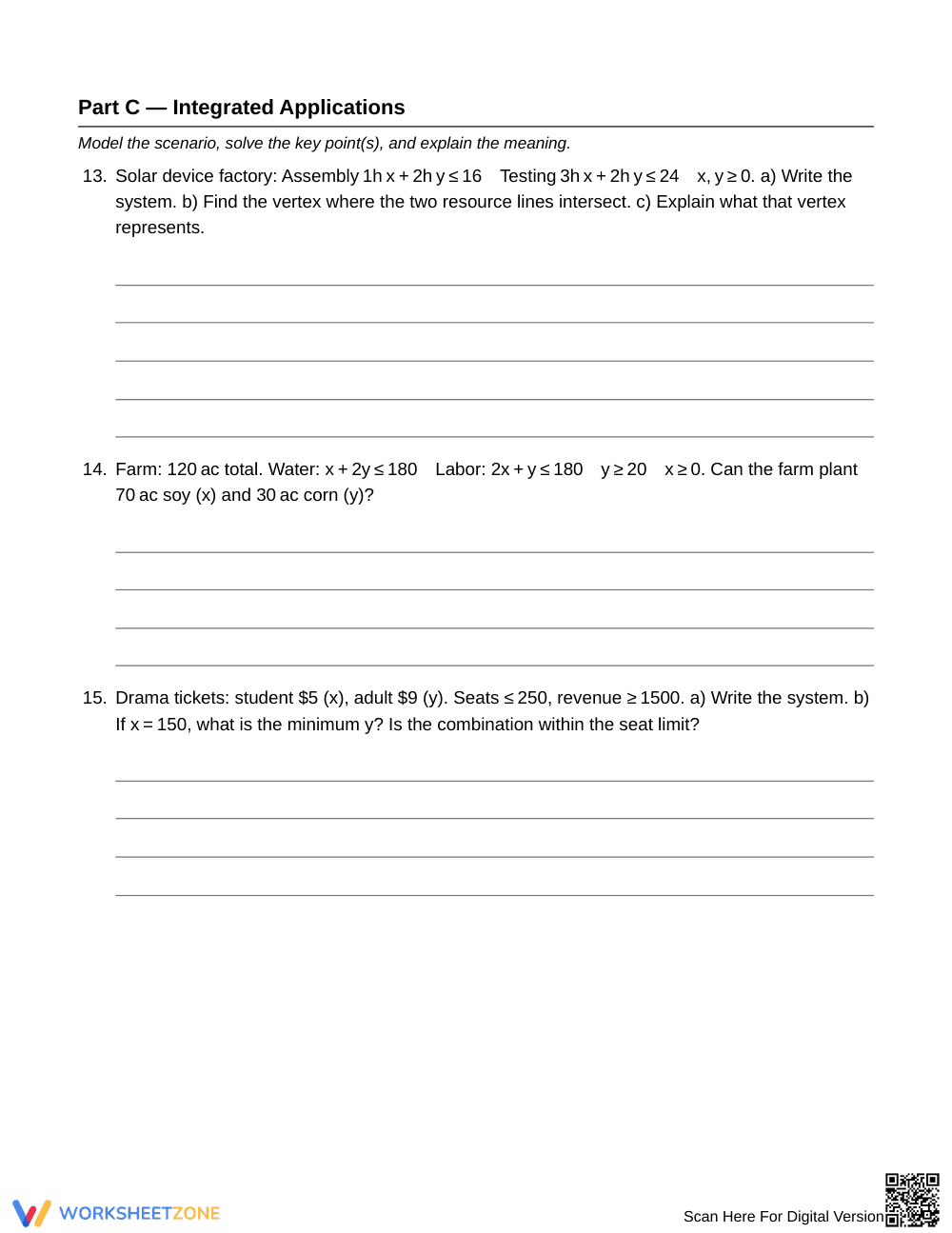
This 5-page packet provides 16 focused problems across three sections, backed by a 2-page answer key. A "Key Ideas" summary defines non-negativity and feasible regions. Tasks include translating verbal limits into inequalities, analyzing graph points, calculating slack capacity, and solving multi-constraint word problems.
Skill Progression
- Guided practice (Part A, 4 problems): Reinforces foundational symbols and non-negativity limits, testing individual coordinates for contextual feasibility.
- Supported practice (Part B, 8 problems): Guides students to select models, calculate intersection vertices, determine slack, and classify points on graphs.
- Independent practice (Part C, 4 problems): Asks learners to construct complete linear systems, solve key boundary intersections, and explain discrete real-world solutions.
This gradual-release structure builds student confidence from direct identification to autonomous mathematical modeling.
Standards Alignment
This worksheet aligns directly to `HSA-CED.A.3`: Represent constraints by equations or inequalities, and interpret solutions as viable or nonviable options in a modeling context. It also supports `HSA-REI.C.6` through solving linear systems. Both standard codes can be copied directly into lesson plans, IEP goals, or district curriculum mapping tools.
How to Use It
Use this worksheet after direct instruction on graphing linear inequalities. Assign Parts A and B during class to observe whether students account for non-negativity boundaries. Reserve Part C for partner application or independent homework. The expected completion time is 45 to 60 minutes.
Who It's For
Designed for Grade 9 Algebra I students, this resource also supports Grade 8 honors or review for Grade 10 geometry. The built-in reference box provides scaffolded access for emerging multilingual learners. Pair this printable with an anchor chart showing shaded feasible regions.
According to research by Fisher & Frey (2014) on the gradual release of responsibility framework, structured cognitive scaffolding is essential for students acquiring complex mathematical modeling competencies. This Algebra I worksheet targets standard HSA-CED.A.3 by systematically guiding learners through the translation of real-world scenarios into systems of linear inequalities. By establishing clear distinction between mathematical feasibility and contextual viability, students build analytical capacity through 16 purposeful tasks. Beginning with immediate keyword-to-symbol associations and non-negativity parameters, the resource transitions into slack analysis and multi-variable optimization problems. Fisher & Frey demonstrate that intentional transitions between guided instruction, peer method selection, and independent modeling prevent cognitive overload and cement procedural fluency. Consequently, students master both the algebraic mechanics of solving linear systems and the interpretative skills needed to evaluate solutions against authentic physical and economic constraints in secondary mathematics classrooms.


