




























Views
Downloads




Complete Conservation of Mass Worksheet | Grade 7 Science

Paste this activity's link or code into your existing LMS (Google Classroom, Canvas, Teams, Schoology, Moodle, etc.).
Students can open and work on the activity right away, with no student login required.
You'll still be able to track student progress and results from your teacher account.
This science worksheet trains Grade 7 students to analyze experimental scenarios, diagnose common misconceptions about disappearing matter, and write precise scientific explanations based on the Law of Conservation of Mass. Students practice accounting for all atoms across both open and closed systems.
At a Glance
- Grade: 7 · Subject: Science
- Standard: Track matter and verify mass conservation across physical and chemical changes
- Skill Focus: Correcting matter-disappears explanations
- Format: 5 pages · 8 problems · Answer key included · PDF
- Best For: Middle school physical science practice
- Time: 30–45 minutes
What's Inside
This 5-page printable resource features a structured reference guide, a fully worked error-repair model, and 8 targeted student analysis tasks. A detailed 2-page answer key provides complete diagnostic breakdowns and model scientific responses for straightforward evaluation.
Skill Progression
- Guided Practice: A complete reference chart and modeled splint combustion problem demonstrate how to identify flawed reasoning and construct a valid atom-tracking explanation.
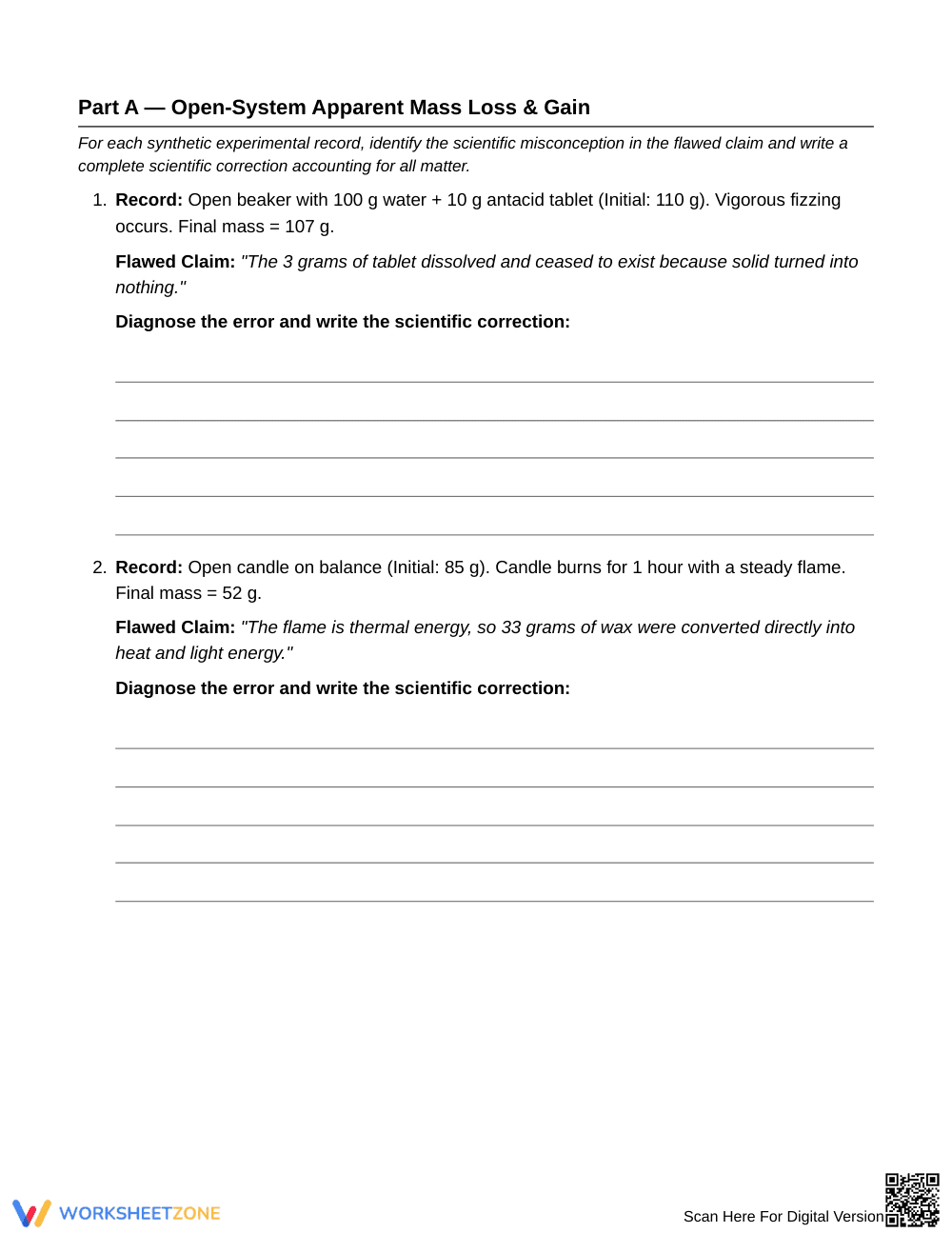
- Supported Practice (Tasks 1–4): Students analyze open-system scenarios, such as antacid dissolution, burning candle wax, evaporating water, and rusting iron nails, to explain apparent mass gains and losses.
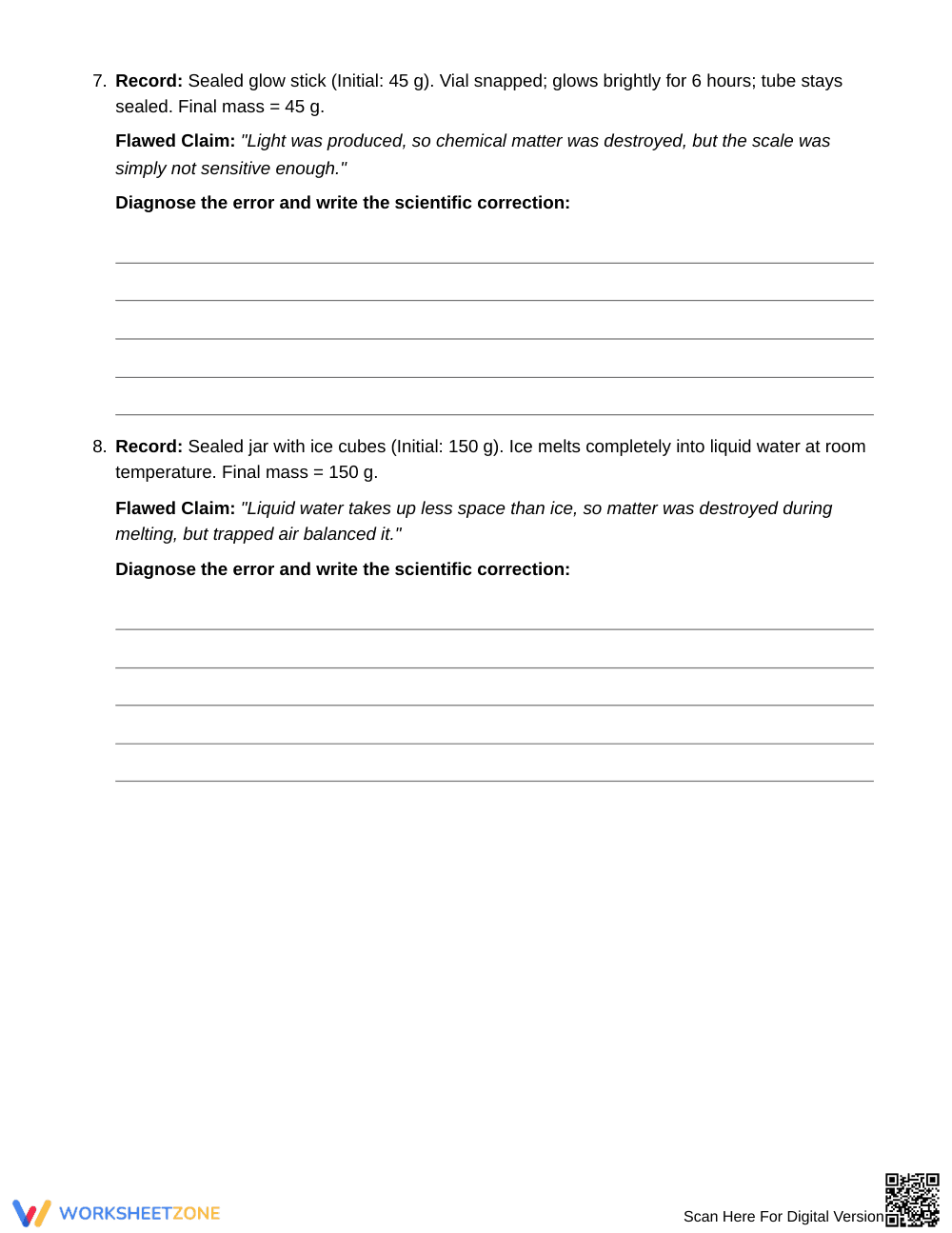
- Independent Practice (Tasks 5–8): Students tackle complex closed-system and gas-behavior claims, including acid-carbonate reactions, sealed baking soda reactions, chemiluminescent glow sticks, and phase changes.
This structured progression uses a gradual-release instructional model to transition learners from scaffolded error detection to independent scientific argumentation.
Standards Alignment
This activity aligns with middle school physical science standards requiring students to develop models showing that the total number of atoms does not change during chemical reactions and physical changes, thereby conserving mass. Both core principles and analytical tasks can be copied directly into lesson plans, IEP goals, or district curriculum mapping tools.
How to Use It
Deploy this worksheet after direct instruction on open versus closed systems. For formative assessment, examine whether students attribute open-system mass changes to escaping or entering atmospheric gases rather than energy transformation or atom destruction. Students typically complete the 8 tasks in 30 to 45 minutes.
Who It's For
Designed for general Grade 7 science classrooms, physical science units, and intervention groups requiring targeted support with chemical reaction concepts. It pairs naturally with hands-on conservation-of-mass laboratory investigations and interactive balancing demonstrations.
According to Fisher & Frey (2014), structured error analysis accelerates conceptual mastery by requiring learners to evaluate flawed reasoning before formulating accurate explanations. This middle school physical science worksheet targets the persistent misconception that matter vanishes when invisible gases form or liquids evaporate. Across 8 rigorous tasks, students analyze open and closed systems, evaluating mass changes in chemical reactions and phase shifts. By articulating why mass remains constant even when substances seem to disappear, students build durable conceptual understandings of physical science principles. The included 2-page answer key outlines expected diagnostic points and comprehensive model explanations, making the resource practical for formative checkpoints, guided remediation, or independent review.


