































Complete Comparing Evidence Quality Worksheet | Grade 8 ELA

Paste this activity's link or code into your existing LMS (Google Classroom, Canvas, Teams, Schoology, Moodle, etc.).
Students can open and work on the activity right away, with no student login required.
You'll still be able to track student progress and results from your teacher account.
This Grade 8 ELA worksheet equips students to evaluate and compare evidence quality across competing informational texts. Working with two opposing arguments regarding school equipment sharing, learners analyze claims against three criteria: relevance, sufficiency, and soundness. Students inspect empirical metrics, local survey data, and unstated assumptions to identify the stronger position.
At a Glance
- Grade: 8 · Subject: ELA
- Standard:
RI.8.8— Evaluate argument claims by assessing whether underlying reasoning is sound and evidence is sufficient- Skill Focus: Compare Evidence Quality Across Arguments
- Format: 5 pages · 10 targeted problems · Detailed answer key included · Printable PDF
- Best For: Paired argument analysis and evidence evaluation
- Time: 35–45 minutes
This 5-page printable resource includes a foundational Core Concepts reference box, two balanced debate texts on a district resource-sharing policy, and 10 analytical problems. Question formats include multiple-choice criteria checks, text-dependent evidence comparisons, and an evaluative synthesis. A complete 3-page answer key provides thorough explanations and sample responses.
Skill Progression
- Guided practice (Part A, Problems 1–2): Students define and differentiate relevance, sufficiency, and soundness using multiple-choice identification and short-response baseline analysis.
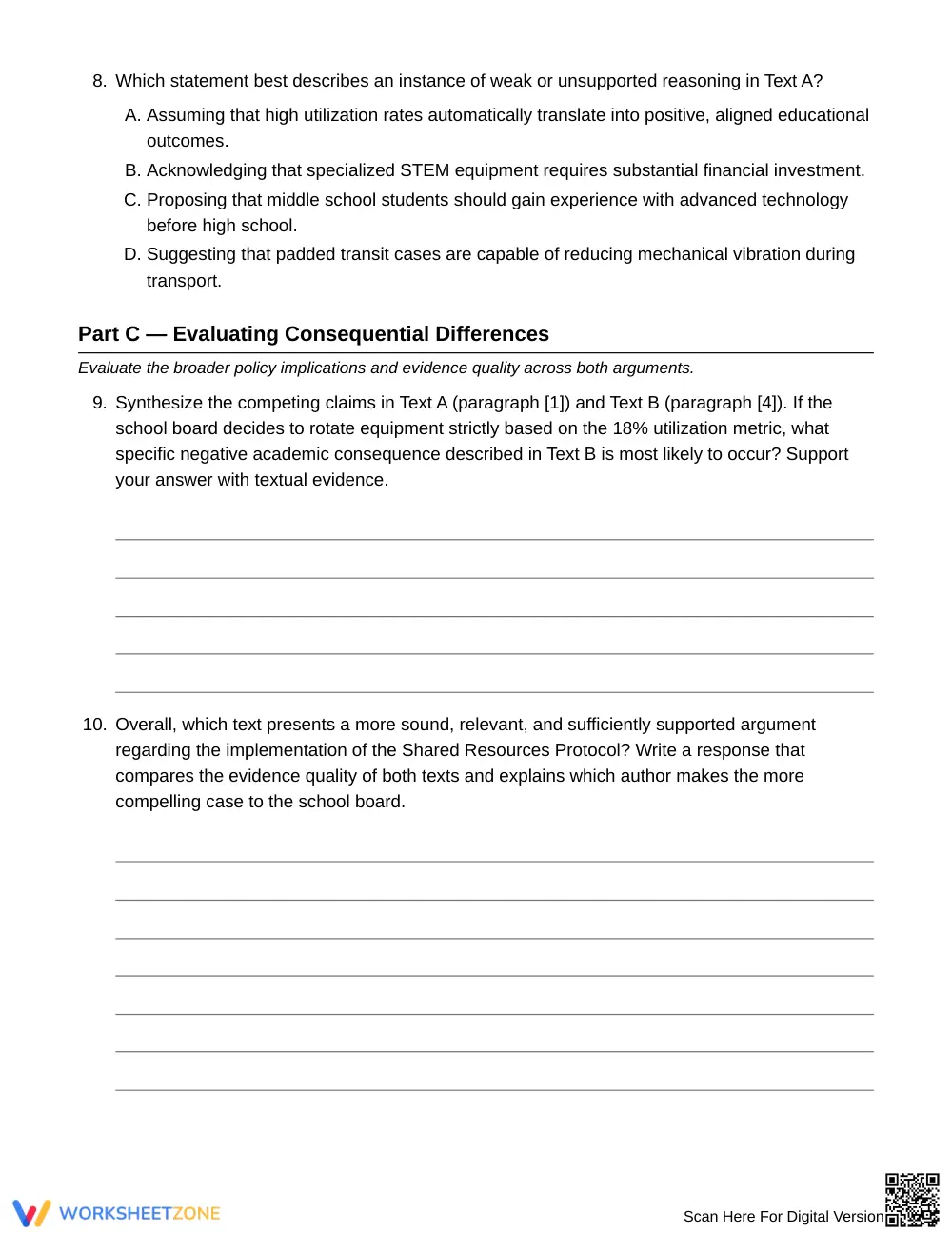
- Supported practice (Part B, Problems 3–8): Students evaluate 6 text-dependent prompts comparing empirical data, local surveys, and unstated assumptions across Text A and Text B.
- Independent practice (Part C, Problems 9–10): Learners complete 2 extended synthesis tasks evaluating real-world academic consequences and drafting a comprehensive comparative critique.
This sequence implements the gradual release of responsibility model, guiding learners from conceptual definitions to autonomous evidence evaluation.
Standards Alignment
This worksheet aligns to `RI.8.8`: Delineate and evaluate the argument and specific claims in a text, assessing whether the reasoning is sound and the evidence is relevant and sufficient. The comparative prompts additionally support `RI.8.1` by requiring explicit textual citations to validate claims. Both standard codes can be copied directly into lesson plans, IEP goals, or district curriculum mapping tools.
How to Use It
Use this resource after introducing argument evaluation criteria to provide structured independent practice or collaborative partner work. It also serves effectively during an argumentative writing unit to help students identify weak reasoning before drafting essays. Formative assessment tip: Check Problem 6 closely; difficulty spotting the author's unstated assumption indicates students need further support distinguishing correlation from causation. Typical completion time is 35 to 45 minutes.
Who It's For
This worksheet is tailored for Grade 8 ELA students mastering argument analysis in general education, co-taught, or intervention settings. Teachers can support striving readers by pre-highlighting key statistics across both texts, while advanced students can propose an alternative district compromise policy. Pair this activity with a mini-lesson on rhetorical appeals or an anchor chart on logical fallacies.
Evaluating evidence quality across competing nonfiction texts represents a pivotal milestone in adolescent literacy development. Under Common Core standard `RI.8.8`, Grade 8 students must systematically delineate argumentative claims, distinguish between relevant and irrelevant details, and determine whether supporting data is sufficient and sound. According to Fisher & Frey (2014), structured close reading paired with scaffolded text-dependent questioning provides the essential framework for students to internalize higher-order analytical habits and evaluate conflicting perspectives objectively. This instructional resource bridges conceptual definitions and rigorous textual critique by presenting balanced, school-based policy arguments that mirror authentic civic discourse. Through 10 targeted tasks spanning criteria identification, comparative data analysis, and written synthesis, middle school learners cultivate the evidentiary reasoning necessary for advanced secondary rhetoric and standardized assessment performance, transforming passive text consumption into rigorous analytical critique across academic disciplines.


