


























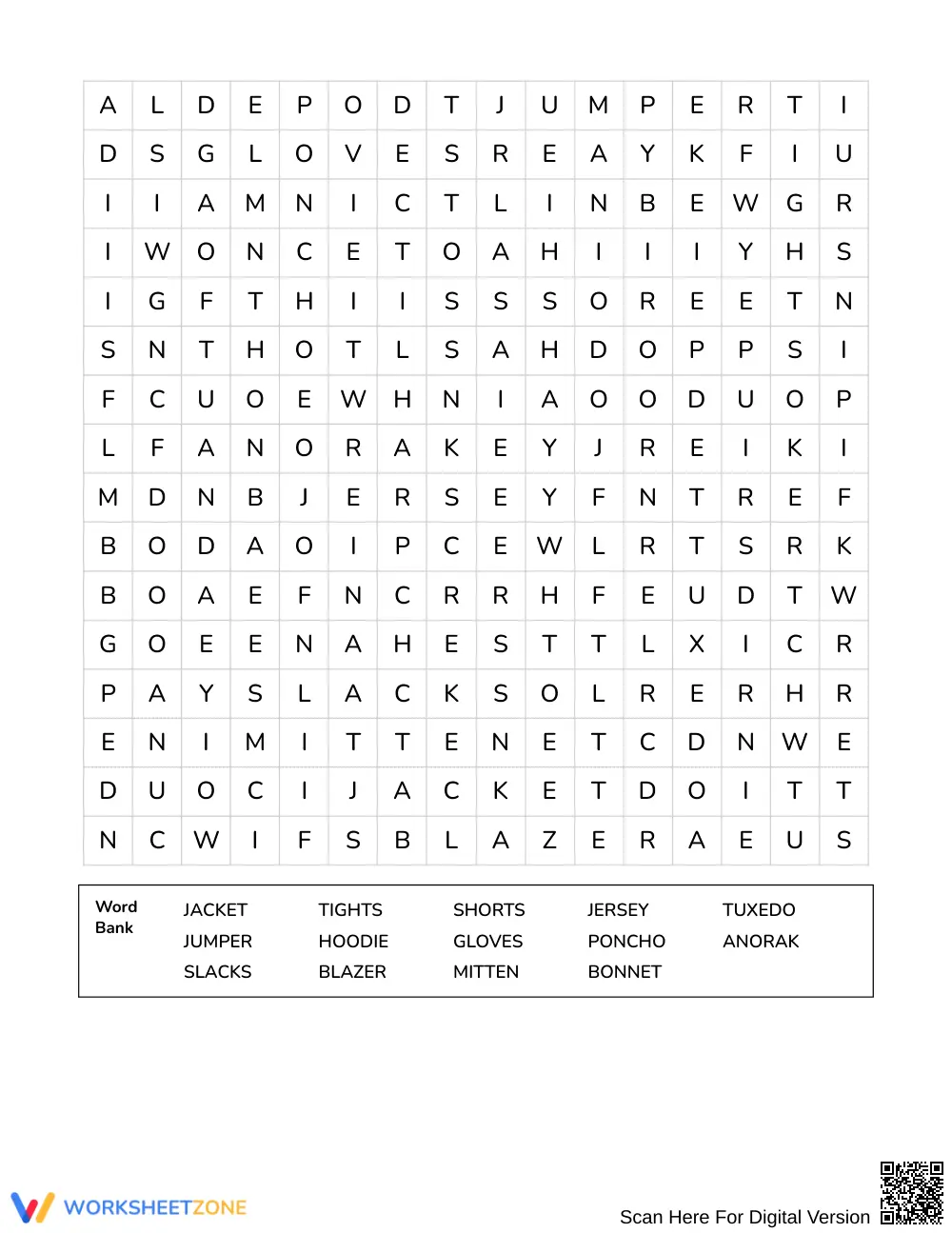

Complete Clothing Words Word Search | Grades 4–5 ELA
Paste this activity's link or code into your existing LMS (Google Classroom, Canvas, Teams, Schoology, Moodle, etc.).
Students can open and work on the activity right away, with no student login required.
You'll still be able to track student progress and results from your teacher account.
This Grades 4–5 vocabulary word search challenges students to identify and locate 14 six-letter clothing terms using descriptive context clues. Learners expand their descriptive language, strengthen spelling recall, and practice semantic reasoning by connecting garment definitions to target vocabulary. It provides engaging, self-directed word study for upper elementary language arts classrooms.
At a Glance
- Grade: Grades 4–5 · Subject: English Language Arts (ELA)
- Standard:
Not standards-assessed— Vocabulary enrichment- Skill Focus: Six-letter clothing words
- Format: 3 pages · 14 words · Answer key included · PDF
- Best For: Independent vocabulary practice
- Time: 20–30 minutes
Inside, you will find a 3-page printable activity featuring a clue detective puzzle and a complete 3-page answer key. Rather than relying on a passive list, students read 14 detailed functional definitions to deduce each target garment before searching the grid. The puzzle includes a shuffled word bank and clear reference sheets that make checking answers simple.
Puzzle Mechanics and Structure
The activity centers on a dense 16 x 16 letter grid designed to reinforce visual scanning and orthographic patterns. Words are hidden across four specific search directions: northeast, east, southeast, and south. Students first analyze the text clues to identify apparel terms like anorak, tuxedo, and poncho, then apply systematic grid-tracking strategies across the shuffled word bank to confirm each find.
Standards Alignment
This activity serves as supplemental vocabulary enrichment and is not aligned to a formal grade-level standard. It supports foundational literacy by strengthening domain-specific vocabulary acquisition, morphological familiarity, and spelling accuracy for upper elementary learners.
How to Use It
Incorporate this activity after direct instruction on descriptive adjectives or context clues to give students immediate application practice. Teachers can also assign it during literacy center rotations or as quiet morning work; observe how students decipher unfamiliar definitions such as "anorak" to assess deductive vocabulary reasoning. Most students will finish the puzzle within 20 to 30 minutes.
Who It's For
This printable resource is designed for general education students in Grades 4–5, English language learners developing everyday apparel terminology, and upper elementary reading intervention groups. Pair this puzzle with an illustrated clothing anchor chart or an informative reading passage on textile history for an integrated thematic literacy lesson.
Explicit vocabulary development in upper elementary education requires active interaction with word meanings rather than passive memorization. As highlighted in research by Fisher & Frey (2014), intentional word study that combines contextual definitions with orthographic recognition promotes deeper semantic retention and reading comprehension. This Grades 4–5 clothing vocabulary word search delivers structured enrichment by prompting students to match functional definitions with 14 precise six-letter terms, including specialized items like blazers, bonnets, and anoraks. By navigating a 16 x 16 letter grid across multiple spatial trajectories, learners reinforce letter-sequence awareness, phonics-to-spelling pathways, and domain-specific lexicon. The integration of deductive clue deciphering bridges definitional knowledge and lexical retrieval, transforming routine puzzle activities into meaningful vocabulary practice. Educators can use these targeted word search tasks to support multi-tiered intervention systems, build background knowledge, and foster enthusiastic linguistic discovery during independent learning blocks.


