




























Complete Classify Reactions Worksheet | Grade 11 Chemistry
Paste this activity's link or code into your existing LMS (Google Classroom, Canvas, Teams, Schoology, Moodle, etc.).
Students can open and work on the activity right away, with no student login required.
You'll still be able to track student progress and results from your teacher account.
This Grade 11 chemistry worksheet equips students to classify chemical reactions, deduce mechanistic pathways, and predict products using thermodynamic driving forces. Learners analyze precipitation, redox, neutralization, and decomposition processes, translating empirical laboratory observations into balanced molecular and net ionic equations with physical states.
At a Glance
- Grade: 11 · Subject: Chemistry
- Standard: Chemistry — Classify chemical reactions and predict products using empirical reference rules
- Skill Focus: Classify and Explain Reactions
- Format: 5 pages · 12 problems · Answer key included · PDF
- Best For: Chemistry review and lab synthesis practice
- Time: 45–60 minutes
What's Inside
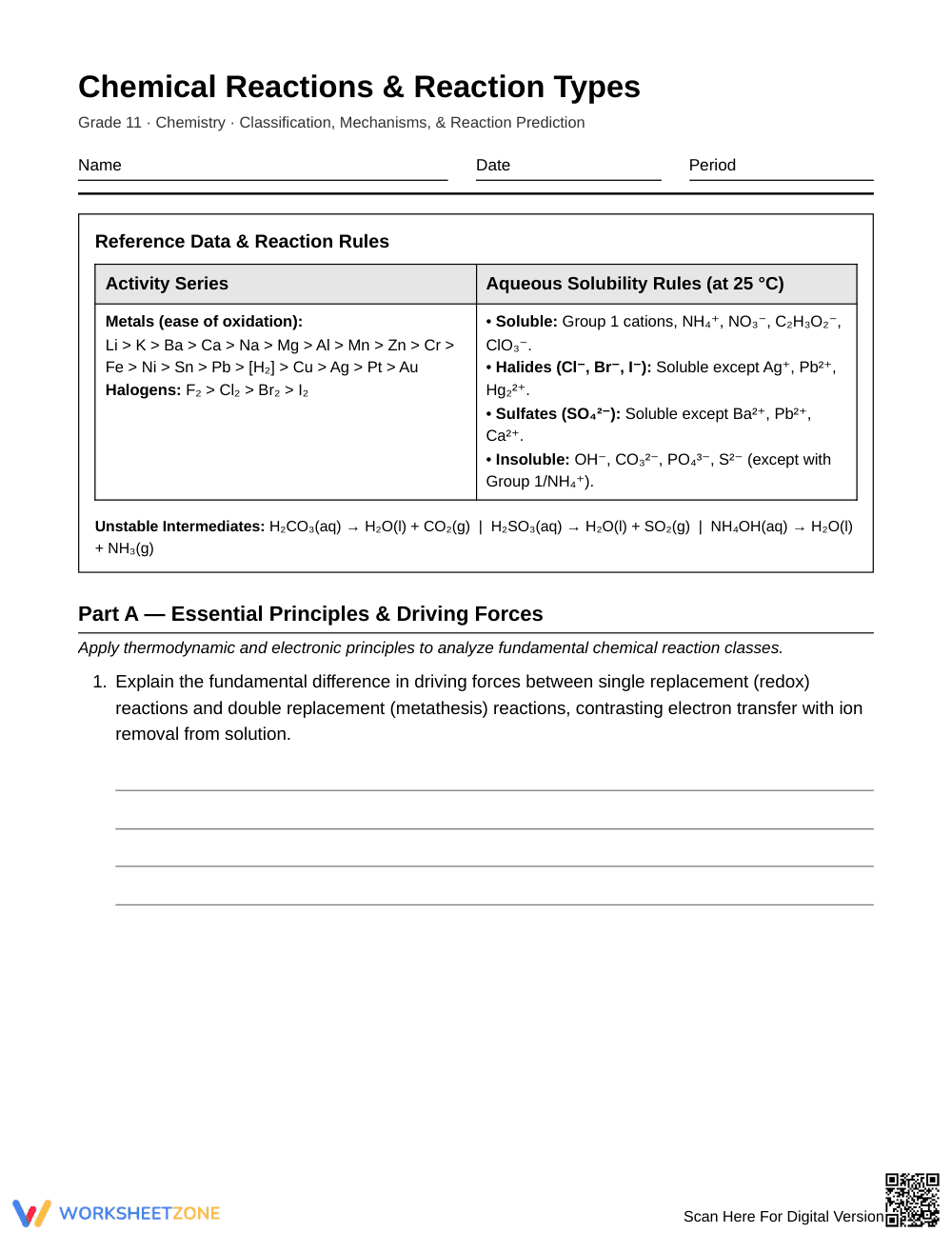
The 5-page worksheet includes reference data for the activity series, solubility rules at 25 °C, and unstable intermediate decompositions. Students complete 12 analytical tasks divided into conceptual justifications, laboratory records, and predictive synthesis. A 3-page answer key provides complete molecular, ionic, and net ionic equations.
Skill Progression
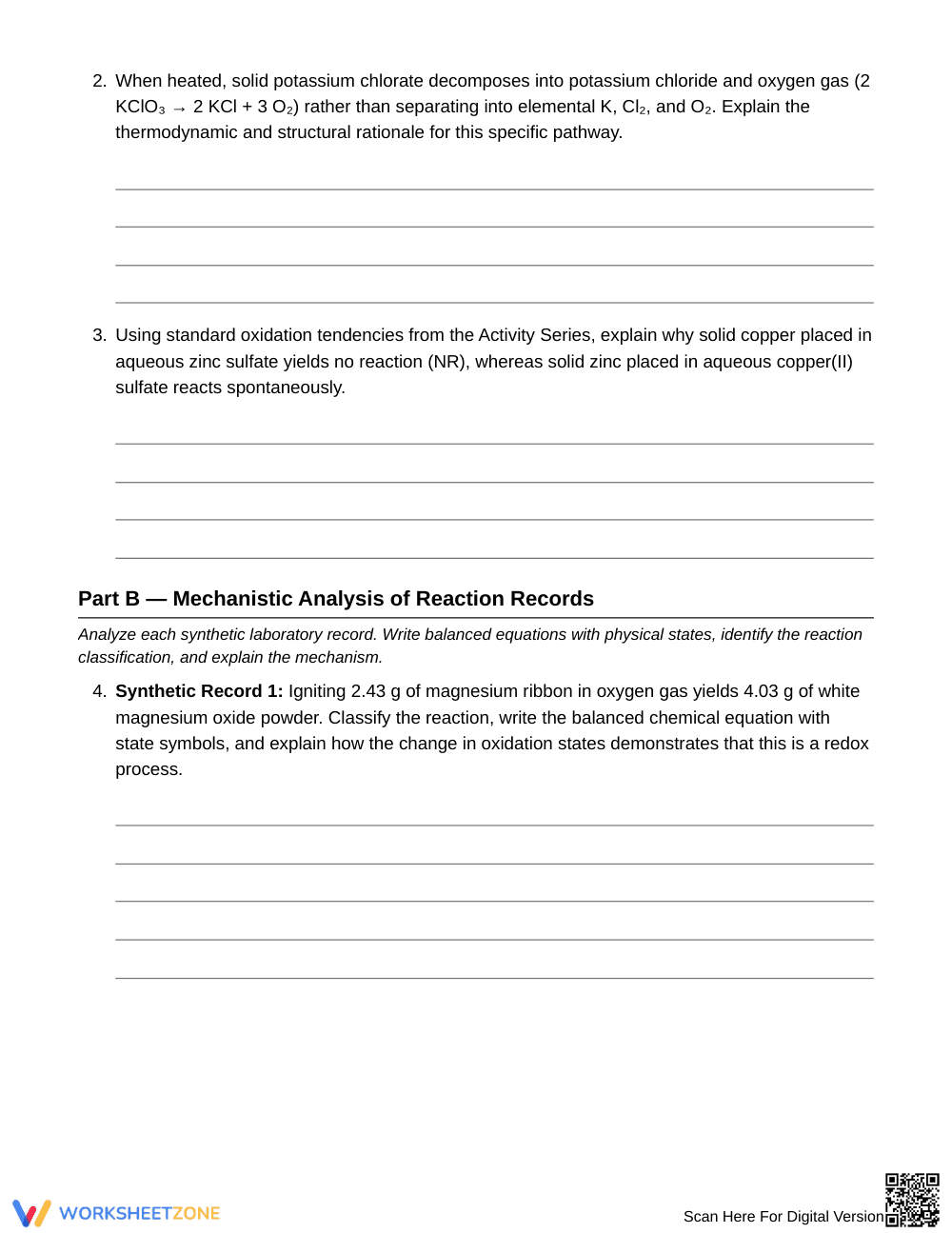
- Guided practice (Part A, Problems 1–3): Students analyze driving forces in single replacement versus metathesis, thermal decomposition pathways, and activity series energetics.
- Supported practice (Part B, Problems 4–9): Learners examine 6 laboratory records, formulating balanced equations while identifying spectator ions, oxidation states, and reaction classes.
- Independent practice (Part C, Problems 10–12): Students predict reaction outcomes, evaluate spontaneity, and explain mass conservation during carbonate decomposition.
This sequence follows a gradual-release model, moving from core principles to autonomous chemical prediction.
Standards Alignment
This resource aligns with high school chemistry expectations for classifying reactions and predicting products using valence properties and thermodynamics. Students demonstrate mass conservation through balanced equations and stoichiometric models. Both standard codes can be copied directly into lesson plans, IEP goals, or district curriculum mapping tools.
How to Use It
Assign this worksheet after direct instruction on reaction mechanisms and solubility guidelines. It functions effectively as paired problem-solving or independent review. During Part B, check student identification of spectator ions to correct misunderstandings of precipitate formation before Part C. Expected completion time is 45 to 60 minutes.
Who It's For
Designed for Grade 11 chemistry students, this practice benefits learners solidifying symbolic and mechanistic chemistry skills. Scaffold learning by walking through reference tables, or challenge advanced students to write full ionic net equations from memory. Pair this worksheet with an aqueous precipitation laboratory investigation.
Mastering chemical reaction classification and predictive equation writing requires students to integrate particulate-level reasoning with symbolic chemical representations. This 12-task chemistry worksheet systematically develops students' ability to classify reaction types, identify driving forces, and predict reaction products using solubility and activity data. Grounded in the structured instructional frameworks synthesized by Fisher & Frey (2014), the resource employs a gradual-release architecture that shifts cognitive load from foundational driving-force explanations in Part A to independent outcome prediction in Part C. By requiring students to articulate why reactions occur—contrasting electron transfer in redox systems with insoluble precipitate formation in double replacement reactions—the worksheet deepens conceptual understanding beyond mechanical balancing. Teachers receive a comprehensive 5-page instructional resource with an annotated 3-page answer key that directly verifies chemical states, spectator ion assignments, and mechanistic justifications across diverse introductory chemical scenarios.


