




























Views
Downloads


Complete Claim Scope & Reasons Worksheet | Grade 8 ELA

Paste this activity's link or code into your existing LMS (Google Classroom, Canvas, Teams, Schoology, Moodle, etc.).
Students can open and work on the activity right away, with no student login required.
You'll still be able to track student progress and results from your teacher account.
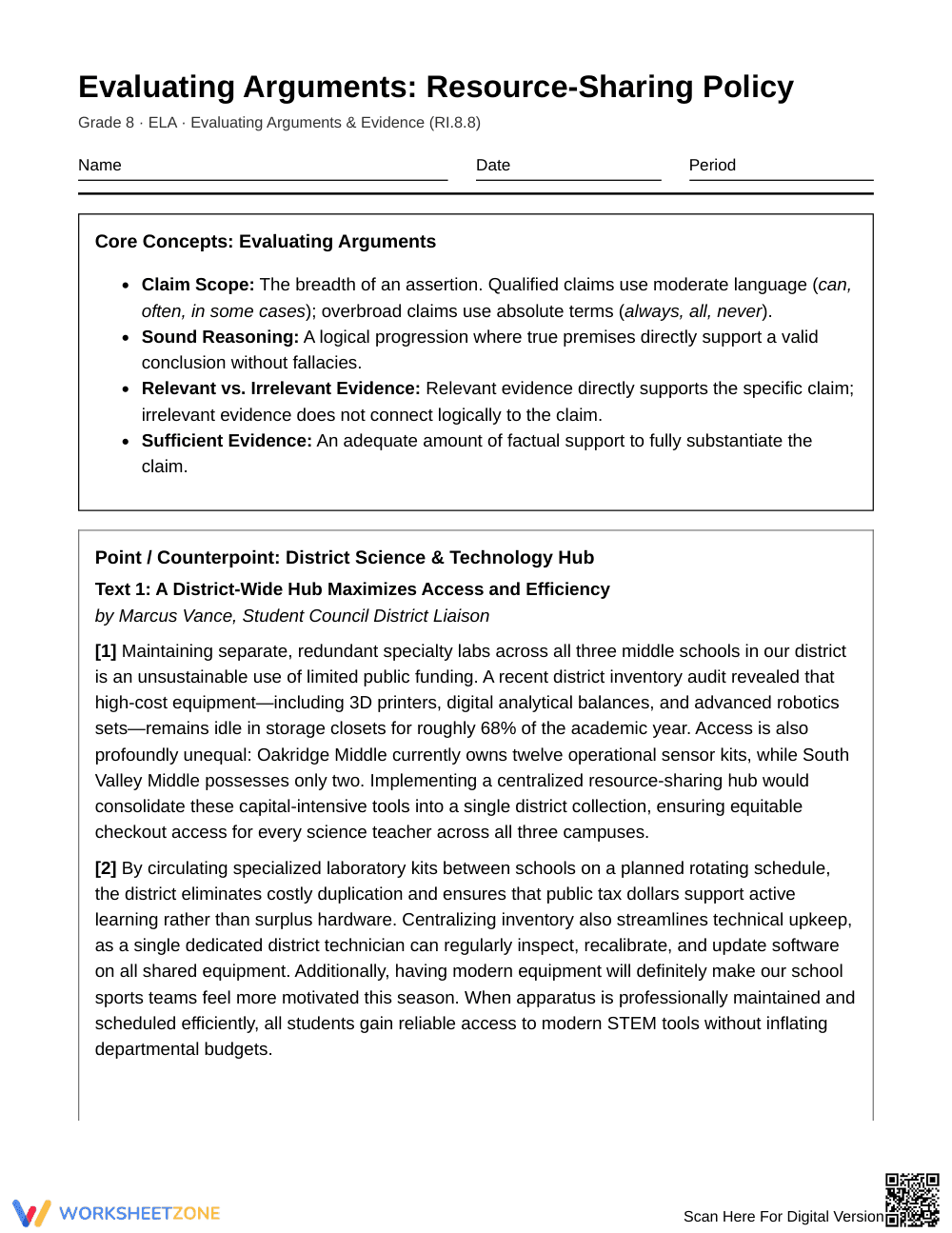
This Grade 8 ELA worksheet equips students to evaluate argument structure, claim scope, and evidence sufficiency across opposing viewpoints. Working with a realistic debate on school lab sharing, learners dissect author claims, isolate irrelevant details, and judge logical validity. The four-page resource provides ten focused tasks that build analytical reading proficiency.
At a Glance
- Grade: 8 · Subject: ELA
- Standard:
RI.8.8— Delineate and evaluate the argument, reasoning soundness, and evidence sufficiency in paired nonfiction texts- Skill Focus: Claim Scope and Supporting Reasons
- Format: 4 pages · 10 problems · Answer key included · PDF format
- Best For: Mid-unit argumentative text analysis, paired passage practice, and test prep
- Time: 40–50 minutes
What's Inside
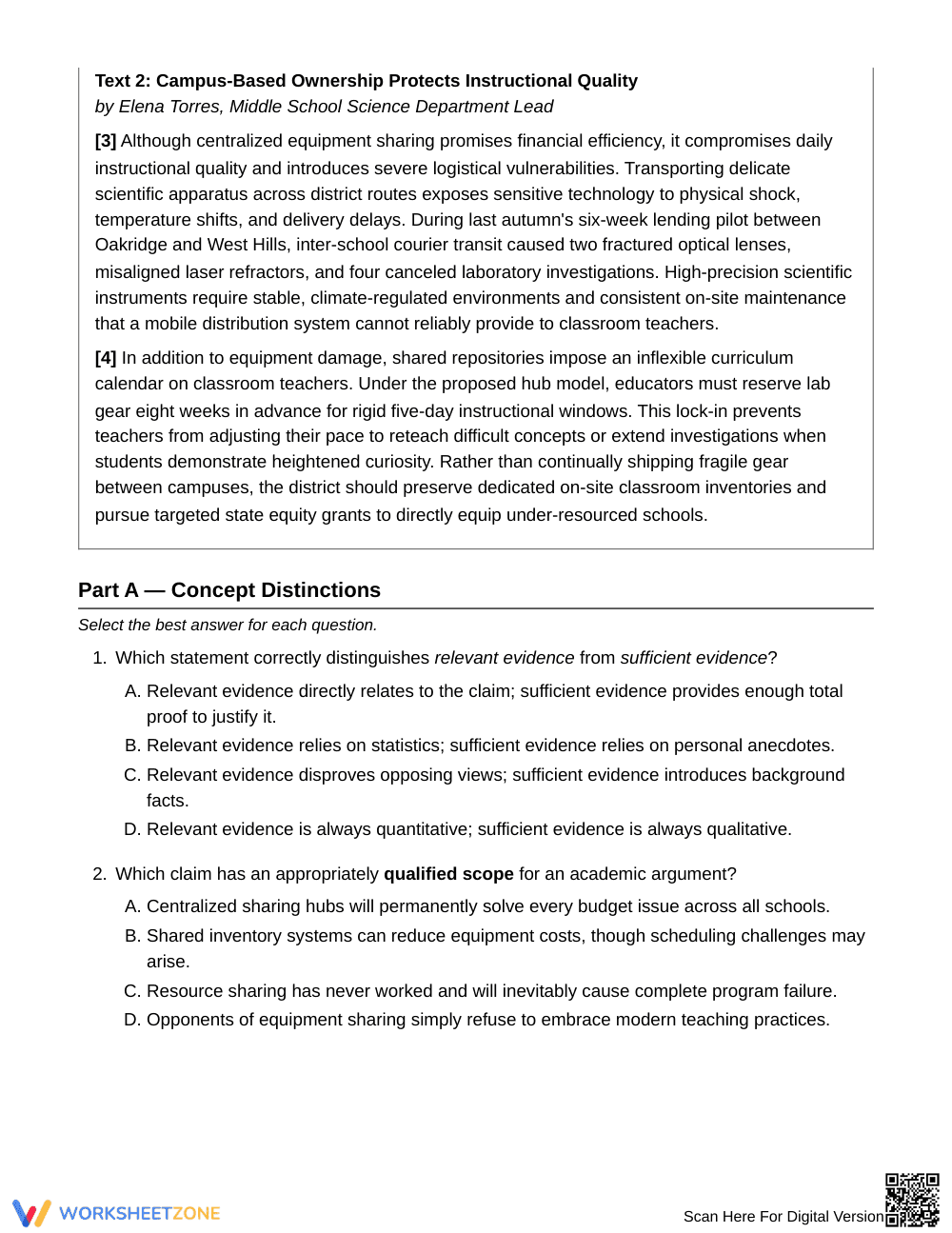
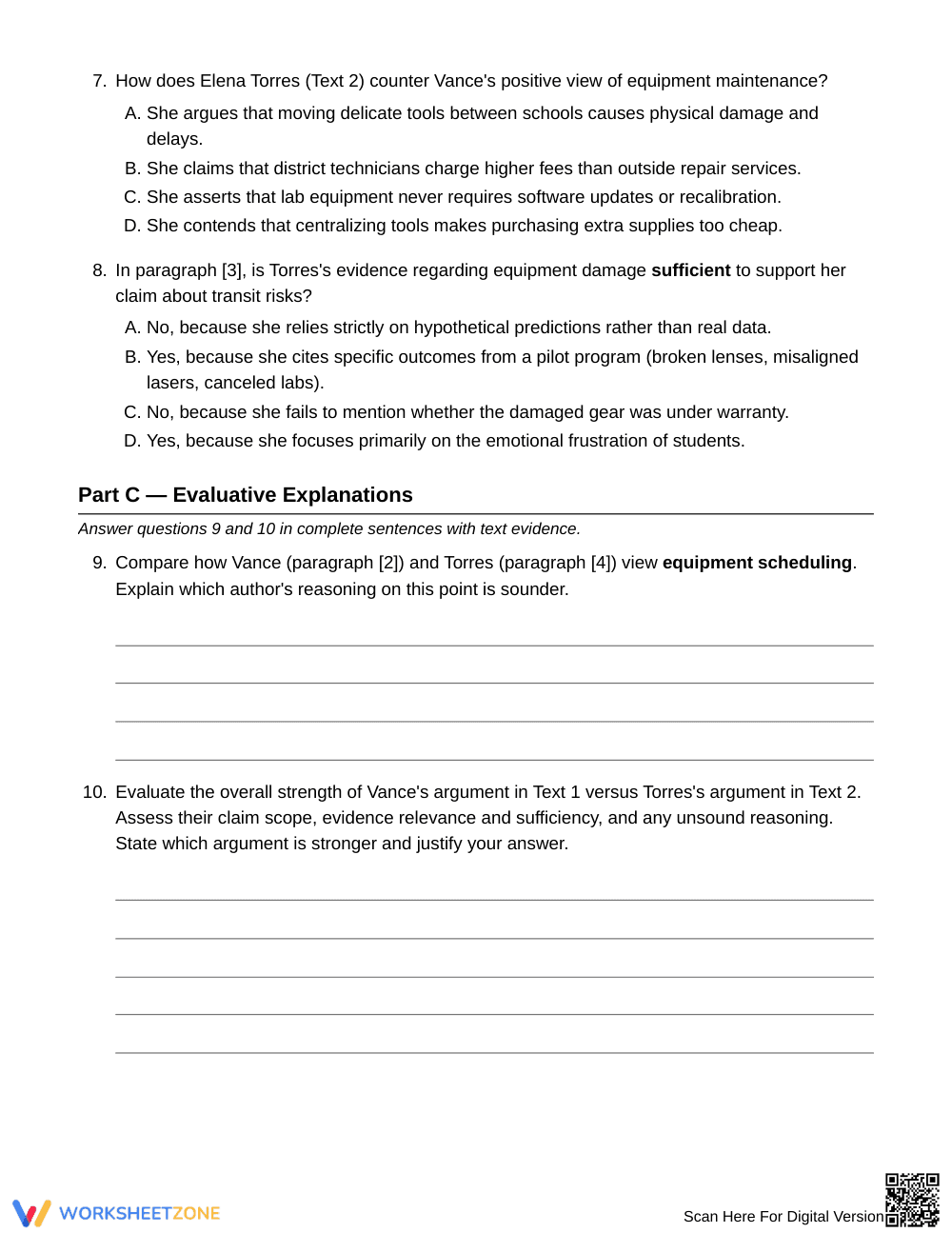
This 4-page resource begins with a reference box defining claim scope, sound reasoning, relevance, and sufficiency. Students read a point/counterpoint passage examining centralized science repositories, complete 8 multiple-choice items, and finish with 2 text-dependent written evaluations. A 2-page answer key provides complete explanations, identified distractors, and model written responses for fast grading.
Skill Progression
- Guided practice (Tasks 1–3): Students review core argument terms, distinguishing relevant from sufficient evidence and recognizing appropriately qualified claims.
- Supported practice (Tasks 4–8): Using paired texts, learners identify central claims, pinpoint irrelevant evidence, and evaluate whether pilot data sufficiently backs logistical concerns.
- Independent practice (Tasks 9–10): Students synthesize both perspectives in written responses, contrasting author reasoning on scheduling and assessing overall validity with citations.
This sequence mirrors the gradual-release framework, guiding learners from conceptual review to critical textual analysis.
Standards Alignment
This activity centers on RI.8.8: "Delineate and evaluate the argument and specific claims in a text, assessing whether the reasoning is sound and the evidence is relevant and sufficient; recognize when irrelevant evidence is introduced." The written responses also reinforce RI.8.1 by requiring textual evidence. Both standard codes can be copied directly into lesson plans, IEP goals, or district curriculum mapping tools.
How to Use It
Deploy this worksheet after direct instruction on logical fallacies and argument structure. Use Tasks 1 through 8 for collaborative partner analysis during class, and assign Tasks 9 and 10 for independent formative assessment. During work time, verify whether students detect the irrelevant athletic sentence in Text 1. Plan for 40 to 50 minutes of instructional time.
Who It's For
Designed for eighth-grade general education students, this material supports striving readers through embedded definition boxes. Advanced learners can extend their critique by drafting rebuttals to Elena Torres's logistical arguments. Pair this printout with an anchor chart on argumentative reasoning or an analytical writing unit.
According to Fisher & Frey (2014), purposeful instructional design requires students to transition systematically from declarative knowledge of argumentative elements to independent textual critique. This worksheet addresses Common Core standard RI.8.8 by guiding eighth-grade readers to evaluate argument validity, claim scope, and evidence sufficiency across competing informational texts. By juxtaposing two contrasting viewpoints on shared laboratory facilities, the material trains students to identify qualified assertions, detect off-topic evidence, and weigh the adequacy of empirical support. Rigorous point-counterpoint tasks require learners to justify why specific premises fail to warrant an author's conclusions. The scaffolded progression from conceptual discrimination to written evaluation ensures students develop the critical habits necessary for analytical reading and evidence-based composition. Educational research demonstrates that isolating flawed reasoning in structured tasks substantially improves high-stakes reading comprehension performance, making this targeted resource an effective tool for verifying student mastery of complex informational reading standards.


