

































Complete Circle Theorems Worksheet | Grade 10 Geometry

Paste this activity's link or code into your existing LMS (Google Classroom, Canvas, Teams, Schoology, Moodle, etc.).
Students can open and work on the activity right away, with no student login required.
You'll still be able to track student progress and results from your teacher account.
This Grade 10 Geometry worksheet builds student proficiency in circle angle and segment relationships. High school learners analyze geometric diagrams, select appropriate circle theorems, set up algebraic equations, and solve for unknown arc measures, angle values, and segment lengths across a carefully structured 16-problem set.
At a Glance
- Grade: 10 · Subject: Geometry
- Standard:
HSG-C.A.2— Identify and describe relationships among inscribed angles, radii, and chords- Skill Focus: Mixed chord, arc, tangent, and secant reasoning
- Format: 5 pages · 16 problems · Answer key included · PDF
- Best For: Circle theorem unit review and practice
- Time: 45–60 minutes
What's Inside
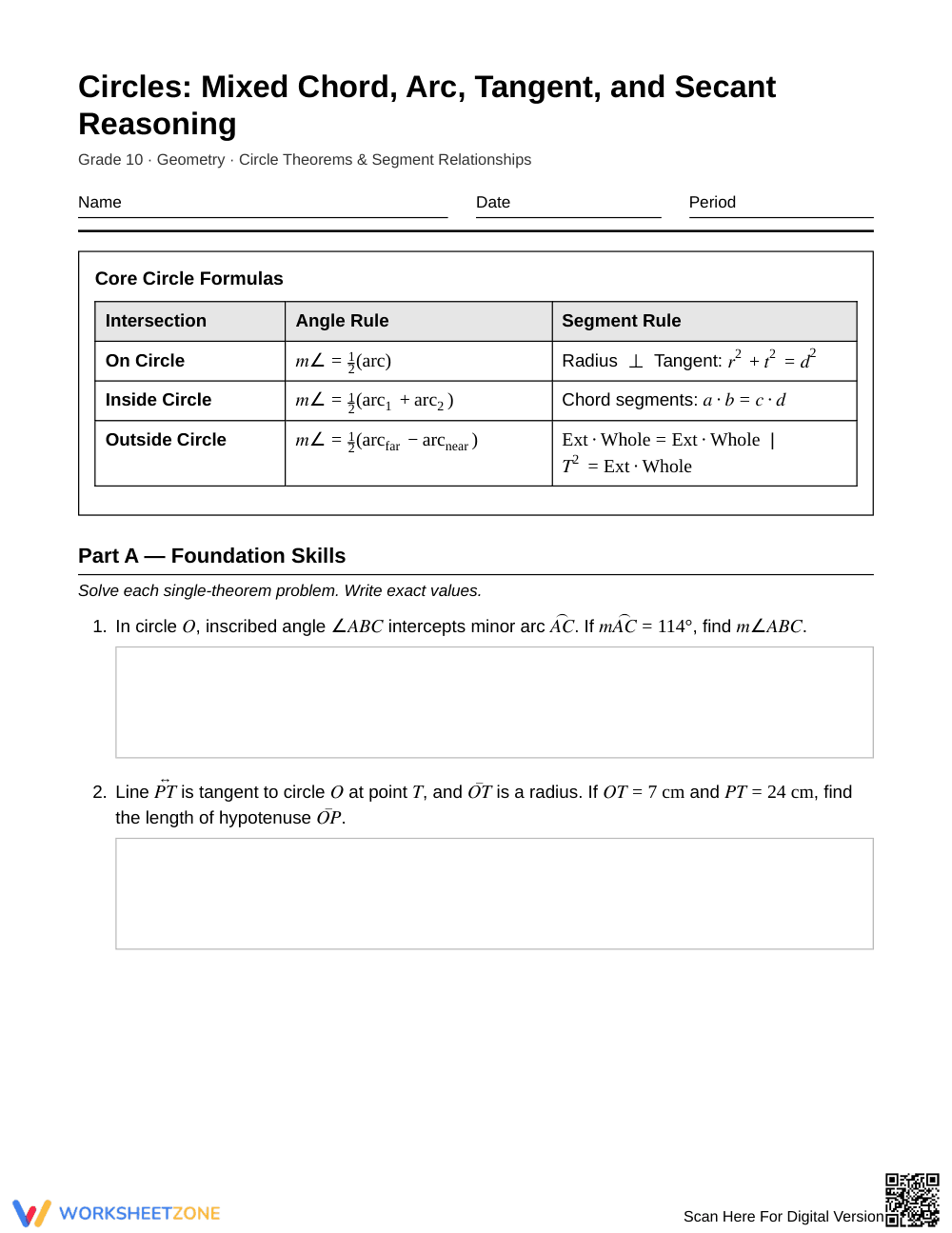
The resource features a quick-reference Core Circle Formulas chart on page 1 summarizing angle and segment rules for interior, on-circle, and exterior intersections. Across five comprehensive pages, students tackle 16 diagram-based tasks spanning single-step calculations to multi-step algebraic modeling, supported by a complete 3-page worked answer key.
Skill Progression
- Guided Practice (Part A, 4 problems): Single-theorem applications covering inscribed angles, tangent-radius right triangles, and intersecting chords with reference rules.
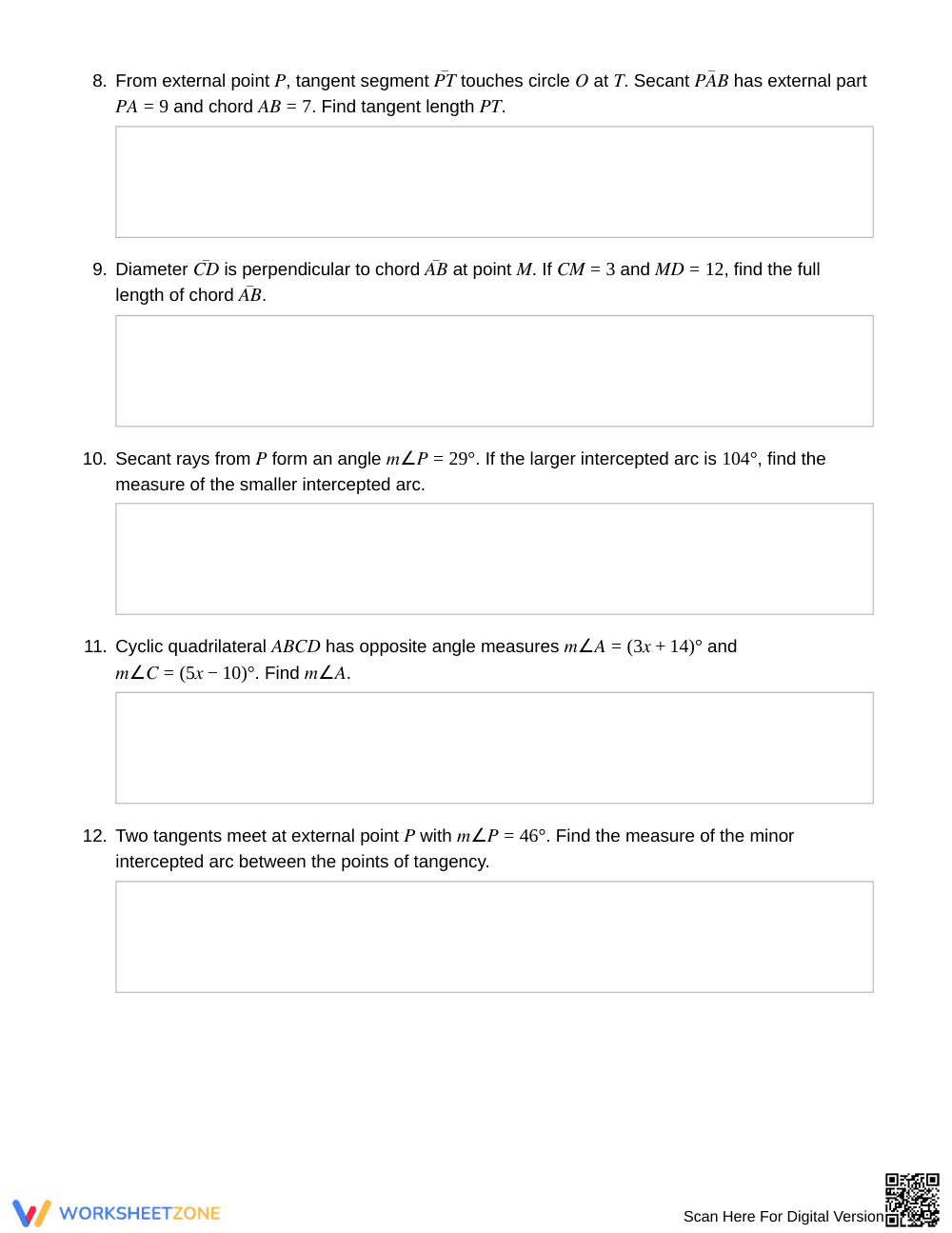
- Supported Practice (Part B, 8 problems): Mixed-theorem problems requiring students to identify whether angle or segment rules apply to secants, tangents, and cyclic quadrilaterals.
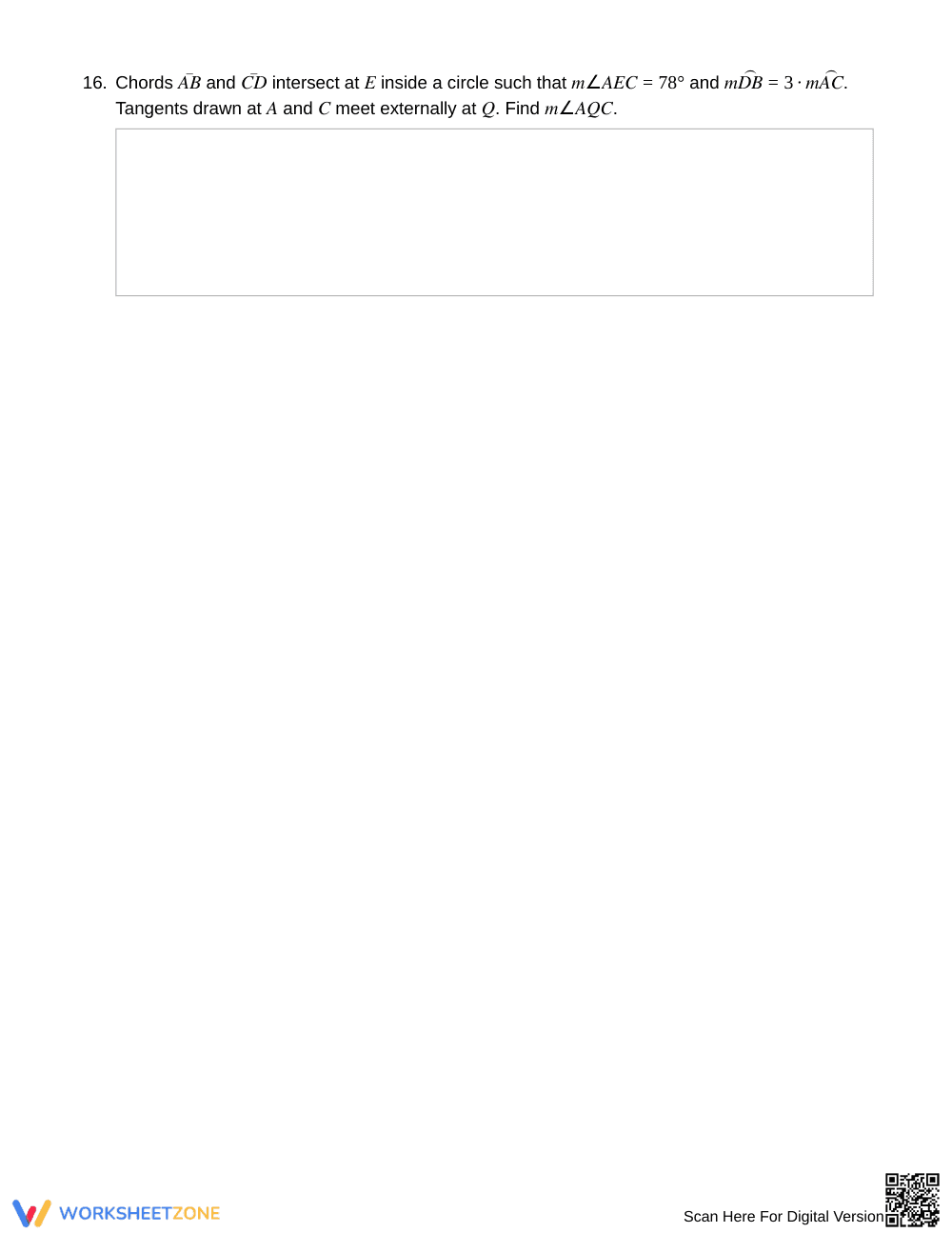
- Independent Practice (Part C, 4 problems): Multi-step applications requiring quadratic factoring and multi-stage geometric reasoning.
This progression follows the gradual-release model to scaffold geometric reasoning from formula recall to algebraic problem solving.
Standards Alignment
This worksheet directly targets HSG-C.A.2 by examining relationships among inscribed angles, radii, and chords, including central and circumscribed angles, right angles on diameters, and tangent-radius intersections. It also reinforces algebraic modeling under HSA-REI.B.4 through quadratic segment equations. Standard codes can be copied directly into lesson plans or curriculum mapping tools.
How to Use It
Deploy this worksheet after direct instruction on circle segments and angles as a mid-unit consolidation activity or summative test review. During independent work, conduct quick formative checks on Part B items: verify that students correctly distinguish between angle formulas (using arc sums or differences) and power theorems (using external and total segment lengths). The full activity requires approximately 45 to 60 minutes of class time.
Who It's For
Designed for on-level and honors Grade 10 Geometry students preparing for circle unit assessments. Provide the formula reference chart to support developing learners, while challenging advanced students with the Part C algebraic circle models. Pair this resource directly with circle theorem graphic organizers or compass-and-straightedge geometric constructions.
According to Fisher & Frey (2014), structured skill progressions that transition from single-rule execution to mixed-method discrimination significantly improve retention and transfer in secondary mathematics education. This 16-problem geometry worksheet aligns directly with Common Core standard HSG-C.A.2, guiding high school learners through essential chord, secant, tangent, and central angle theorems. By integrating reference tables, mixed identification tasks, and multi-step algebraic applications, the instructional material systematically builds procedural fluency and conceptual understanding. High school students benefit from explicit scaffolding as they move from basic formula recall to complex multi-step proofs and quadratic equation solving. Mathematics educators can easily implement these structured practice exercises during regular instructional periods, targeted intervention blocks, small group remediation, or collaborative study sessions before summative exams to ensure students attain comprehensive mastery over circle properties, strengthen geometric problem-solving techniques, and build lasting mathematical confidence.


