

































Complete Circle Relationships Worksheet | Grade 10 Geometry

Paste this activity's link or code into your existing LMS (Google Classroom, Canvas, Teams, Schoology, Moodle, etc.).
Students can open and work on the activity right away, with no student login required.
You'll still be able to track student progress and results from your teacher account.
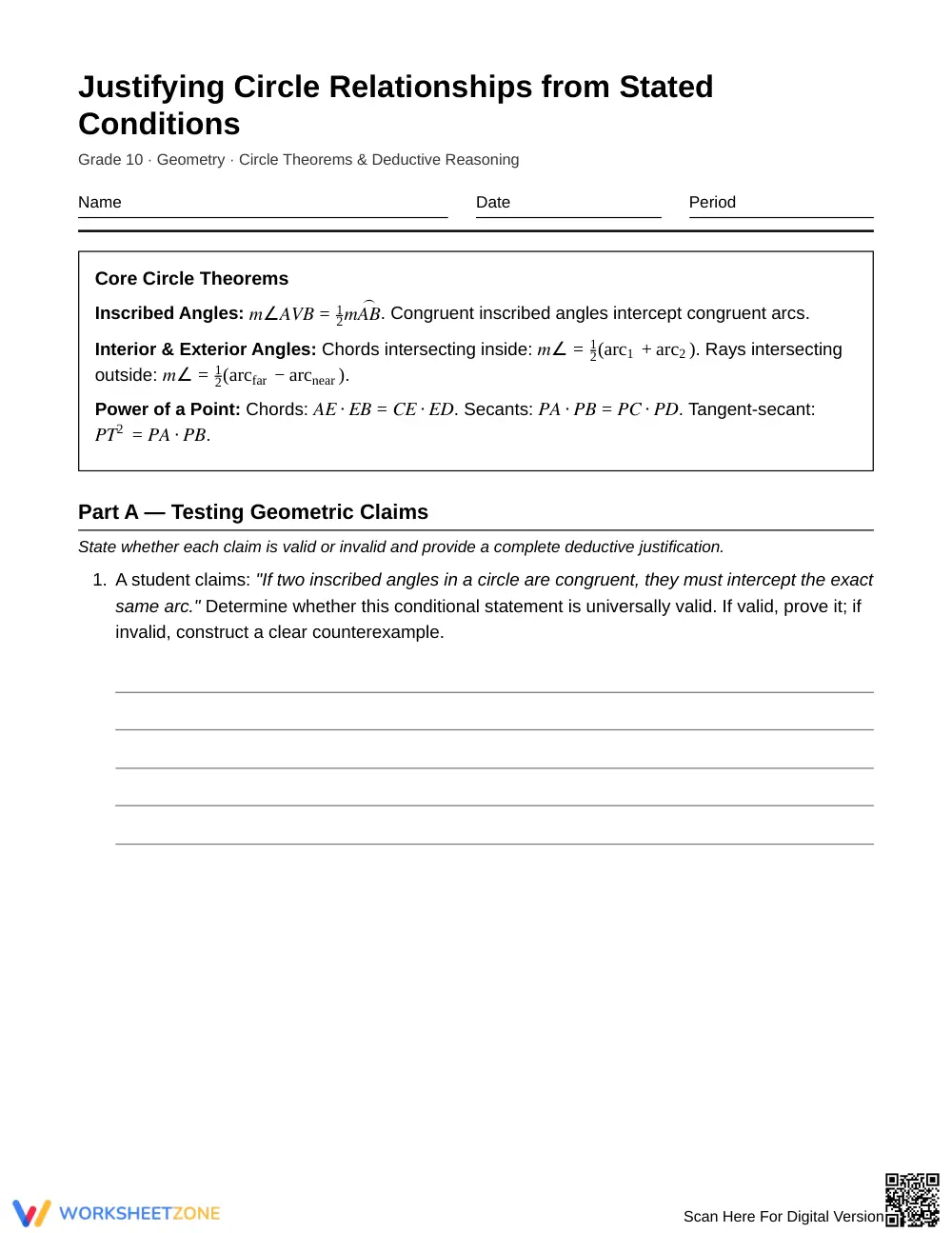
This Grade 10 geometry worksheet strengthens students' ability to prove and justify relationships among chords, secants, tangents, and inscribed angles in circles. High school learners evaluate geometric conjectures, write step-by-step deductive proofs, and construct counterexamples to establish when circle theorems hold under specific geometric conditions.
At a Glance
- Grade: 10 · Subject: Geometry
- Standard:
HSG-C.A.2— Identify and describe relationships among inscribed angles, radii, and chords- Skill Focus: Justify a circle relationship from stated conditions
- Format: 5 pages · 8 problems · Answer key included · PDF
- Best For: Geometry proof practice and deductive reasoning
- Time: 45–60 minutes
What's Inside
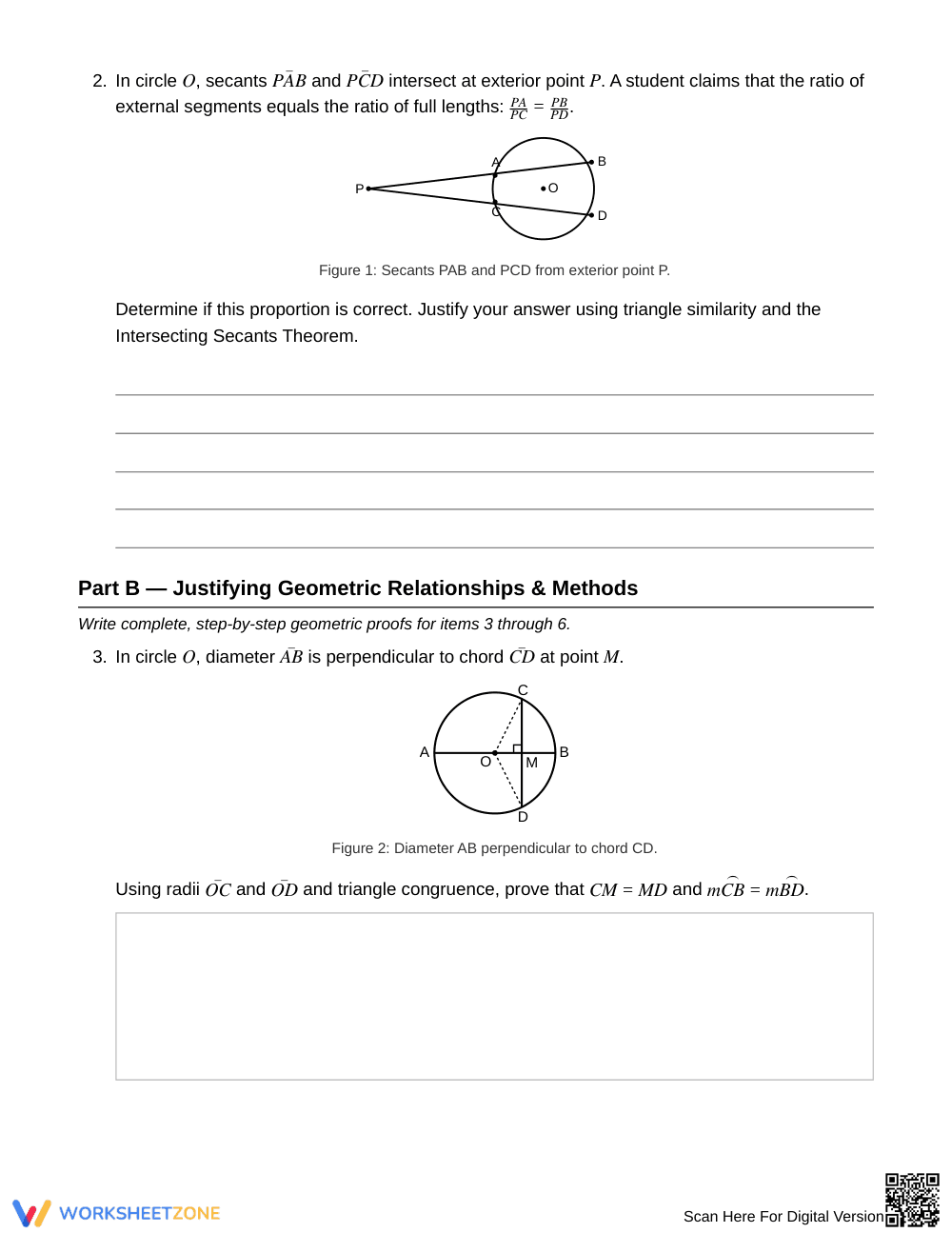
The 5-page printable PDF features a reference summary of core circle theorems followed by 8 geometric tasks organized into three sections. Students complete diagram-supported proof exercises, claim evaluations, and counterexample constructions, accompanied by a complete 2-page teacher answer key.
Skill Progression
- Guided practice (Problems 1–2): Students analyze pre-stated claims about secant ratios and inscribed arcs, determining validity through similarity proofs and counterexamples.
- Supported practice (Problems 3–6): Learners construct multi-step proofs for chord bisection, interior intersecting chords, tangent-secant similarity, and cyclic quadrilaterals.
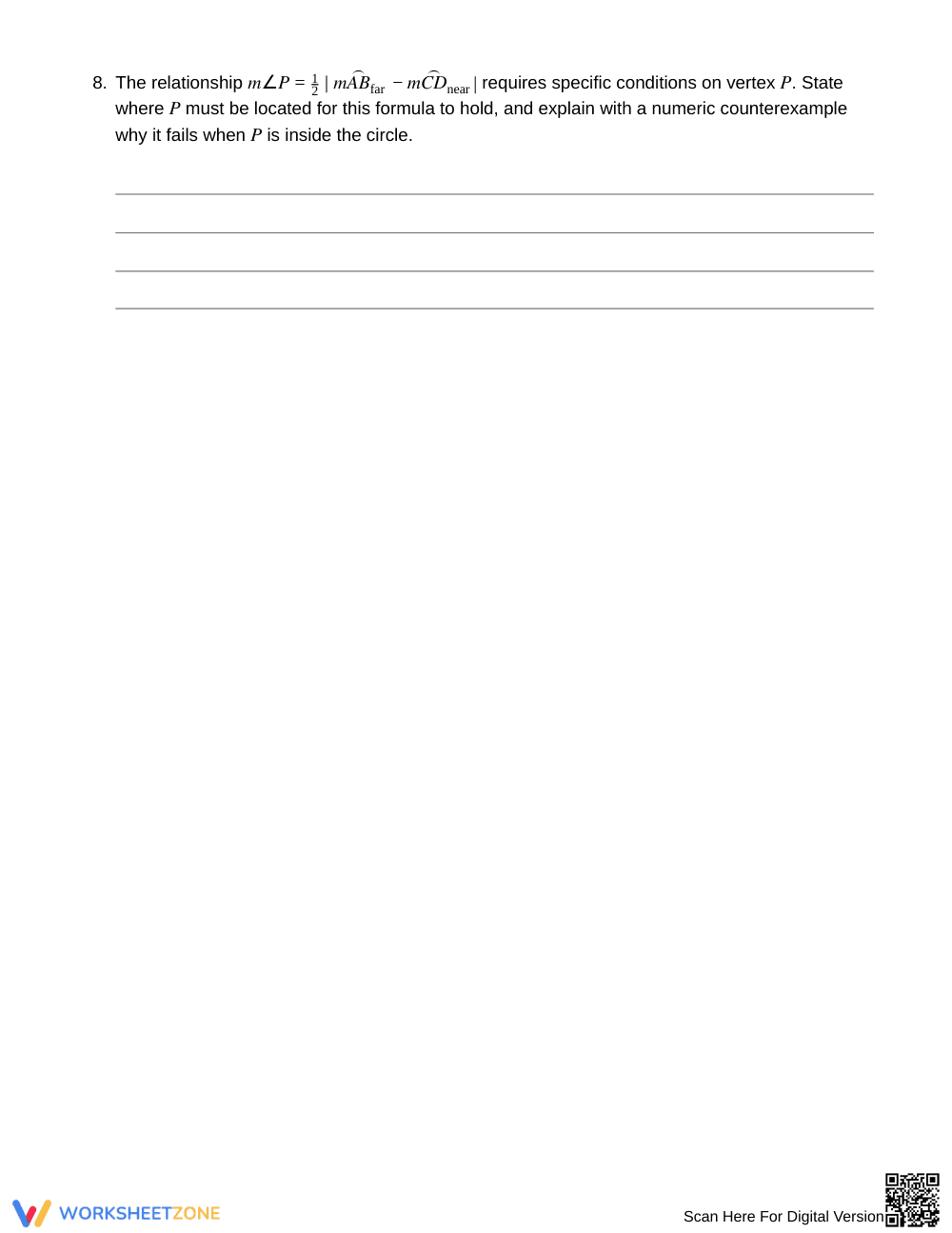
- Independent practice (Problems 7–8): High schoolers independently analyze boundary conditions by generating non-parallel chord counterexamples and identifying vertex constraints for angle formulas.
This sequence supports a gradual-release instructional model from guided verification to independent justification.
Standards Alignment
This worksheet directly aligns with HSG-C.A.2: Identify and describe relationships among inscribed angles, radii, and chords, including relationships among angles and chords. It also supports HSG-CO.C.9 through formal geometric proof structures. Both standard codes can be copied directly into lesson plans, IEP goals, or district curriculum mapping tools.
How to Use It
Assign this resource after direct instruction on circle angle and segment theorems to solidify deductive reasoning. It works well as partner proof practice or as an intensive small-group station activity. During class, formatively check whether students correctly establish triangle similarity before writing segment ratio deductions. Expected completion time is 45 to 60 minutes.
Who It's For
This worksheet is designed for Grade 10 geometry students mastering formal proofs and circle properties. For differentiation, provide the included theorem reference box as an anchor chart alongside pre-drawn auxiliary segments. Pair this activity with dynamic geometry software demonstrations of intersecting circle chords.
According to Fisher & Frey (2014), structured progression from evaluating claims to constructing deductive proofs reinforces durable mathematical reasoning and conceptual clarity. This Grade 10 geometry resource focuses on justifying circle relationships under standard HSG-C.A.2, requiring students to identify, describe, and formally prove relationships among inscribed angles, radii, chords, secants, and tangents. By engaging in 8 targeted exercises that balance algebraic derivation with geometric counterexamples, learners bridge intuitive spatial observations with formal deductive logic. Students evaluate conditional statements, apply auxiliary segments in cyclic quadrilaterals, and justify segment power relationships through triangle similarity. The explicit gradual-release structure scaffolded across 5 pages ensures high school mathematicians build verifiable proof competency. Incorporating systematic counterexample analysis further guards against overgeneralization, establishing an evidence-based foundation for advanced Euclidean proof mastery and standardized high school geometry assessments.


