































Complete Circle Design Models Worksheet | Grade 10 Geometry

Paste this activity's link or code into your existing LMS (Google Classroom, Canvas, Teams, Schoology, Moodle, etc.).
Students can open and work on the activity right away, with no student login required.
You'll still be able to track student progress and results from your teacher account.
This Grade 10 geometry worksheet equips students to model circular physical structures using chord, secant, and tangent theorems. High school learners calculate structural dimensions, evaluate multi-step architectural cross-sections, and justify real-world engineering constraints through rigorous geometric modeling. Students gain reliable proficiency translating technical design scenarios into solvable algebraic circle equations.
At a Glance
- Grade: 10 · Subject: Geometry
- Standard:
HSG-C.A.2— Identify and describe relationships among inscribed angles, radii, chords, tangents, and secants- Skill Focus: Model a Circle-Based Geometric Design
- Format: 5 pages · 10 problems · Answer key included · PDF
- Best For: High school geometry modeling practice
- Time: 45–60 minutes
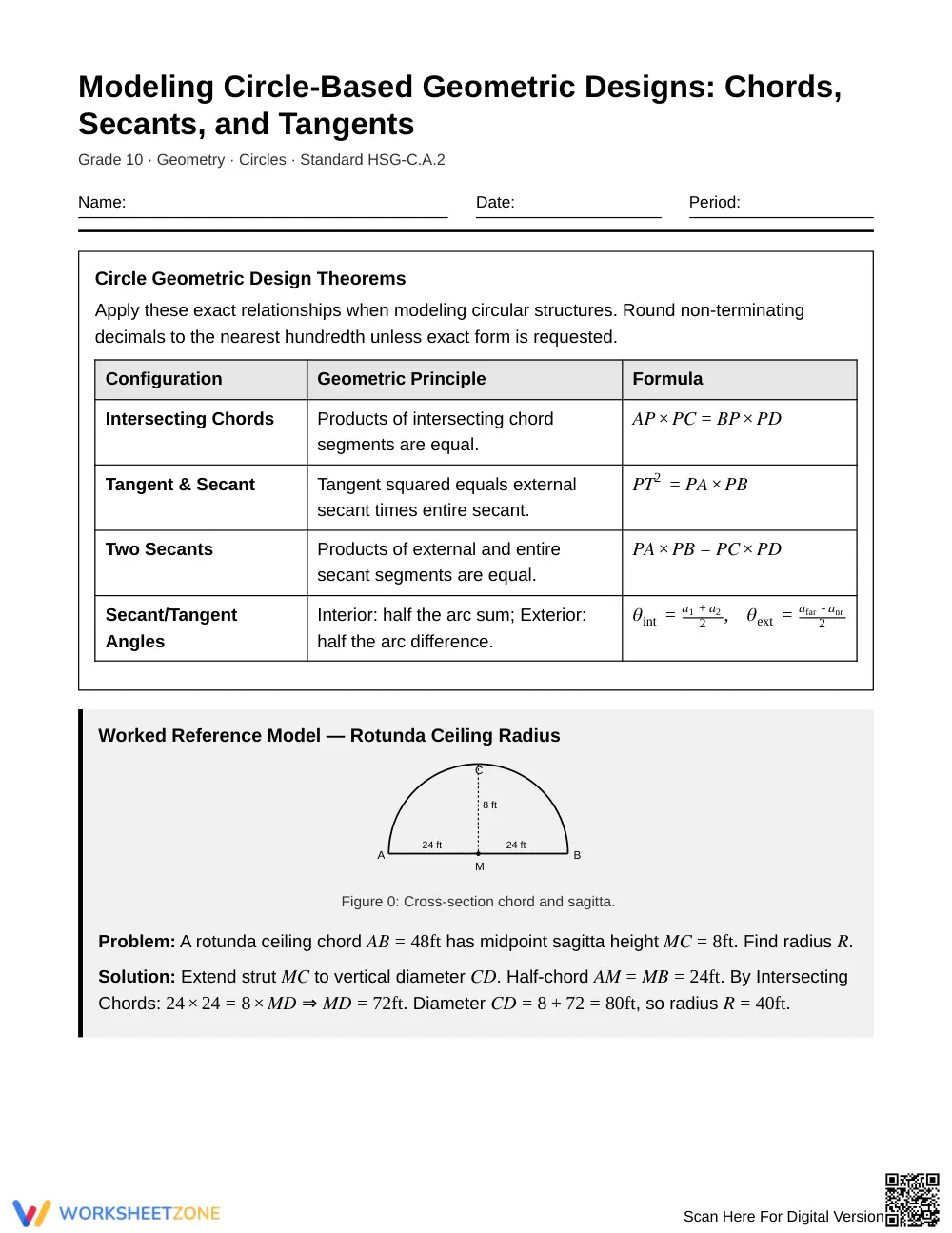
This 5-page printable resource includes 10 rigorous modeling tasks, a theorem reference chart, a fully worked reference model, and a comprehensive 2-page answer key. Students reference formulas for intersecting chords, secant-tangent segments, and subtended angles before tackling contextual scenarios ranging from rotunda ceiling sagitta measurements to radar barrier sweeps.
Skill Progression
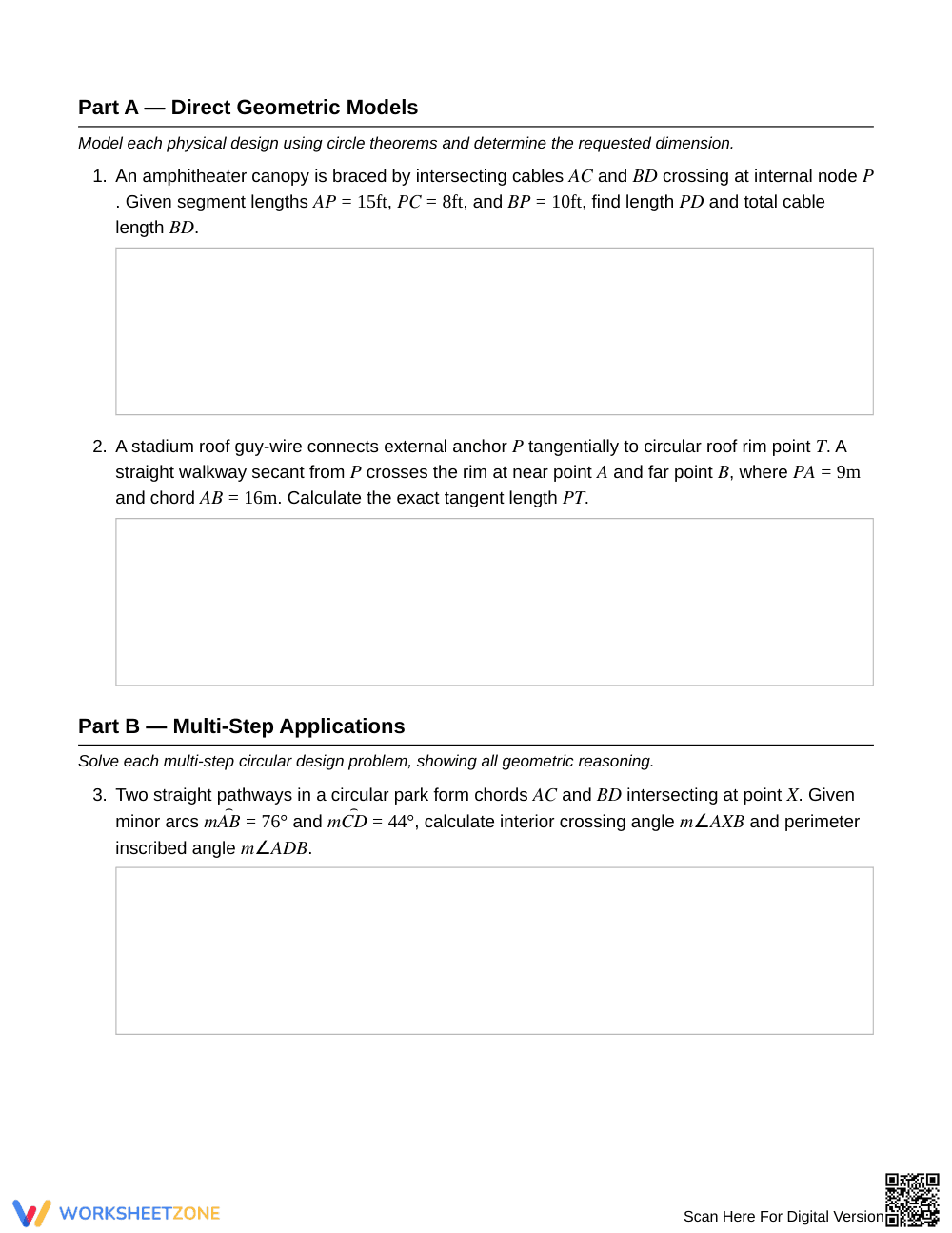
- Guided practice (Part A, 2 tasks): Direct models apply chord and tangent-secant theorems to find specific structural lengths from clear technical descriptions.
- Supported practice (Part B, 6 tasks): Multi-step applications integrate angle formulas, Pythagorean checks, tunnel clearances, and acoustic chord properties.
- Independent practice (Part C, 2 tasks): Constraint-based engineering decisions require students to compute parameters and evaluate design options against strict tolerances.
This sequence embodies a gradual-release model transitioning learners from formula application to engineering evaluation.
Standards Alignment
This worksheet aligns with `HSG-C.A.2`: Identify and describe relationships among inscribed angles, radii, and chords, including angles formed by chords, tangents, and secants. The tasks also support modeling standard `HSN-Q.A.2` through real-world descriptive quantities. Both standard codes can be copied directly into lesson plans, IEP goals, or district curriculum mapping tools.
How to Use It
Deploy this activity during the consolidation phase after direct instruction on circle power theorems, or utilize it as a multi-day collaborative modeling laboratory. During classwork, circulate to formatively assess whether students correctly identify whether intersecting lines cross internally or externally before selecting their theorem. Expect student completion to span 45 to 60 minutes.
Who It's For
This resource is designed for Grade 10 Geometry students, honors geometry learners, and secondary students preparing for standardized STEM assessments. For differentiation, provide struggling learners with the worked rotunda example as an anchor model, while challenging advanced students to derive alternative trigonometric verification methods. Pair this worksheet directly with a circle theorem interactive demonstration or an architectural geometry anchor chart.
Applying geometric theorems to physical architecture and engineering systems anchors abstract geometric proofs in authentic mathematical practice. Under standard `HSG-C.A.2`, high school students must identify and apply relationships among chords, tangents, and secants to solve complex spatial modeling problems. According to foundational educational research on structured instructional design by Fisher & Frey (2014), gradual-release problem sets that transition from scaffolded worked reference models to multi-step contextual applications significantly increase procedural fluency and conceptual transfer in secondary mathematics classrooms. This 10-task geometry worksheet reinforces critical spatial reasoning by linking algebraic circle power formulas directly to real-world structural constraints such as tunnel clearances, canopy cable tensions, and optical angle evaluations. By practicing systematic constraint evaluation alongside precise dimensional calculations, tenth-grade learners build the essential analytical modeling competencies required for success in advanced STEM coursework and rigorous standards-aligned performance assessments.


