































Complete Chinese Pastries Word Search | Grades 6–7 ELA

Paste this activity's link or code into your existing LMS (Google Classroom, Canvas, Teams, Schoology, Moodle, etc.).
Students can open and work on the activity right away, with no student login required.
You'll still be able to track student progress and results from your teacher account.
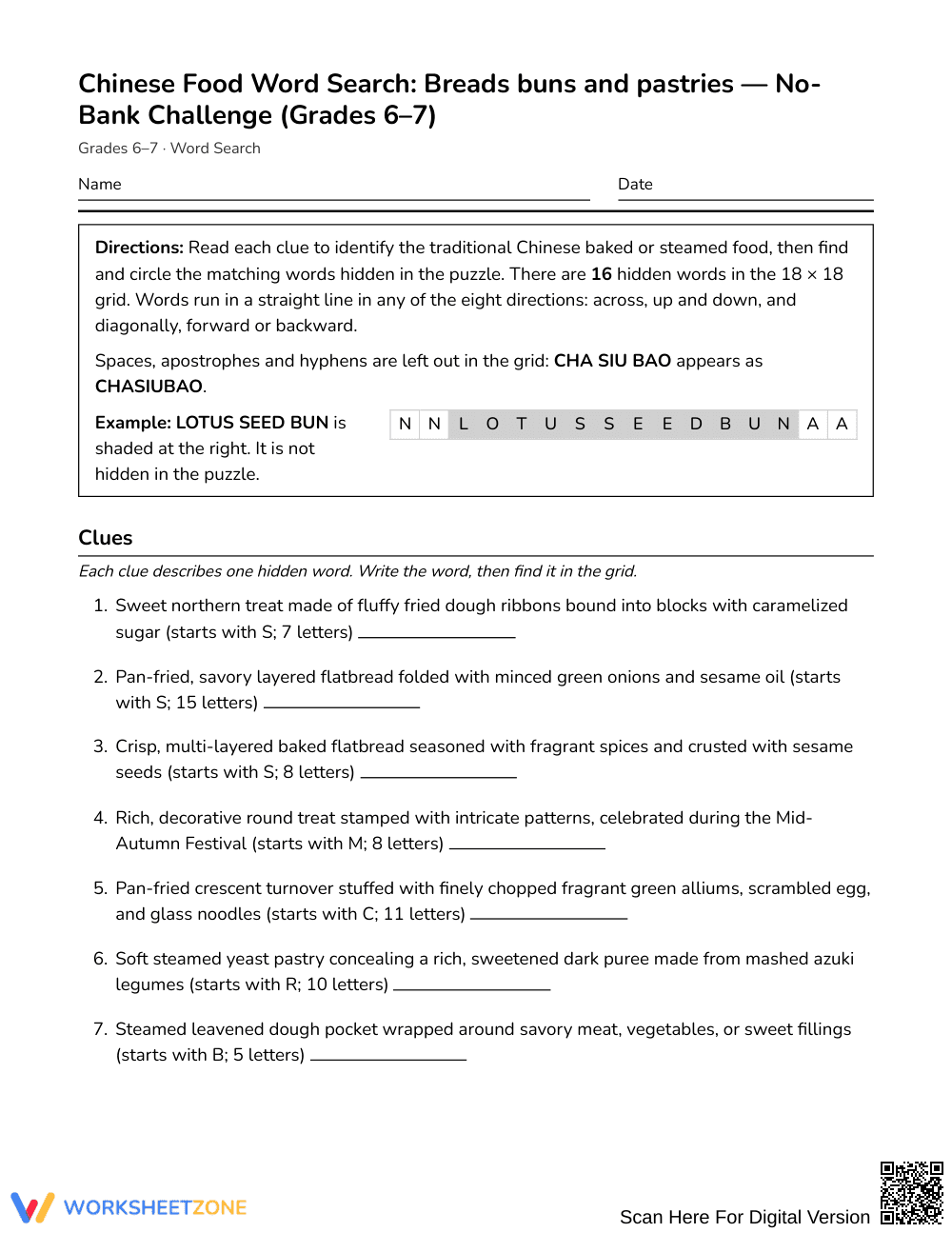
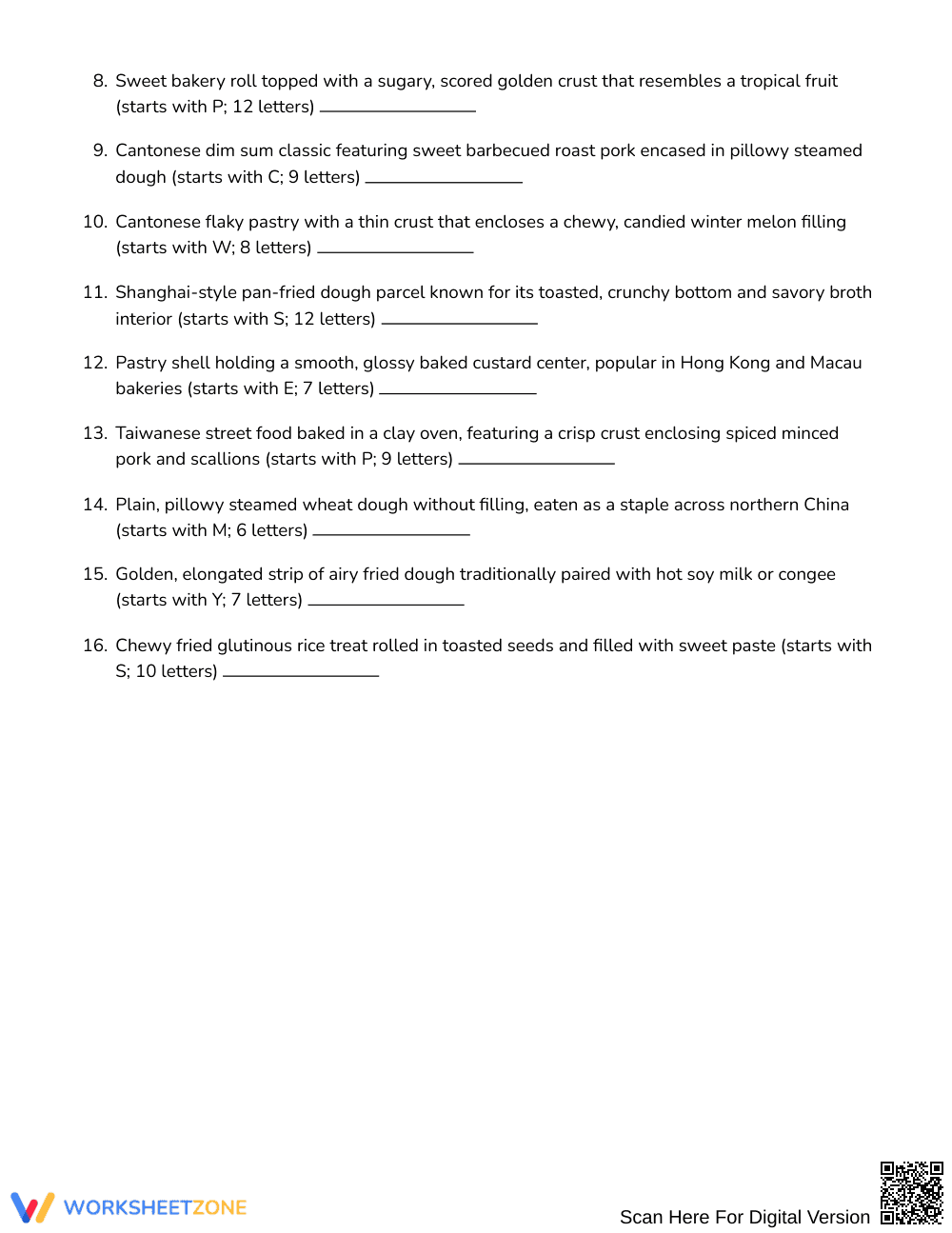
This cultural food word search expands middle school vocabulary by challenging students to identify and locate 16 traditional Chinese breads, buns, and pastries. Rather than relying on a simple list, learners interpret culinary definitions to uncover items across an engaging letter grid, strengthening reading comprehension and world culture knowledge.
At a Glance
- Grade: Grades 6–7 · Subject: English Language Arts (ELA)
- Standard: Not standards-assessed — vocabulary enrichment
- Skill Focus: Traditional Chinese breads, buns, and pastries vocabulary
- Format: 3 pages · 16 words · Answer key included · PDF
- Best For: Independent cultural vocabulary practice and extension
- Time: 25–35 minutes
What's Inside
This 3-page printable activity features a challenging letter grid, 16 descriptive food clues, and a comprehensive 4-page answer key. Instead of a standard word bank, students read context-rich clues describing regional textures, cooking techniques, and ingredients—from steamed mantou to flaky egg tarts—to deduce each term before searching.
Puzzle Mechanics and Structure
The activity utilizes an 18 x 18 grid designed to promote active visual scanning and spelling reinforcement without an exposed word bank. Target terms run across all eight possible directions: north, northeast, east, southeast, south, southwest, west, and northwest. Students must synthesize clue information, deduce the corresponding Chinese pastry name, and track multi-directional letter sequences across the puzzle matrix.
Standards Alignment
This activity provides direct vocabulary enrichment and is not aligned to a specific state or national content standard. It supports domain-specific terminology acquisition, cultural literacy, and morphological awareness through contextual descriptions of culinary traditions.
How to Use It
Deploy this puzzle as an engaging extension activity after an informational reading unit on world cultures, or introduce it as a meaningful vocabulary warm-up before food-writing assignments. During work time, observe whether students identify key descriptive words within each clue—such as leavened, flaky, or glutinous—to verify vocabulary comprehension before they begin searching. The full activity requires approximately 25 to 35 minutes for most middle schoolers to complete.
Who It's For
This resource is tailored for Grades 6–7 English Language Arts learners developing descriptive reading skills and cultural vocabulary. It offers engaging independent practice for fast finishers, multilingual learners exploring cross-linguistic food terms, and social studies cross-curricular units. Pair this puzzle with an informational article on Asian culinary history or a sensory descriptive writing workshop.
Contextual vocabulary acquisition relies on cognitive retrieval pathways that link conceptual definitions to precise lexical items. Research by Fisher & Frey (2014) highlights that purposeful vocabulary tasks requiring learners to negotiate semantic meaning—rather than rote copying—measurably improve long-term word retention and reading comprehension across middle grade classrooms. By removing the traditional word bank and providing descriptive culinary clues, this 16-word puzzle compels students to process morphological and syntactic attributes, such as dough textures, cooking methods, and regional distinctions, before visually verifying letter strings across an 18 x 18 grid. This dual-demand structure bridges content-area literacy with cultural schema building, ensuring that students do not simply scan letters passively but actively retrieve and consolidate new domain-specific terms. Integrating structured word puzzles with rigorous informational clues provides an accessible, evidence-based supplement for expanding specialized vocabulary in Grades 6–7 English Language Arts.


