































Complete Chinese New Year Word Search | Grades 7–8 ELA

Paste this activity's link or code into your existing LMS (Google Classroom, Canvas, Teams, Schoology, Moodle, etc.).
Students can open and work on the activity right away, with no student login required.
You'll still be able to track student progress and results from your teacher account.
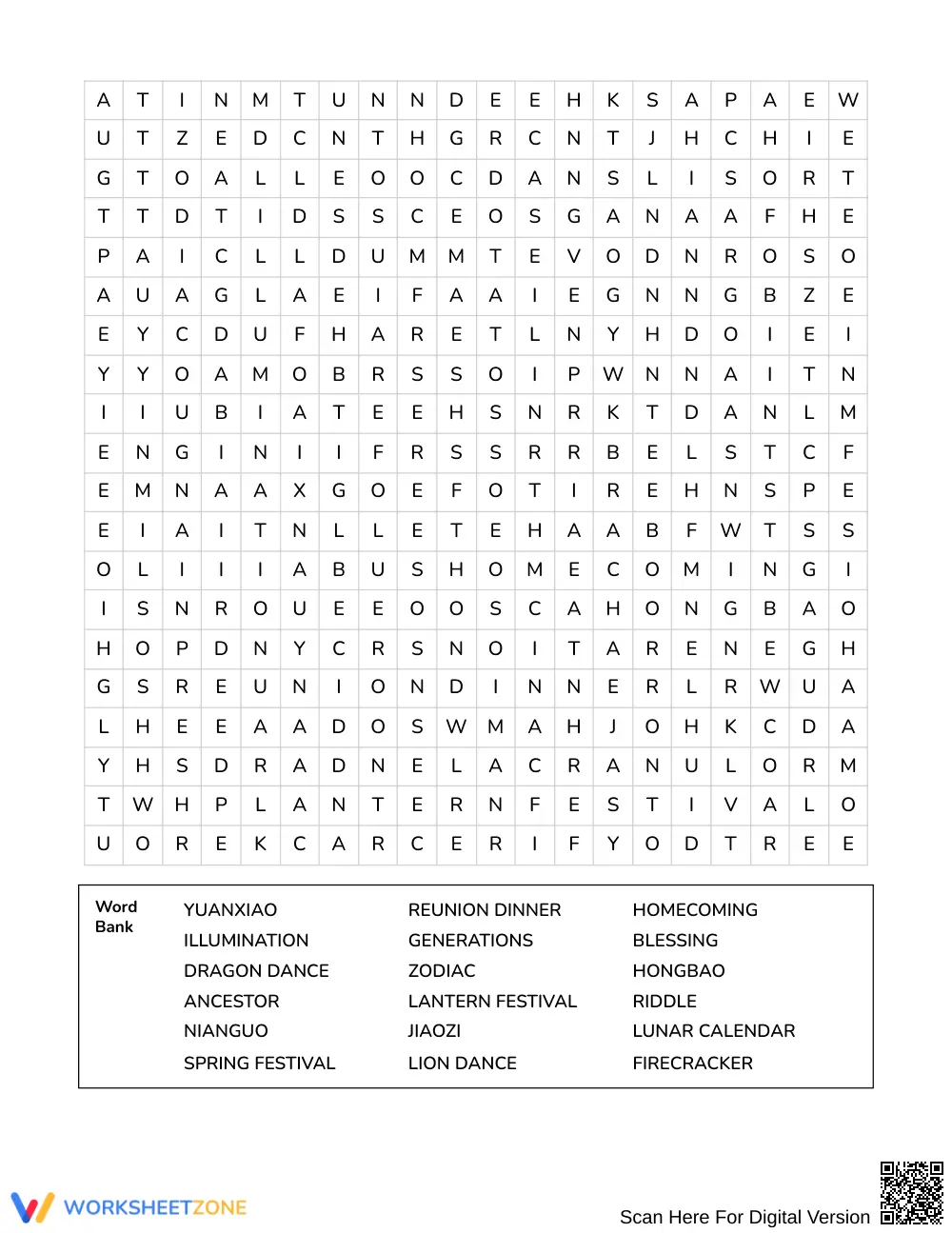
This Chinese New Year word search introduces and reinforces key cultural vocabulary for Grades 7–8 students. Learners read detailed definitions to identify 18 holiday-specific terms before locating each hidden word inside a challenging letter matrix. The activity builds cultural literacy and ELA domain-specific vocabulary through an engaging, text-based puzzle format.
At a Glance
- Grade: Grades 7–8 · Subject: English Language Arts
- Standard: Not standards-assessed — vocabulary enrichment
- Skill Focus: Chinese New Year cultural vocabulary review
- Format: 3 pages · 18 words · Answer key included · PDF
- Best For: Holiday vocabulary review and cultural enrichment
- Time: 25–35 minutes
What's Inside
The 3-page printable PDF features an 18-clue vocabulary sheet paired with an expansive word search grid. Students read cultural descriptions for traditional customs like the reunion dinner, lion dance, hongbao, and jiaozi, matching each definition to its target term. The resource includes a full 4-page answer key that highlights exact word placements on the grid for rapid grading.
Puzzle Mechanics and Structure
This puzzle challenges students with an authentic, rigorous search format built around specific design constraints:
- Clue-Driven Identification: Students read 18 informational clues to determine each holiday term before searching, linking definitions directly to cultural concepts.
- Expansive 20x20 Grid: Hidden terms are embedded across a dense letter field that requires systematic visual scanning.
- Full 8-Direction Placement: Words run in all eight compass directions: north, northeast, east, southeast, south, southwest, west, and northwest, including forward and reverse diagonals.
A shuffled word bank provides reference support while keeping students focused on semantic meaning.
Standards Alignment
This resource serves as targeted vocabulary enrichment and is not aligned to a formal academic standard. It supports cross-curricular cultural literacy by reinforcing domain-specific terms connected to world traditions, social customs, and seasonal celebrations.
How to Use It
Introduce this word search after direct instruction on seasonal cultural traditions or assign it as an independent enrichment activity during social studies and ELA integration. For formative assessment, observe whether students identify terms from the descriptive clues before looking at the word bank. Learners typically complete the full 18-word puzzle in 25 to 35 minutes.
Who It's For
This activity is designed for Grades 7–8 English Language Arts students building cultural schema and tier-three vocabulary. It offers structured vocabulary exposure for general education classes, ELL support, and early finishers. Pair this puzzle with an informational reading passage about Lunar New Year traditions or student-led presentations on seasonal folklore.
Cultural vocabulary enrichment provides middle school students with essential schema needed to interpret informational and literary texts across diverse world traditions. According to Fisher & Frey (2014), intentional word exposure through varied context clues and interactive retrieval strengthens long-term lexical retention far more effectively than isolated rote memorization. This Grades 7–8 resource requires learners to review Chinese New Year cultural vocabulary by matching 18 content-rich definitions to key terms before locating them within a complex 20x20 grid. Because words run in eight distinct directions, the search demands sustained orthographic processing and focused visual scanning. By combining definition-based clues with active puzzle solving, the activity reinforces cultural literacy, enhances morphological awareness, and engages students in independent linguistic discovery. Educators can implement this print-ready resource as an enriching holiday study that strengthens foundational language acquisition without requiring formal standards-based testing.


