































Complete Chemical Bonding Worksheet | Grade 9–12 Science

Paste this activity's link or code into your existing LMS (Google Classroom, Canvas, Teams, Schoology, Moodle, etc.).
Students can open and work on the activity right away, with no student login required.
You'll still be able to track student progress and results from your teacher account.
This high school chemistry worksheet develops data analysis and scientific reasoning by prompting students to classify ionic and covalent bonding using experimental evidence. Students evaluate melting points, conductivity measurements, electron transfer diagrams, and electronegativity values across 15 structured tasks to construct claim-evidence-reasoning explanations of bond behavior.
At a Glance
- Grade: Grades 9–12 · Subject: Science
- Standard: High School Physical Science — Construct explanations of bonding from empirical data and molecular models
- Skill Focus: Evidence-based interpretation of ionic and covalent bonding properties
- Format: 4 pages · 15 problems · Answer key included · PDF
- Best For: Mid-unit practice or formative assessment
- Time: 45–55 minutes
What's Inside
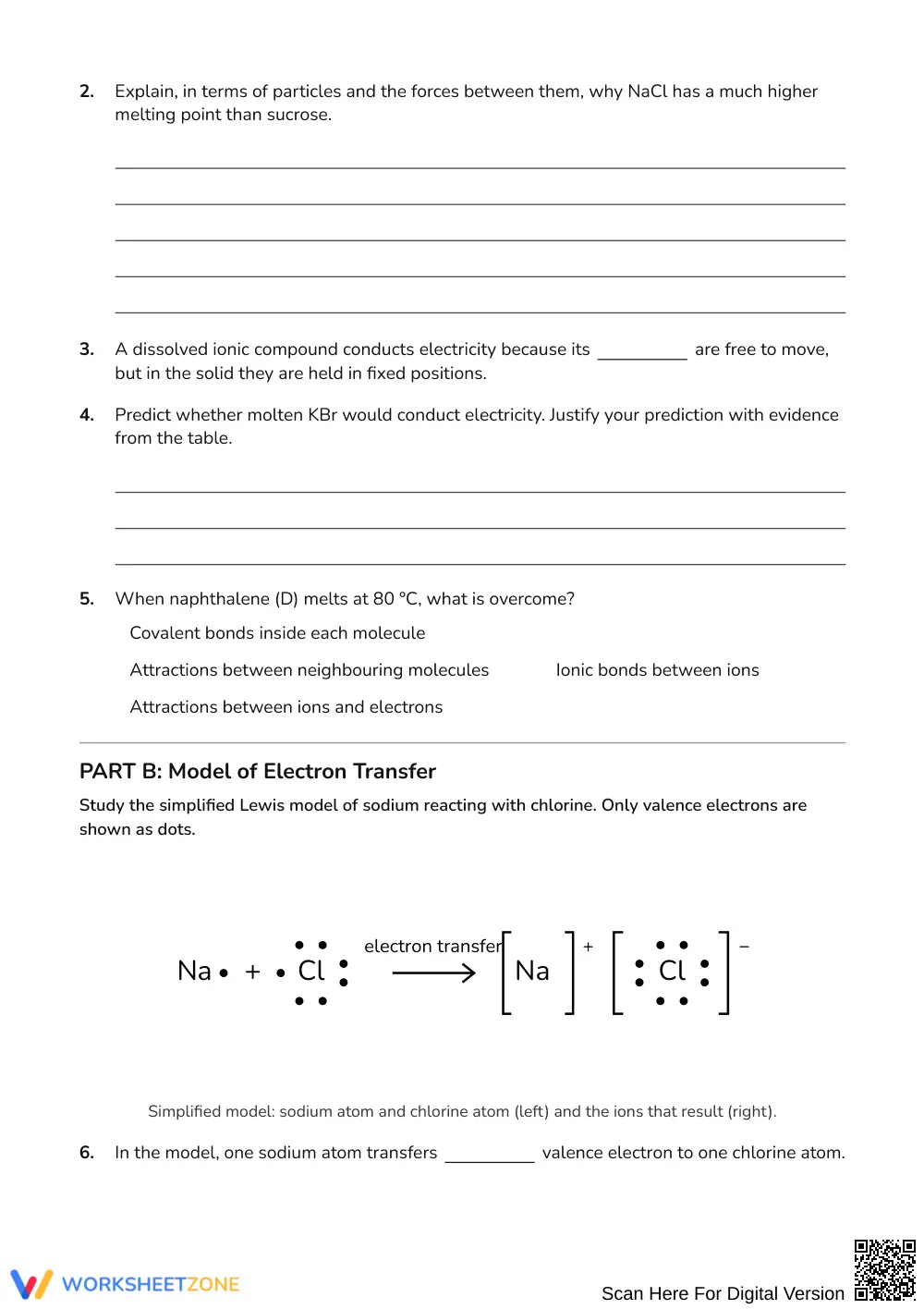
The 4-page resource includes three organized sections: Part A presents data tables and melting point values for four mystery solids; Part B provides Bohr and Lewis electron transfer diagrams; and Part C graphs electronegativity differences across common chemical bonds. The document includes multiple-choice identification items, short-answer particle justifications, and an extended claim-evaluation task supported by a complete 4-page teacher answer key.
Skill Progression
- Guided practice (Tasks 1–5): Students examine paired conductivity and thermal data for substances like sodium chloride and sucrose, matching macroscopic bulk properties to underlying electrostatic attractions.
- Supported practice (Tasks 6–10): Learners interpret structural Lewis models showing valence electron transfer, identifying ion stability and lattice energy changes during compound formation.
- Independent practice (Tasks 11–15): Students graph electronegativity differences along a continuous scale, analyzing polar versus nonpolar sharing and refuting common misconceptions about room-temperature solids.
This structured progression reflects an intentional gradual-release framework, guiding learners from concrete observational data toward nuanced particle-level modeling.
Standards Alignment
This activity aligns with high school physical science performance expectations that require students to plan and conduct investigations to gather evidence comparing the structure of substances at the bulk scale to infer the strength of electrical forces between particles. It also supports core ideas regarding chemical interactions, matter stability, and electrical attraction. These alignment descriptions can be copied directly into lesson plans, IEP goals, or district curriculum mapping tools.
How to Use It
Administer this worksheet during guided practice immediately following direct instruction on electronegativity and ionic lattices, or use it after lab investigations as a summative analysis activity. Circulate during Part C to check whether students recognize bonding as a continuum rather than a rigid binary category. Most high school classes complete the 15 tasks in 45 to 55 minutes.
Who It's For
Designed for general chemistry and introductory physical science students, this activity supports varied learners through explicit data sets and labeled models. Pair this worksheet with an interactive ball-and-stick modeling kit or a conductivity probe demonstration to reinforce the underlying molecular concepts.
According to Fisher & Frey (2014), structured data analysis paired with graduated-release prompts significantly strengthens student transfer of abstract molecular concepts. This 4-page resource targets high school physical science standards by prompting students to interpret bulk physical properties, examine electron transfer mechanisms, and analyze electronegativity gradients across 15 evidence-based tasks. High school learners frequently struggle to connect macroscopic properties—such as melting temperature and aqueous electrical conductivity—with the microscopic forces holding crystal lattices or covalent molecules together. By examining empirical data sets for compounds such as sodium chloride, sucrose, and naphthalene, students construct precise scientific explanations grounded in particle interaction. The complete teacher key provides sample claim-evidence-reasoning responses, making it a reliable diagnostic measure for district curricula and classroom formative checkpoints.


