































Complete Cemetery & Memorial Word Search | Grades 4–5 ELA

Paste this activity's link or code into your existing LMS (Google Classroom, Canvas, Teams, Schoology, Moodle, etc.).
Students can open and work on the activity right away, with no student login required.
You'll still be able to track student progress and results from your teacher account.
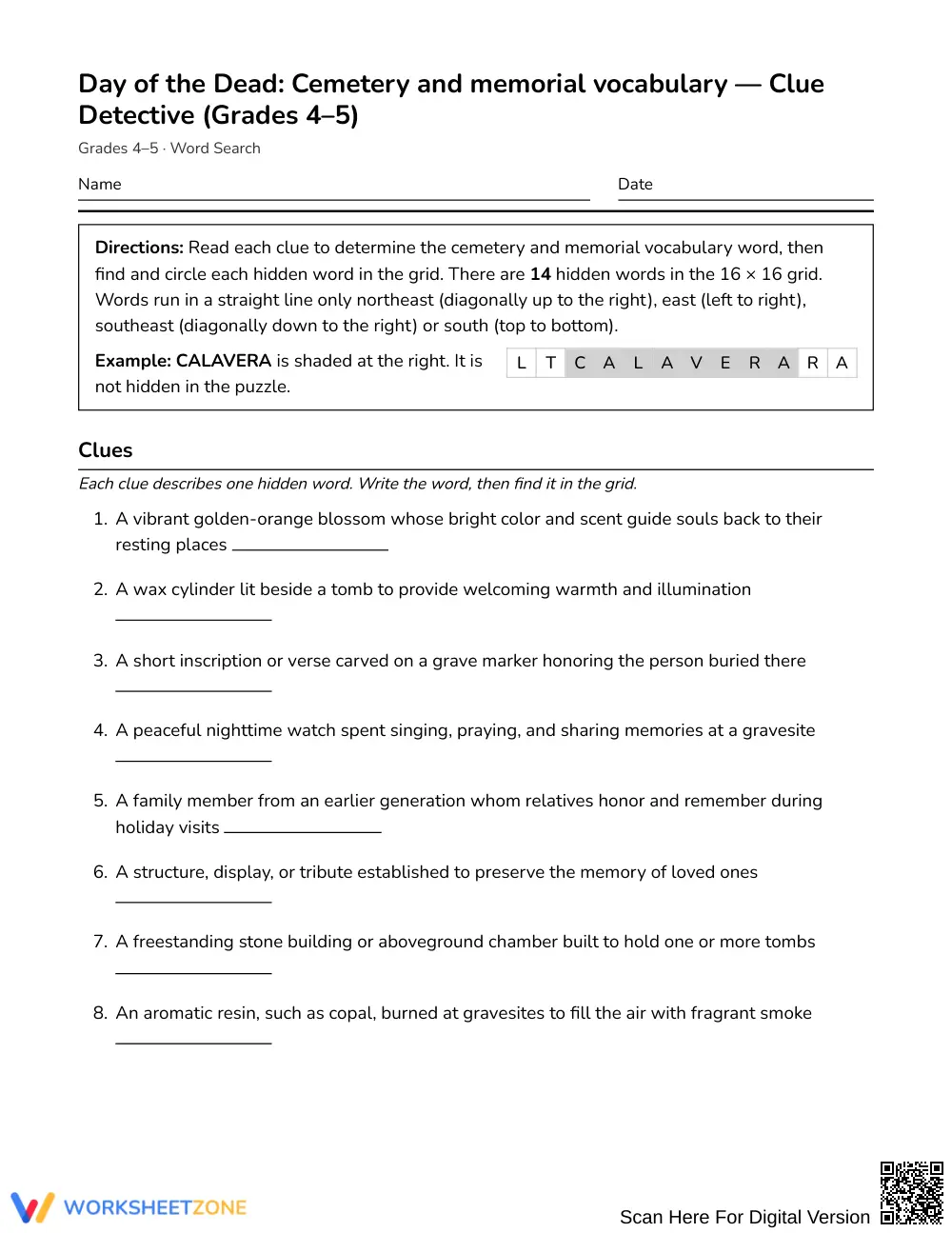
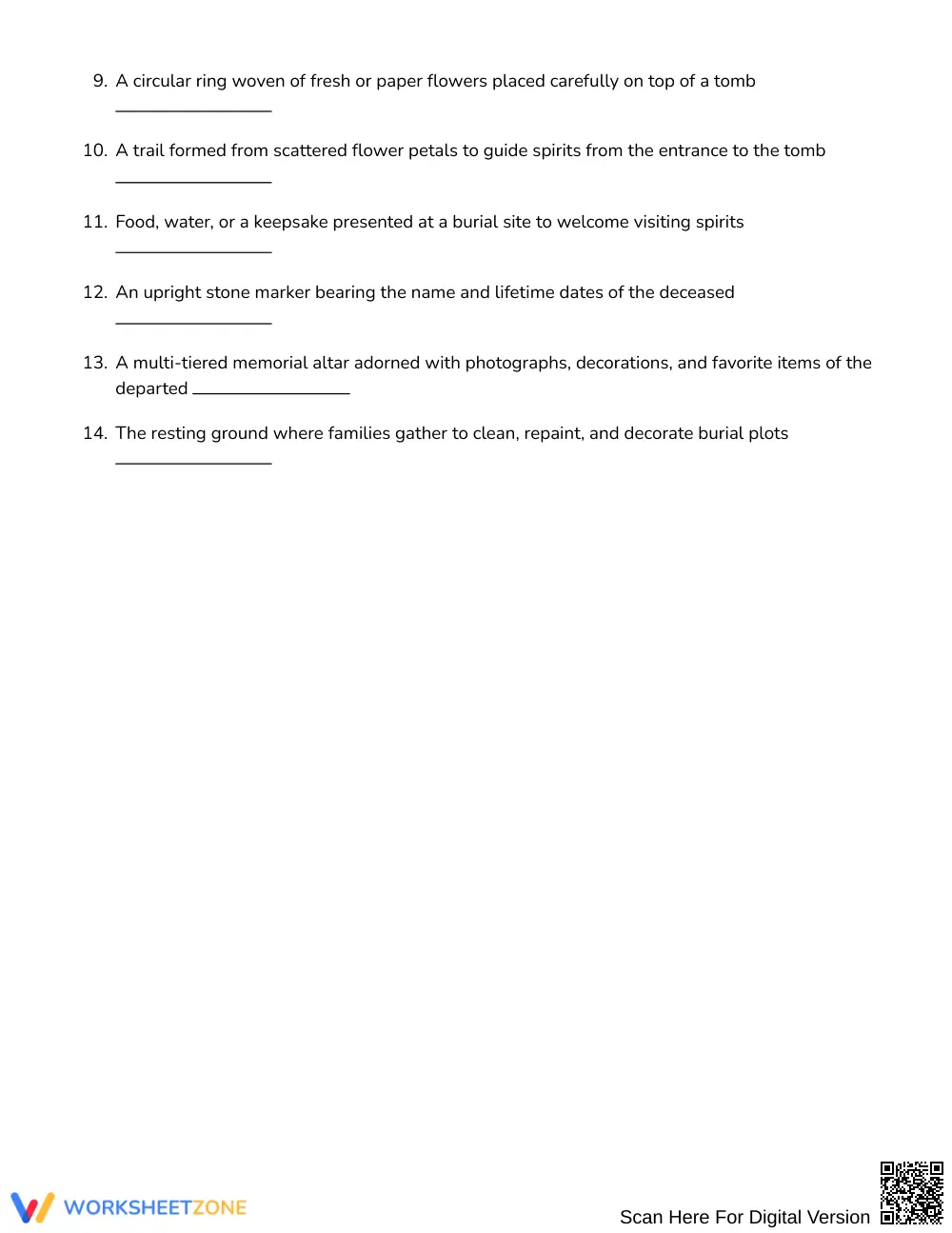
This Grades 4–5 vocabulary word search strengthens cultural literacy and word knowledge by challenging learners to identify and locate 14 key cemetery and memorial terms. Students read detailed context clues to deduce each vocabulary word before searching the letter grid, reinforcing domain-specific definitions through engaging, active puzzle solving.
At a Glance
- Grade: Grades 4–5 · Subject: English Language Arts (ELA)
- Standard: Not standards-assessed — vocabulary enrichment through cultural and historical word study
- Skill Focus: Cemetery and memorial vocabulary related to Day of the Dead traditions
- Format: 3 student and answer pages · 14 hidden words · Complete full-size answer key included · PDF printable
- Best For: Day of the Dead cultural vocabulary enrichment and independent practice
- Time: 20–30 minutes of focused classroom work
The activity packet spans 3 pages, including a clean student puzzle sheet and a complete 3-page solution reference. Instead of a basic word list, this clue detective puzzle provides 14 descriptive clues that prompt students to identify each term—such as ofrenda, epitaph, mausoleum, and marigold—before locating it within the letter matrix.
Puzzle Structure and Mechanics
This word search uses an intentional design to build vocabulary recall and visual scanning skills:
- Grid Layout: The puzzle features a 16 × 16 letter grid packed with cemetery and memorial vocabulary.
- Word Placement: All 14 words run in four distinct directions—northeast, east, southeast, and south—offering an accessible yet rigorous search challenge for upper elementary students.
- Clue Detective Format: Students solve descriptive clues to reveal each target word, practicing definition matching rather than passive copying.
Standards Alignment
This activity serves as dedicated vocabulary enrichment and is not aligned to a formal standard. Designed to broaden cultural and historical vocabulary, it offers targeted language practice that supports reading comprehension across social studies and ELA themes without standard-specific testing constraints.
How to Use It
Use this word search during an introductory cultural unit to activate background knowledge, or assign it after direct instruction on memorial traditions as an engaging reinforcement activity. While students work, circulate to observe whether they correctly identify vocabulary terms from the clues before scanning the grid; students struggling with terms like epitaph or mausoleum can highlight clue keywords. Expected completion time is 20 to 30 minutes.
Who It's For
This resource is designed for Grades 4–5 students developing academic and domain-specific vocabulary. For emerging readers or multilingual learners, pair the puzzle with an illustrated anchor chart displaying altar items and memorial monuments. It pairs naturally with an informational reading passage about Day of the Dead traditions or a classroom discussion on cultural commemoration practices.
Vocabulary enrichment activities that integrate contextual clues with active retrieval foster deeper lexical acquisition than rote memorization. According to Fisher & Frey (2014), intentional word-learning routines that require upper elementary students to analyze definitions, retrieve meanings, and apply domain-specific language accelerate content-area reading comprehension. This Grades 4–5 cemetery and memorial vocabulary word search operationalizes that principle by requiring learners to solve 14 definitional clues before finding each hidden term in a 16 by 16 letter grid. By linking descriptive prompts to cultural terms such as ofrenda, epitaph, and mausoleum, the activity bridges receptive and expressive vocabulary development. Educational research confirms that combining puzzle-based orthographic scanning with semantic clue solving increases student engagement while reinforcing spelling patterns and semantic memory. Teachers can implement this resource as an independent cultural literacy task or small-group vocabulary exploration with 20 to 30 minutes of focused student practice.


