































Complete Carbon Reservoirs Worksheet | Grade 8 Science

Paste this activity's link or code into your existing LMS (Google Classroom, Canvas, Teams, Schoology, Moodle, etc.).
Students can open and work on the activity right away, with no student login required.
You'll still be able to track student progress and results from your teacher account.
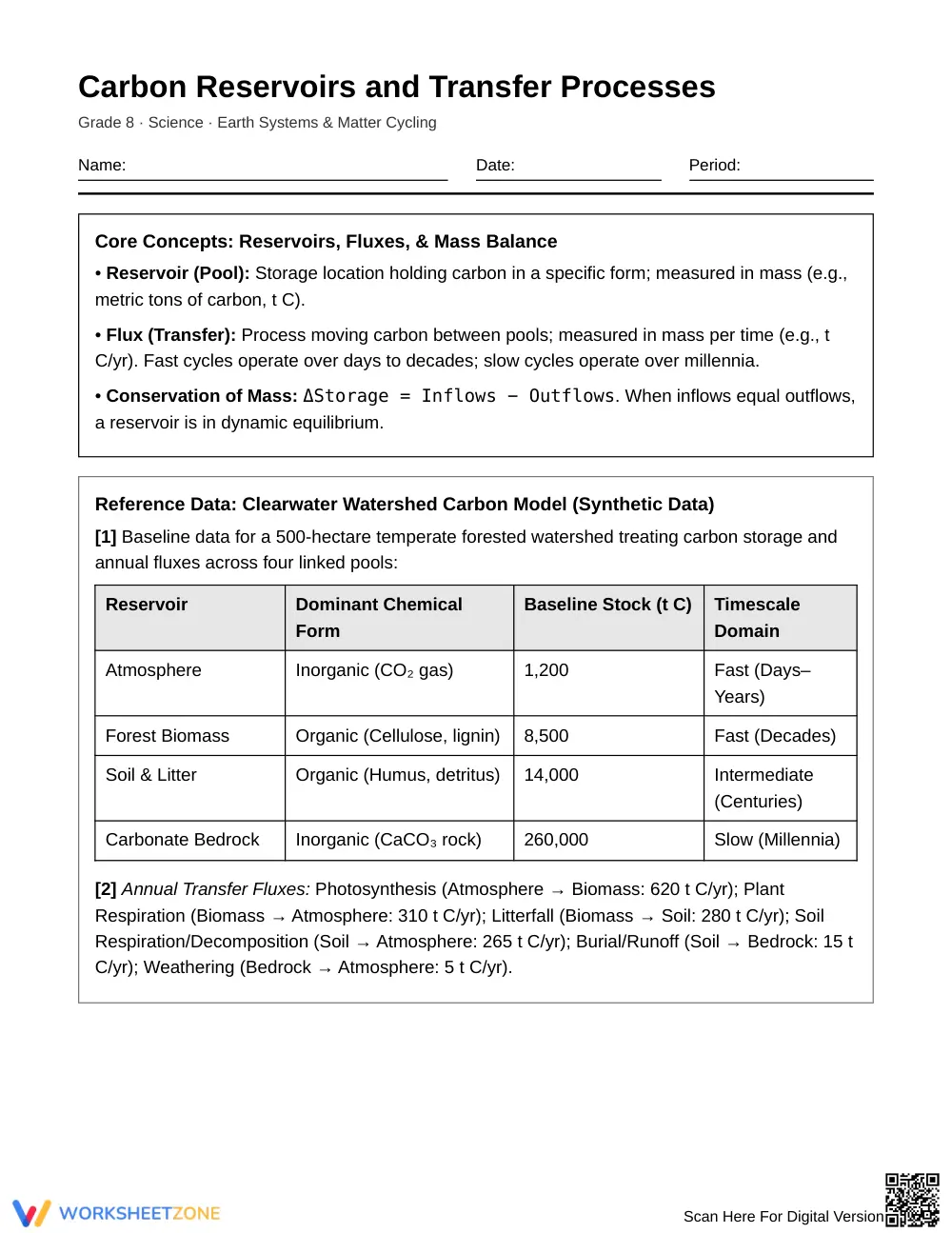
Master Earth system matter cycling with this comprehensive worksheet on carbon reservoirs and transfer processes. Grade 8 science students analyze quantitative baseline data from a forested watershed, calculate reservoir mass balances, and predict system responses to environmental disturbances like wildfires and logging.
At a Glance
- Grade: 8 · Subject: Science
- Standard: Model matter cycling and energy flow in Earth systems
- Skill Focus: Carbon Reservoirs and Transfer Processes
- Format: 4 pages · 12 problems · Answer key included · PDF
- Best For: Earth systems practice and mass balance calculations
- Time: 40–50 minutes
What's Inside: This 4-page resource provides synthetic baseline data for a forested watershed model across atmospheric, biomass, soil, and bedrock pools. Students complete 12 tasks featuring classification, mechanism explanations, flux accounting calculations, and disturbance predictions. A 2-page teacher answer key provides worked mathematical solutions and sample responses.
Skill Progression
- Guided practice (Tasks 1–4): Distinguish reservoirs from fluxes, compare chemical forms, and classify biological versus geological processes.
- Supported practice (Tasks 5–10): Apply conservation of mass to calculate net annual accumulation across biomass, soil, and atmospheric reservoirs.
- Independent practice (Tasks 11–12): Construct justified explanations predicting system responses to prescribed burns and clearcut timber harvests.
This sequence reinforces mastery through gradual release, advancing from conceptual definitions to quantitative system modeling.
Standards Alignment
This resource aligns with middle school Earth and Life Science standards governing matter cycling and energy flow in ecosystems. Students examine how photosynthesis and respiration cycle carbon atoms between organic and inorganic pools, applying mass conservation to Earth systems. Standard codes can be copied directly into lesson plans, IEP goals, or district curriculum mapping tools.
How to Use It
Use this worksheet following direct instruction on biogeochemical cycles. For independent practice, students calculate reservoir mass balances before evaluating disturbance scenarios in pairs. Formative observation tip: Review Task 8 to ensure students correctly sum atmospheric inflows before subtracting photosynthetic outflows. Expected completion time is 40 to 50 minutes.
Who It's For
This activity suits Grade 8 science students and introductory environmental science learners. Visual learners benefit from clear data tables, while learners needing support utilize given mass-balance formulas. Pair this worksheet with an interactive carbon cycle diagram or dynamic system simulation.
According to EdReports 2024, rigorous middle school science curricula require students to engage directly with quantitative data representations and multi-step systems modeling rather than relying solely on rote vocabulary recall. This Grade 8 science worksheet supports deep conceptual learning by challenging students to track carbon stocks and transfer fluxes across terrestrial, atmospheric, and geological reservoirs. By calculating reservoir mass balances using the formula ΔStorage = Inflows − Outflows, learners apply the law of conservation of mass to dynamic biological and geological interactions. Students evaluate real-world environmental disturbances, including wildfire combustion and commercial deforestation, to predict shifts in carbon source and sink behaviors. The structured 12-task progression guides students from foundational reservoir identification to complex scenario analysis, providing educators with concrete formative assessment data regarding student comprehension of Earth system matter cycling.


