





























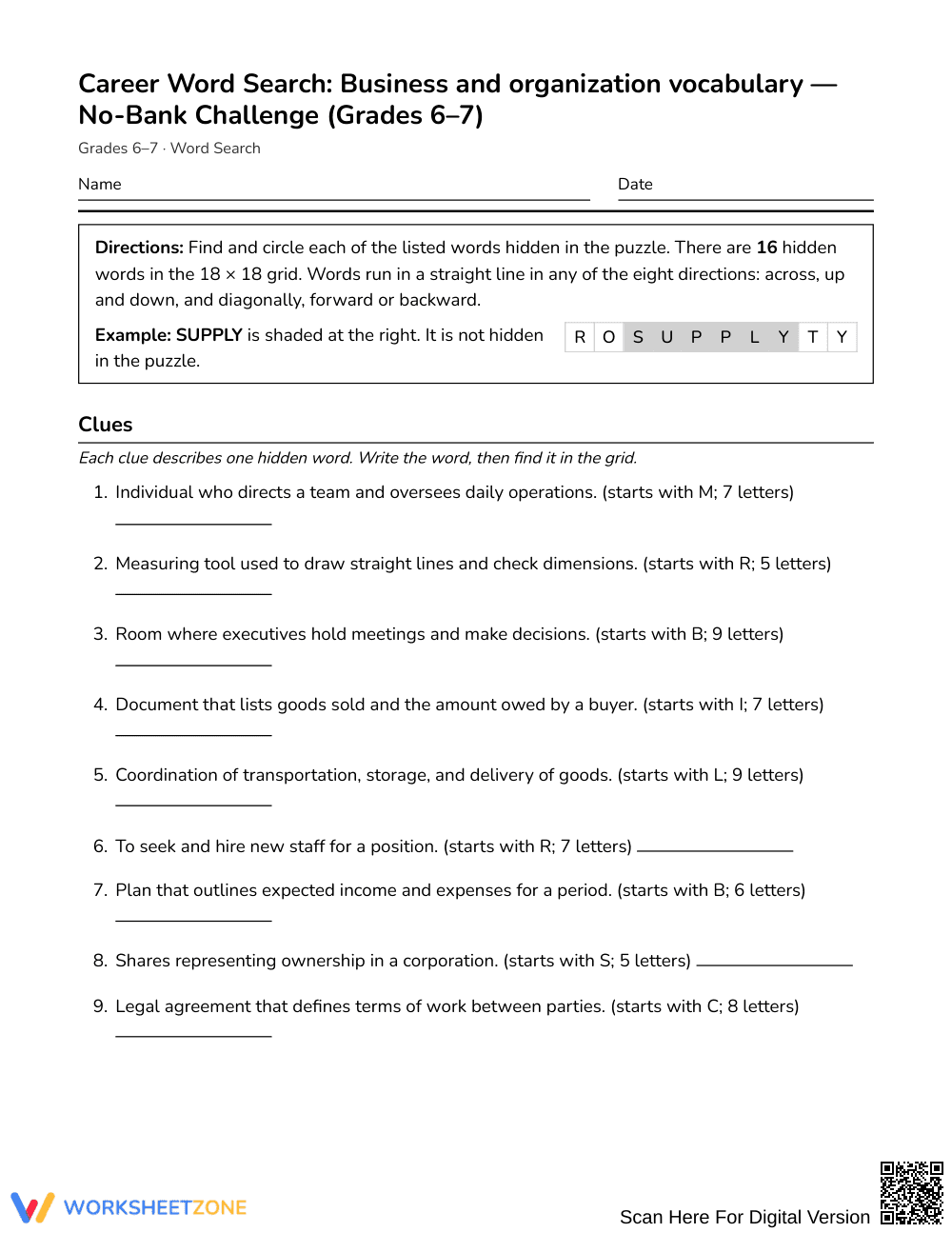


Complete Business Vocabulary Word Search | Grades 6–7 ELA

Paste this activity's link or code into your existing LMS (Google Classroom, Canvas, Teams, Schoology, Moodle, etc.).
Students can open and work on the activity right away, with no student login required.
You'll still be able to track student progress and results from your teacher account.
This business and organization vocabulary word search strengthens middle school literacy by introducing 16 essential workplace terms through definition-driven puzzle solving. Designed for Grades 6–7, the activity challenges students to read professional definitions and locate targeted terminology, reinforcing word recognition, spelling precision, and career-oriented reading comprehension across three printable pages.
At a Glance
- Grade: Grades 6–7 · Subject: English Language Arts (ELA)
- Standard: Not standards-assessed — vocabulary enrichment
- Skill Focus: Business and organization vocabulary
- Format: 3 pages · 16 words · Answer key included · PDF
- Best For: Vocabulary enrichment and career exploration
- Time: 20–30 minutes
Inside this resource, educators will find a no-bank vocabulary challenge spanning three student pages paired with a three-page answer key. Rather than relying on a passive word list, students read 16 distinct clues defining commercial terms such as invoice, logistics, merger, and consultant. Students deduce the correct term from the definition before locating it within the letter array, building active recall and lexical reasoning.
This puzzle features an 18 by 18 letter grid configured for intermediate challenge. The 16 target words run in all eight directions: north, northeast, east, southeast, south, southwest, west, and northwest. Because the printable omits a pre-listed word bank, learners must decode the clue definitions first, preventing simple letter-matching and requiring sustained spatial scanning to identify each hidden term.
This resource serves as targeted vocabulary enrichment and is not aligned to a formal academic standard. It emphasizes practical career and organizational terminology, allowing middle school teachers to broaden general academic language, support cross-curricular business units, and enhance foundational spelling without the constraints of standardized testing benchmarks.
Deploy this word search during an introductory career exploration unit or immediately after direct instruction on workplace communications. For independent seatwork, have learners read each definition, write the deduced term in the margin, and then search the grid. During early-finisher stations, observe whether students identify terms by scanning root letters or checking intersecting vowels, offering prompt support if diagonal placements cause visual tracking fatigue. The activity typically takes 20 to 30 minutes to complete.
This activity is designed for Grades 6–7 students expanding their academic and business lexicons. It benefits general education classes, English language learners building functional workplace vocabulary, and learners seeking a no-bank visual puzzle challenge. Pair this word search with an informational text on modern entrepreneurship or an introductory lesson on business letter writing to anchor the vocabulary in authentic professional contexts.
According to Fisher & Frey (2014), intentional exposure to domain-specific terminology across varied instructional formats accelerates contextual word acquisition and deepens reading comprehension in middle school learners. This Grades 6–7 business and organization vocabulary word search delivers purposeful enrichment through 16 defined workplace terms embedded within an 18 by 18 letter matrix. By requiring students to interpret explicit clue definitions without the aid of a visible word bank, the activity stimulates cognitive retrieval mechanisms before initiating visual-spatial search across eight directional axes. As educational researchers emphasize, engaging students in multi-step vocabulary tasks bolsters orthographic memory and conceptual retention more effectively than rote memorization lists. Incorporating structured career vocabulary activities within English Language Arts instruction supports interdisciplinary background knowledge, equips early adolescents with functional professional language, and strengthens foundational analytical reading skills necessary for secondary academic readiness.


