


























Views
Downloads

Complete Braking & Reaction Worksheet | Grade 12 Physics
Paste this activity's link or code into your existing LMS (Google Classroom, Canvas, Teams, Schoology, Moodle, etc.).
Students can open and work on the activity right away, with no student login required.
You'll still be able to track student progress and results from your teacher account.
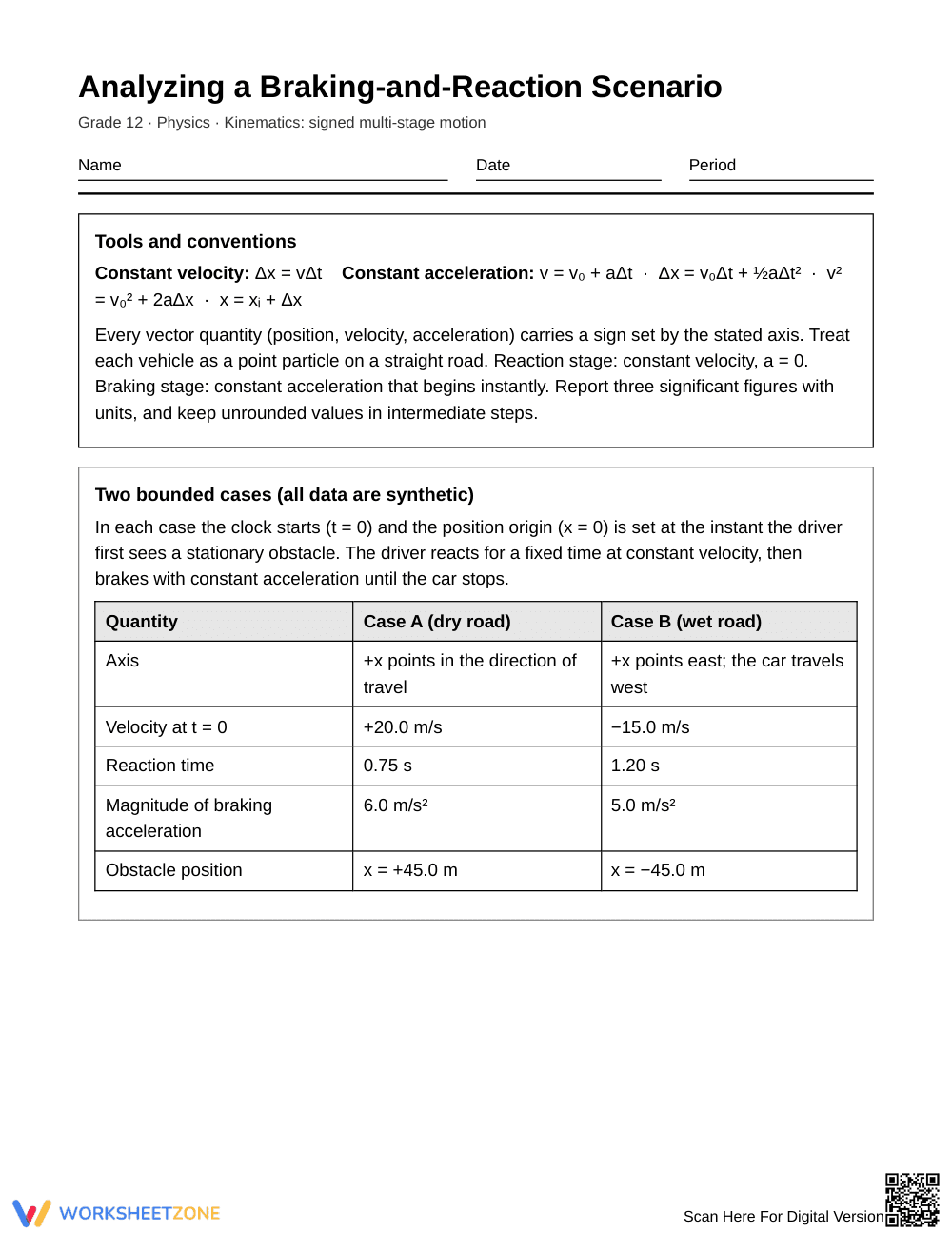
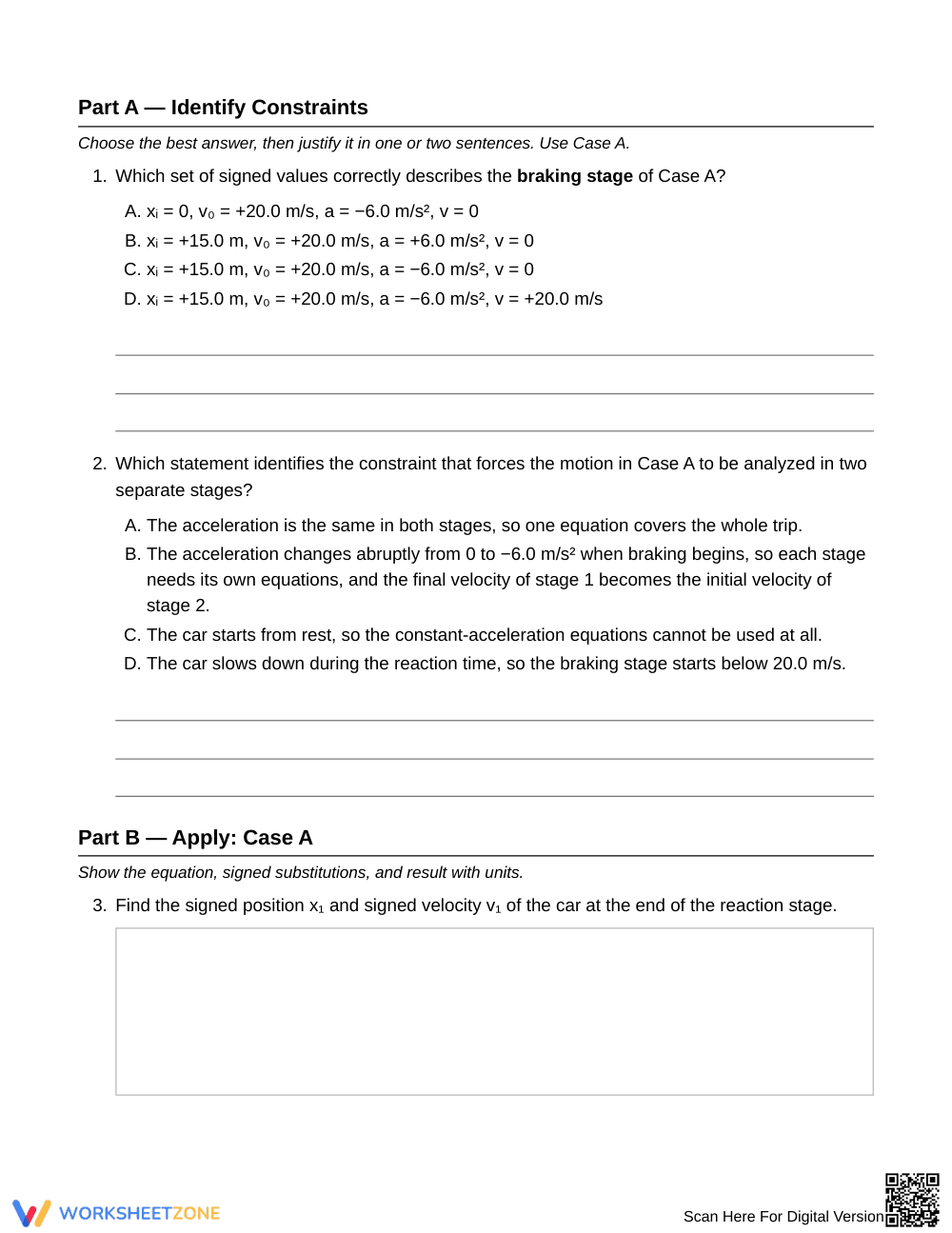
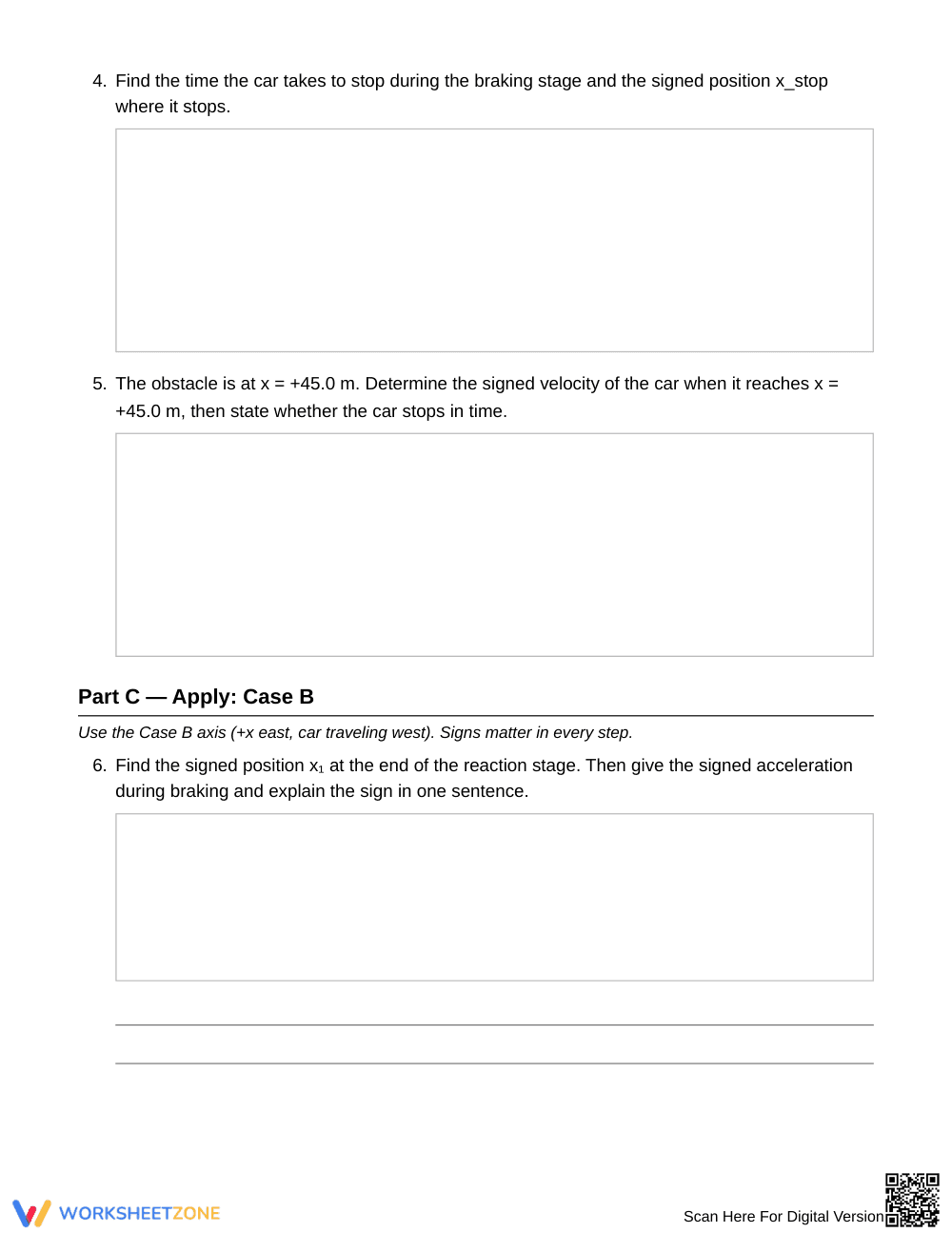
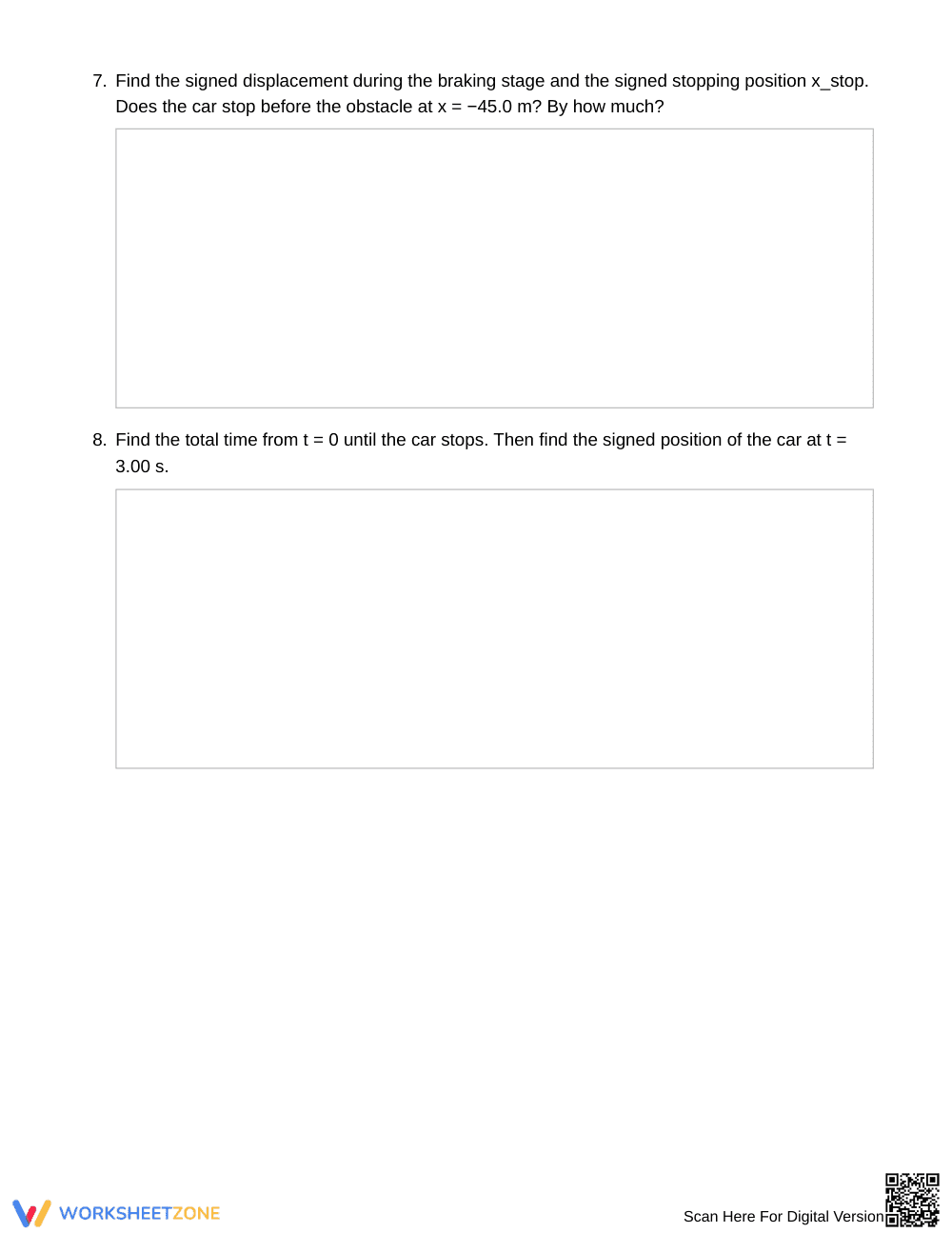
This worksheet teaches Grade 12 physics students to analyze a braking-and-reaction scenario by splitting motion into a constant-velocity stage and a constant-acceleration stage. Students assign signed values, chain the stages together, and judge whether a car stops before an obstacle, then defend their conclusion with numbers.
At a Glance
- Grade: 12 · Subject: Physics
- Standard: Kinematics in one dimension — model two-stage motion using signed values and constant acceleration
- Skill Focus: Signed two-stage kinematics with reaction and braking
- Format: 5 pages · 10 problems · Answer key included · PDF
- Best For: Unit review and independent problem practice
- Time: 40–50 minutes
What's Inside
This 5-page worksheet combines two multiple-choice items with written justification, six multi-step calculations, and two student-conclusion evaluations. A tools box lists the kinematic equations and sign conventions, and a data table describes two cases (dry road and wet road). The answer key runs 2 pages.
Skill Progression
- Guided practice (2 problems): Part A uses multiple choice plus a one- or two-sentence justification to identify signed values and the two-stage constraint.
- Supported practice (3 problems): Part B applies the equations to Case A with the data table and tools box close at hand.
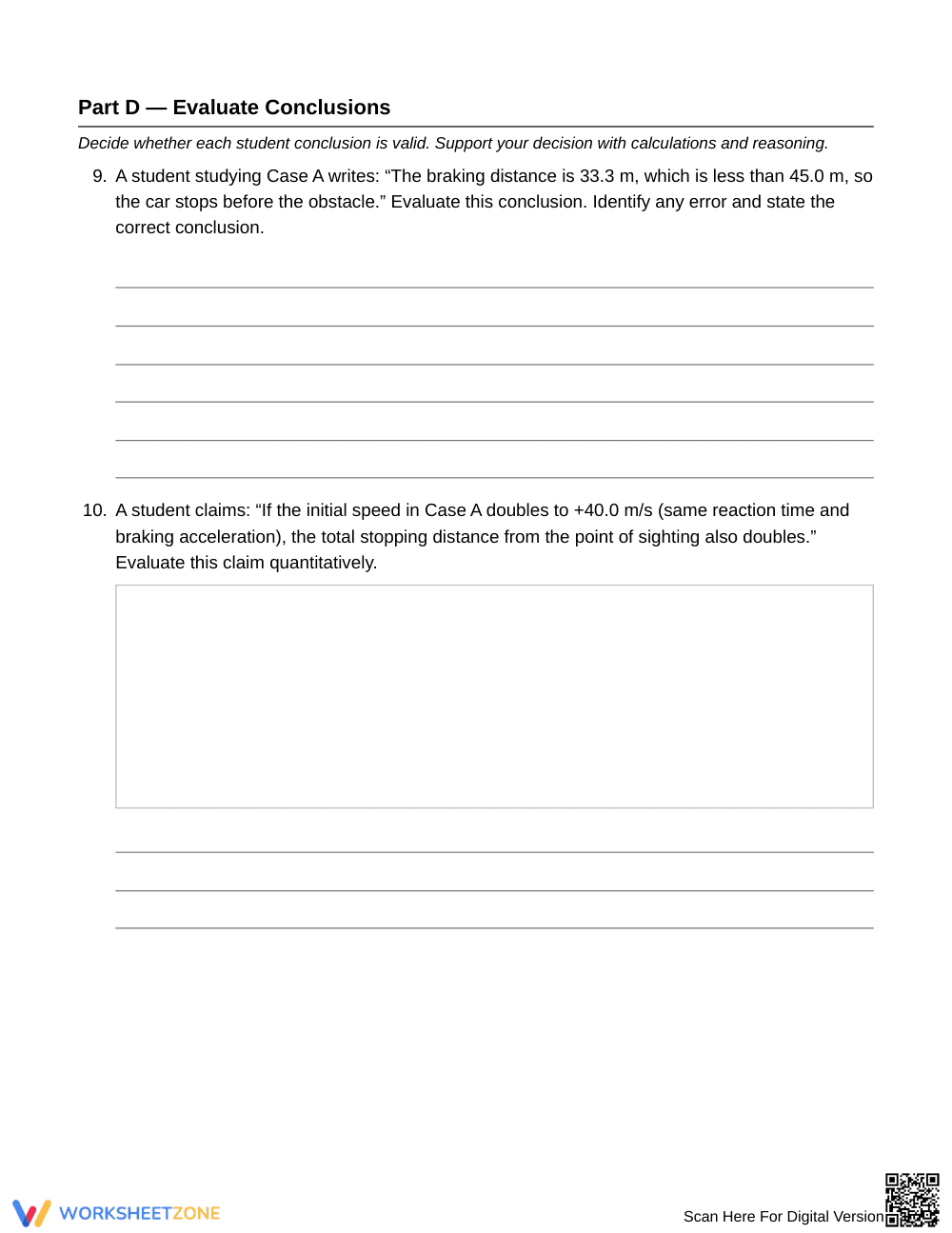
- Independent practice (5 problems): Part C reverses the axis in Case B, and Part D asks students to evaluate flawed conclusions.
The sequence mirrors gradual release: I Do, We Do, You Do.
Standards Alignment
No standard code was supplied for this resource. It targets high school kinematics: modeling one-dimensional motion with signed position, velocity, and acceleration, and applying constant-velocity and constant-acceleration equations across multiple stages. Add your district's standard code when copying this into lesson plans, IEP goals, or curriculum mapping tools.
How to Use It
- During instruction: Model Part A together after teaching constant-acceleration equations, then let students complete Parts B and C in class.
- After instruction: Assign the full set as unit review or homework before a kinematics assessment.
Formative tip: check whether students carry the final velocity of the reaction stage into the braking stage as the initial velocity, and whether they keep the sign of acceleration correct in Case B. Expect 40–50 minutes.
Who It's For
Designed for Grade 12 Physics students, including honors and AP-style kinematics units. For support, have students start with Part A and Case A only; for extension, emphasize Part D. Pair it with a kinematics equation anchor chart.
This Grade 12 Physics worksheet teaches students to analyze a braking-and-reaction scenario using signed, two-stage kinematics: constant velocity during reaction, then constant acceleration while braking. No standard code was supplied, so alignment is described by skill. Across 10 tasks and 5 pages, students identify constraints, calculate positions, velocities, and stopping times for two road cases with opposite axis directions, then evaluate flawed student conclusions. The sequence follows the gradual-release approach described by Fisher & Frey (2014), moving from guided identification to supported application to independent evaluation. A two-page answer key shows equations, signed substitutions, and results, so teachers can use the PDF for unit review, homework, or formative checks in roughly 40 to 50 minutes. Calculations require units and three significant figures, which reinforces precise scientific communication. Students must also keep unrounded intermediate values.


